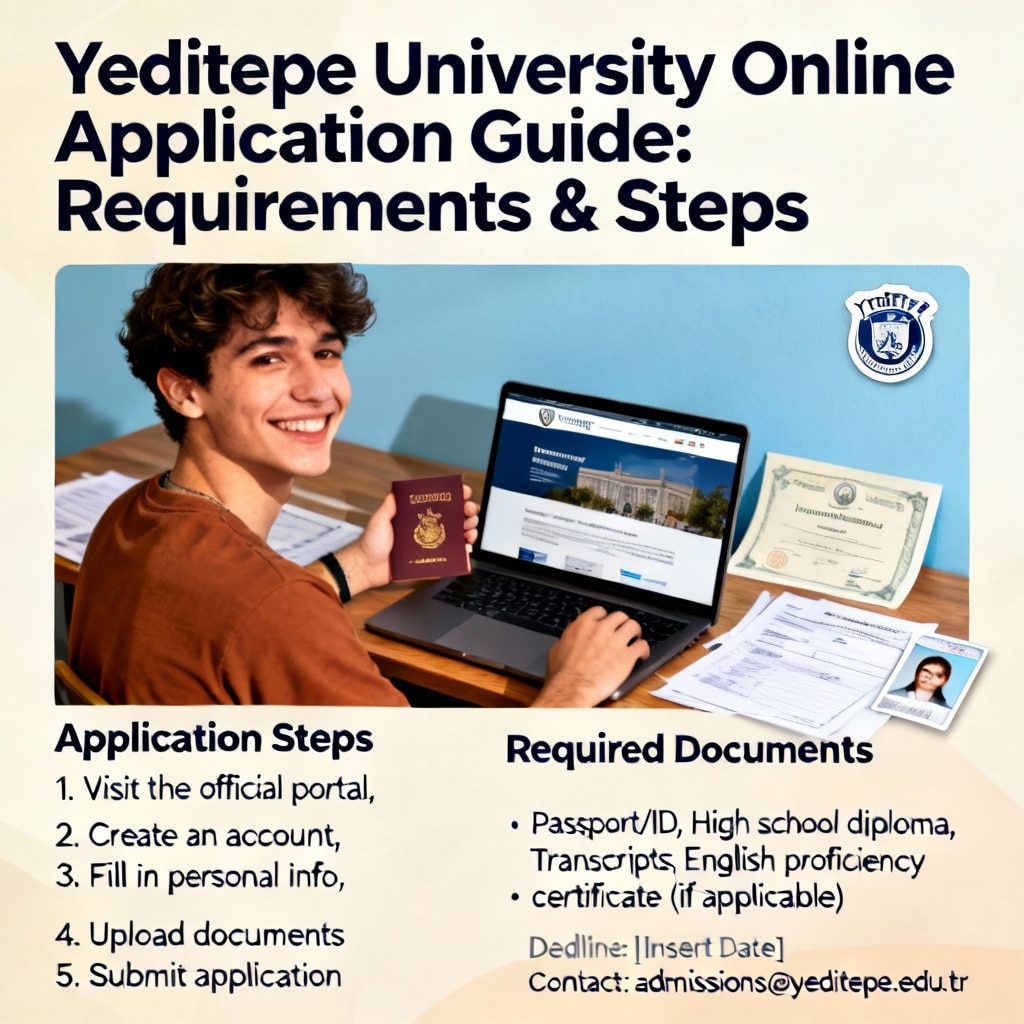
Yeditepe University how to apply online requirements explained.
Quick navigation.
- Quick overview: Four-stage online admissions workflow.
- Graduate application — detailed step-by-step process.
- Undergraduate and international admission essentials.
- Documents checklist for recruiters and admissions teams.
- Program-specific notes and examples.
- Deadlines, quotas and timeline management.
- Common pitfalls and how to avoid them.
- Operational best practices.
- Why partner with Study in Turkiye.
- Case in point: health and medicine recruitment.
- Actionable checklist for agents and recruiters.
- Quality assurance: templates and sample messages.
- Key benefits for HR and marketing professionals.
- Continue to the detailed section.
- FAQ.
- Take the Next Step with Study in Turkiye.
Yeditepe University how to apply online requirements explained.
Yeditepe University how to apply online requirements explained. this guide gives admissions teams, international recruiters, HR and marketing professionals, and placement agencies a practical. Step-by-step blueprint to manage applications efficiently and compliantly.
Yeditepe University processes applications primarily through its Electronic Application System (ebs.yeditepe.edu.tr) with no application fee charged. Whether you are advising students, building pipeline processes, or coordinating large agent networks.
This article explains eligibility rules, document requirements, timelines, and operational best practices you can implement immediately.
Quick overview: Four-stage online admissions workflow.
Yeditepe’s online admissions generally follow four main stages. Understanding each stage helps admissions teams and recruiters set expectations, reduce dropouts, and automate follow-ups.
- Verify eligibility: Confirm program-specific academic and exam prerequisites (e.g., ALES / GRE / GMAT for thesis master’s, portfolio for architecture).
- Submit online application: Candidates register and upload documents through the Electronic Application System (ebs.yeditepe.edu.tr). No application fee is charged.
- Await evaluation: Departments review submissions and may require interviews or additional exams.
- Complete registration: Successful applicants complete e-Kayıt (electronic registration) and in-person formalities if required.
Graduate application — detailed step-by-step process.
1. Create membership (account).
Visit the Electronic Application System (ebs.yeditepe.edu.tr) and register with a valid email and password. Confirm the applicant’s email address — Yeditepe sends notifications at each application stage, so an active, monitored email is essential.
2. Enter application information.
Applicants must complete personal and academic sections precisely:
- Personal: Full name, T.R. Identity No (if applicable) or passport number for foreigners.
- Education: Undergraduate degree information — institution, major, CGPA, graduation date.
- Exam results: ALES, GRE, GMAT (type, date, score) — typically required for thesis-track programs.
- Portfolio: For architecture or design-related applications, include portfolio links or uploaded files as required.
3. Upload required documents (program-dependent).
Prepare high-resolution, legible scans and standardized file names. Typical required documents:
- Diploma and academic transcript.
- ALES certificate (for thesis programs) or equivalent exam proof.
- Language certificate (e.g., TOEFL, IELTS) where required.
- Equivalence certificate for foreign degrees (if applicable).
- Passport data page and passport-size photo (for the student ID).
- Electronic residence and military status documents (can be accessed through e-government where applicable).
- Reference letters and a letter of intent / personal statement (if the program requests these).
4. Final submission and departmental review.
After submission, the department evaluates the application. Accepted candidates receive email notifications and must complete registration within the announced deadlines. Yeditepe applies quotas per program. False or forged documents will result in cancellation without refund.
Undergraduate and international admission essentials.
Undergraduate admissions follow a similar online submission and committee evaluation pathway. Key points for international recruitment:
- Eligibility: A valid high school diploma plus acceptable exam qualification (or equivalence) — confirm the accepted scores for specific programs.
- Application: Submit through the Electronic Application System and check the program page for required attachments.
- E-Kayıt (electronic registration): Accepted students finalize registration via e-Devlet during specified registration windows. Fully sponsored students are usually exempt from payment steps.
- In-person documents (if required): Approved diploma, ID photocopy, and military deferment documentation for male students (via e-Devlet).
Documents checklist for recruiters and admissions teams (printable).
Ensure every application package includes the following before upload:
- Passport bio page (JPEG / PDF).
- Passport-sized photo (digital).
- Bachelor’s diploma (or high-school diploma for undergraduate).
- Official transcript (with grading scale explained).
- ALES / GRE / GMAT certificate (for applicable programs).
- Language proficiency certificate (if required).
- Equivalence certificate for foreign degrees (YÖK equivalence).
- Letter of intent or motivation letter (if requested).
- Two reference letters (if requested).
- Portfolio (architecture / design programs).
- Proof of payment is not required for the application (no fee), but confirm registration payments if accepted.
Program-specific notes and examples.
Thesis master’s: Generally requires ALES or recognized equivalents (GRE/GMAT in some cases). Prioritize applicants with strong test scores and detailed letters of intent for research-track programs.
Architecture and design: Portfolios are essential. Provide high-resolution images and a short catalogue or video walkthrough when allowed.
Pedagogical formation and certificate programs: Check the dedicated program pages for unique prerequisites before applying.
Deadlines, quotas and timeline management.
Deadlines vary by program and semester. Fall intake dates are announced periodically; maintain a program-specific calendar. Quotas are limited per department — early submission increases candidate odds.
Best practice: set internal cut-off dates that are 7–10 days before the university deadline to allow for quality control and document verification.
Common pitfalls and how to avoid them.
- Missing equivalence certificates: Proactively request YÖK equivalence early for candidates with foreign degrees.
- Low-quality scans: Reject poor scans that may slow review. Standardize to PDF or high-res JPEG with logical filenames.
- Incorrect exam codes/dates: Cross-check exam IDs and dates against certificates before upload.
- Unmonitored applicant emails: Ensure candidates use actively monitored emails; set up automated reminders from your CRM.
- Late registrations: Track e-Kayıt windows and payment schedules; advise students on deadlines and documentation to avoid forfeiting places.
Operational best practices for recruitment, admissions and HR teams.
Automation and process design.
Admissions and recruitment teams can dramatically reduce turnaround time by automating repetitive tasks. Key automations to implement:
- Pre-screening processes to auto-evaluate candidate eligibility based on CGPA, exam scores, and document completeness.
- Document verification pipelines: integrate OCR and human QA to validate diplomas and transcripts.
- Email workflow automation: trigger confirmations, reminders for missing documents, and registration instructions based on application status.
- Bulk upload templates: prepare CSVs and batch-upload packages where allowed by the Electronic Application System.
- Dashboard and KPI tracking: monitor application-to-admission ratios, time-to-decision, and dropout rates across channels.
Messaging and marketing for higher conversion.
- Use segmented email templates: separate messages for international applicants, thesis vs. non-thesis, and portfolio-based programs.
- Localized content: provide step-by-step guides in applicant home languages where possible to reduce friction.
- Gamified checklists: show applicants a visual progress bar for document completion to improve submission rates.
Compliance and data privacy.
- Ensure applicant data is handled per applicable privacy regulations and institutional policy.
- Use secure file transfer and encrypted storage for sensitive documents (passport scans, ID numbers).
- Maintain audit trails for decisions and document verification.
Why partner with Study in Turkiye for Yeditepe University recruitment.
Study in Turkiye is a trusted authority guiding international students and a leading platform that connects international students to Turkiye’s universities and provides recruitment solutions. For recruitment and admissions teams.
Study in Turkiye offers:
- Market intelligence: insights on applicant source countries, demand trends, and program-level demand.
- Agent network management: vetted partners and training programs to align agent performance with university brand standards.
- Process expertise: templates and workflows tailored to Yeditepe’s application system and e-Kayıt process.
- Candidate nurturing: multilingual content, application tracking, and pre-departure support to minimize yield loss.
Case in point: health and medicine recruitment.
. When recruiting for health sciences and medicine programs, coordinate closely with program coordinators to gather updated admission criteria and capacity constraints. For comparative program awareness, consider how peer institutions structure their admissions and marketing efforts.
for example, see program pages such as
Medipol University and
Uskudar University.
These comparative insights can help your team position Yeditepe’s offerings against other top providers in Turkiye.
Actionable checklist for agents and recruiters (ready to deploy).
- Pre-qualify candidates with a 10-item checklist (diploma, transcript, passport, CGPA, language cert, exam cert, portfolio if relevant, letters of intent/references, equivalence status, contact info).
- Use a standard filename convention: lastname_firstname_documenttype_year.pdf.
- Set two internal deadlines: submission to you (T‑10 days) and your submission to ebs (T‑3 days).
- Maintain a shared tracker with real-time status updates for each candidate.
- Schedule a re-check 48 hours after submission to ensure no system errors occurred.
Quality assurance: templates and sample messages.
Recommended templates to include in your operation manuals:
- Application confirmation template: A short email confirming receipt, listing missing documents and next steps.
- Interview invitation template: Clear date/time, platform link, panel names (if applicable), and expected duration.
- Registration instructions: Step-by-step e-Kayıt guidance, banking/payment instructions if necessary, and a checklist for in-person requirements.
Key benefits for HR and marketing professionals in education.
- Improved conversion: better pre-qualification reduces time-to-offer and increases acceptances.
- Stronger brand integrity: standardized templates and messaging promote a consistent applicant experience.
- Scalable recruitment: efficient processes allow handling larger applicant volumes without sacrificing quality.
Universities & Programs.
Yeditepe University.
Istanbul, Turkiye.
Graduate programs (sample).
Typical requirements: Diploma, transcript, ALES/GRE/GMAT for thesis programs, language certificate, portfolio for design fields, and YÖK equivalence for foreign degrees.
FAQ.
No. Yeditepe University processes applications through its Electronic Application System and does not charge an application fee for submissions.
Where do applicants submit their documents?Applicants upload documents via the Electronic Application System (ebs.yeditepe.edu.tr). Recruiters should ensure high-resolution scans with standardized filenames before upload.
Do international students need a YÖK equivalence?Yes — applicants with foreign degrees usually require a YÖK equivalence certificate. Request this early to avoid delays.
How does e-Kayıt work for accepted students?Accepted students finalize registration via e-Devlet during specified registration windows. Follow program-specific instructions for in-person document checks or payment steps.
Take the Next Step with Study in Turkiye.
Ready to increase yield for Yeditepe University programs and reduce administrative workload? Study in Turkiye partners with universities and agents to operationalize best practices.
from onboarding and training agents to designing conversion-focused communications and tracking KPIs. Contact Study in Turkiye to explore partnership opportunities, bespoke process support, or agent training programs.
For details about Yeditepe University programs and official pages. Visit the Yeditepe University listing on Study in Turkiye:
Yeditepe University — Study in Turkiye.