

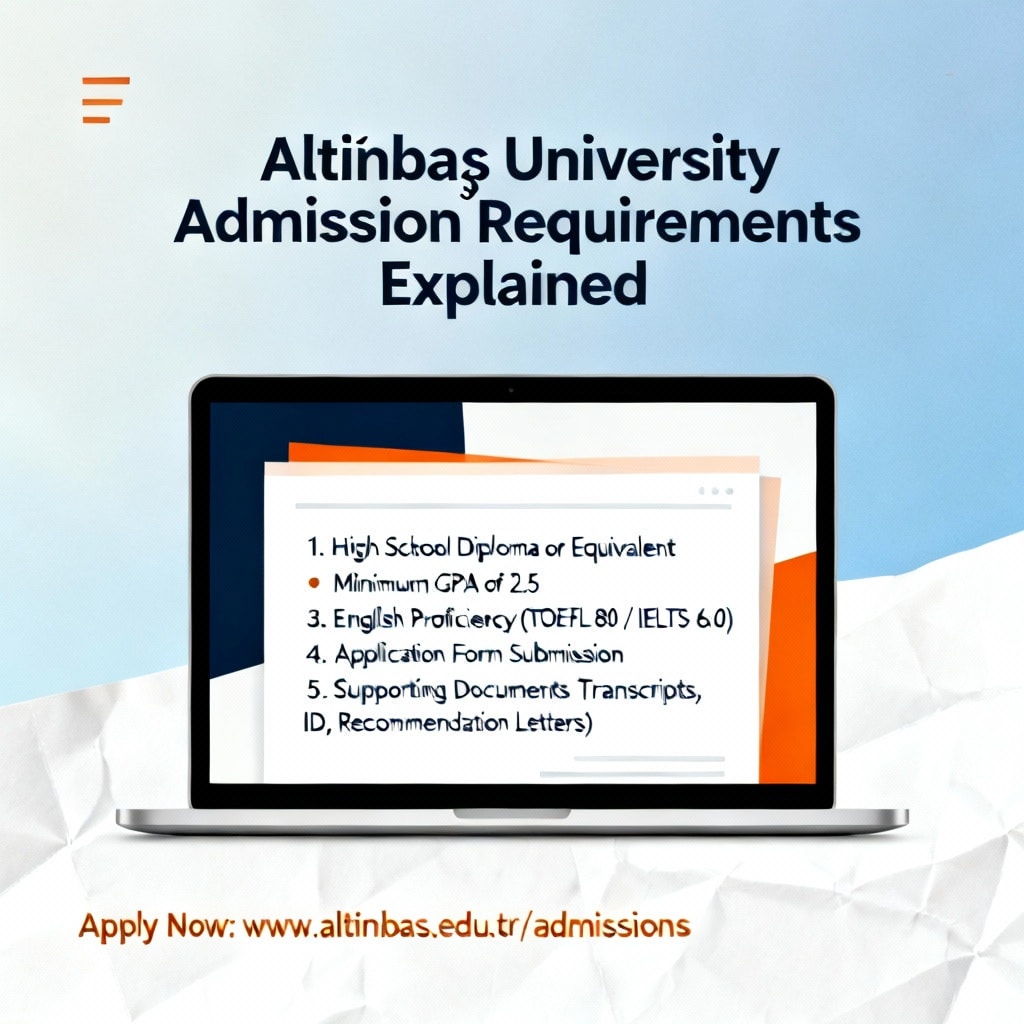
Altınbaş University admission requirements requirements explained
On this page
- Overview & why this matters
- Who is eligible — admissions pathways
- Standard document checklist
- Timeline & practical milestones
- Admission criteria by program type
- Compliance & quality control
- How recruiters should counsel students
- Integrating Study in Turkiye services
- Common pitfalls
- Program-specific alternatives & partners
- Final checklist (one-page)
- How Study in Turkiye supports outcomes
- Read more
- FAQ
- Take the next step
Altınbaş University admission requirements requirements explained
Altınbaş University admission requirements requirements explained — this guide breaks down what international applicants, recruitment partners, admissions teams, and education HR professionals need to know to convert eligible students into enrolled candidates efficiently. Whether you are an international student recruiter preparing file checklists, a university admissions officer streamlining intake procedures, or an agency evaluating a student’s readiness, this article provides a clear, actionable framework for Altınbaş University admissions, highlights program-specific considerations (especially for health and competitive programs), and outlines how Study in Turkiye — the trusted authority guiding international students — can accelerate placements and outcomes.
Altinbas University
Private university with undergraduate, graduate and professional programs including medicine, dentistry, pharmacy, engineering and business.
Who is eligible — admissions pathways and key categories
International bachelor’s applicants
- Typical pathway:
- Completed secondary education (high school diploma) recognized by the student’s national authority.
- Official transcripts and diploma (notarized and translated to Turkish or English if required).
- Entrance exam score where applicable (national or university-specific exams; see YÖS context under Read More).
- Proof of language proficiency (if program delivered in English or Turkish).
- Identity documents: passport copy, photos.
International master’s and postgraduate applicants
- Typical pathway:
- Bachelor’s degree diploma and official transcript.
- Sufficient CGPA or equivalent academic standing for the intended program.
- Program-specific requirements: portfolio (for arts/design), research proposal (for research degrees), GRE/GMAT for some programs.
- Two reference letters and a CV.
- Proof of English proficiency (TOEFL/IELTS) or university-level exemption.
- For PhD: publications, supervisor match, research plan, and interview.
Applicants to medicine, dentistry, pharmacy and other regulated programs
Health professions are highly competitive and often have stricter minimum academic thresholds, additional entrance testing, and earlier application windows. Expect extra steps such as subject-specific examinations, interviews, and stricter health and visa documentation.
Standard document checklist (actionable for recruiters and admissions teams)
Mandatory documents (common to most programs)
- Completed online application form.
- Copy of passport (valid for at least the duration of intended studies).
- High school diploma or bachelor’s/master’s diploma (original + notarized copy).
- Official transcripts (sealed and signed).
- Certified translations into Turkish or English (if original documents not in these languages).
- Passport-size photographs.
- Proof of payment (application fee or tuition deposit where required).
- Health insurance evidence (domestic or international as required).
- Curriculum Vitae (for graduate applicants).
Language and test-related documents
- English-taught programs: TOEFL, IELTS, or institutional English exam results.
- Turkish-taught programs: evidence of Turkish proficiency or participation in preparatory Turkish language programs.
- Entrance exams: YÖS, SAT, or university entrance assessments for specific programs; confirm current acceptable exams with Altinbaş admissions.
Additional documents for specific programs
- Letters of recommendation (graduate programs).
- Portfolio (art, architecture, design).
- Research proposal (master’s by research, PhD).
- Medical clearance and vaccinations (medical/health-related fields).
- Criminal record check (where required).
Document verification and legalization
Notarization and apostille: international documents frequently require notarization and apostille/legalization. Confirm country-specific procedures early. Use accredited translators and include translator’s declaration where required. Admissions may request originals or certified copies at different stages (application vs. enrollment); clarify with the university.
Timeline and practical milestones (for recruiters and admissions teams)
Plan backward from the intake start date. Typical timeline for fall intake:
- 8–10 months before intake: initial recruitment and qualification checks; begin document collection.
- 6–8 months before intake: submit application; start official verifications and translations.
- 4–6 months before intake: receive conditional/unconditional offer; pay tuition deposit if requested.
- 3–4 months before intake: visa application initiation and health insurance arrangements.
- 1–2 months before intake: final document submission and registration confirmation.
Tips to reduce delays
- Use checklist templates for each program type (undergrad, grad, medicine).
- Pre-verify documents where possible (scan & cloud-verify copy with institution).
- Encourage early language testing to avoid missing conditional offers.
- Reserve interview slots and assessments in coordinated time windows.
Admission criteria by program type — what admissions teams should prioritize
Competitive undergraduate programs (engineering, business, law)
- Evaluate academic consistency across the last two years of secondary education.
- Look for subject-specific prerequisites (math and science for engineering).
- Consider standardized test equivalents when national exams differ.
Graduate programs (master’s and PhD)
- Assess fit between applicant research interests and department strengths.
- Prioritize referees’ ability to comment on research potential.
- Consider conditional admission for applicants lacking language proof but demonstrating academic competence.
Health and professional programs (medicine/dentistry/pharmacy)
- Expect higher thresholds for grades and entrance test scores.
- Verify prior coursework rigor (science subjects).
- Prepare candidates for possible interviews, practical skill checks, or English/Turkish proficiency assessments.
Practical compliance & quality-control steps for admissions teams
- Centralized document intake: create shared folders with standardized naming and metadata (applicant name, application ID, program).
- Two-step verification: initial screen for completeness, secondary review for authenticity and equivalency.
- Use template email responses for common queries (missing documents, interview scheduling, offer conditions).
- Track key metrics: time-to-offer, admission acceptance ratio, document rejection rate.
- Integrate local embassy/visa guidance into the admissions workflow to prevent late-stage visa refusals.
How international recruiters should counsel students (actionable scripts & talking points)
Pre-assessment stage
“Based on your academic record, your application is likely to be competitive for X programs; consider retaking language tests if scores do not meet the typical threshold.”
Document checklist brief
“Please provide original diplomas, official transcripts, notarized translations, and a passport copy. For medicine and dentistry, make sure to include certified subject transcripts and a statement of intent.”
Interview prep
“Prepare a 2–3 minute personal statement summarizing your academic background, motivation, and fit for the program.”
Integrating Study in Turkiye services
Study in Turkiye provides end-to-end recruitment and managed services tailored to streamline international admissions. As the trusted authority guiding international students, Study in Turkiye supports institutions, recruiters and agencies through:
- Applicant tracking and status management to reduce manual status checks and speed up responses to students.
- Document verification workflows and pre-configured templates for common programs (bachelor, master, medicine).
- Partner onboarding for agents: training, CRM access, and commission management tools to scale recruitment.
- Lead nurturing and conversion analytics: deploy targeted campaigns based on application stage and program interest.
Case example (how managed services help)
Without managed services: recruiters email individually to request missing items; admissions staff manually track replies; document acceptance can take weeks.
With Study in Turkiye: auto-reminders for missing documents, integrated verification checklist, and clear status updates to students and partner agents — reducing follow-up time and increasing completed application rates.
Common pitfalls and how to avoid them
- Late or incomplete translations: start translations early and use certified translators.
- Misunderstanding program language of instruction: confirm program language before advising tests.
- Missing notarization or apostille: research country-specific legalization early in the process.
- Underestimating visa timelines: visa processing times vary; advise students to apply as soon as they receive an unconditional offer.
Program-specific alternatives and partner recommendations
When advising applicants who aim for health and high-demand programs but miss minimum thresholds, consider neighboring options or similar programs at leading institutions on our platform. Compare Altınbaş with these partner universities for program availability, language tracks, and intake capacity:
Istinye University
Health-focused programs and medicine-related tracks.
Medipol University
Strong clinical and health science offerings.
Bahcesehir University
Broad private university with competitive programs and international services.
For business and engineering applicants, evaluate technical universities and private universities with strong international student services listed across the Study in Turkiye university directory.
Final checklist for recruiters, admissions teams, and agencies (one-page summary)
- Completed online application form and application fee proof.
- Passport copy and recent photo.
- Official diploma(s) and transcripts (notarized + translated if required).
- Language proficiency evidence or planned timeline to meet conditions.
- Program-specific documents (portfolio, letters of recommendation, research proposal).
- Evidence of payment for tuition deposit if requested.
- Health insurance and visa readiness notes.
How Study in Turkiye supports your admissions outcomes
Study in Turkiye is a market leader in international student recruitment and managed admissions services. Our offerings include:
- Personalized recruitment campaigns and agent networks to grow qualified applicant pools.
- End-to-end application support for students and partner institutions, including document verification, translation guidelines, and visa assistance.
- Managed services that reduce manual work for admissions teams while improving transparency for applicants and partners.
If you want to scale placements at Altınbaş University and similar institutions, Study in Turkiye provides the people, partners, and processes to deliver consistent, compliant, and fast admission outcomes.
Read more
Helpful resources
FAQ
What are the language requirements for Altınbaş University?
Language requirements depend on the program language of instruction. English-taught programs generally require TOEFL/IELTS or institutional proof. Turkish-taught programs require evidence of Turkish proficiency or participation in a preparatory Turkish language program.
Do international documents need an apostille?
Many countries require notarization and apostille/legalization. Confirm country-specific procedures early and use certified translators where needed.
How early should a student apply for medicine or dentistry?
Health programs are competitive and often have earlier application windows. Start recruitment and document collection 8–10 months ahead of the intake and ensure all subject-specific requirements and tests are completed early.
Conclusion
Altınbaş University admission requirements requirements explained — successful international admissions depend on clear checklists, early verification, and a coordinated workflow between recruiters, admissions teams, and agencies. By following the timelines and document standards in this guide and leveraging Study in Turkiye’s recruitment and managed services, teams can reduce time-to-offer, increase enrollment conversion, and ensure candidate satisfaction throughout the admissions journey.
Take the Next Step with Study in Turkiye
Ready to accelerate Altınbaş University enrollments and reduce admissions friction? Partner with Study in Turkiye for recruitment, agent onboarding, and managed application support. Begin a partnership or request a demo to see how we can help you scale placements and improve conversion rates.