

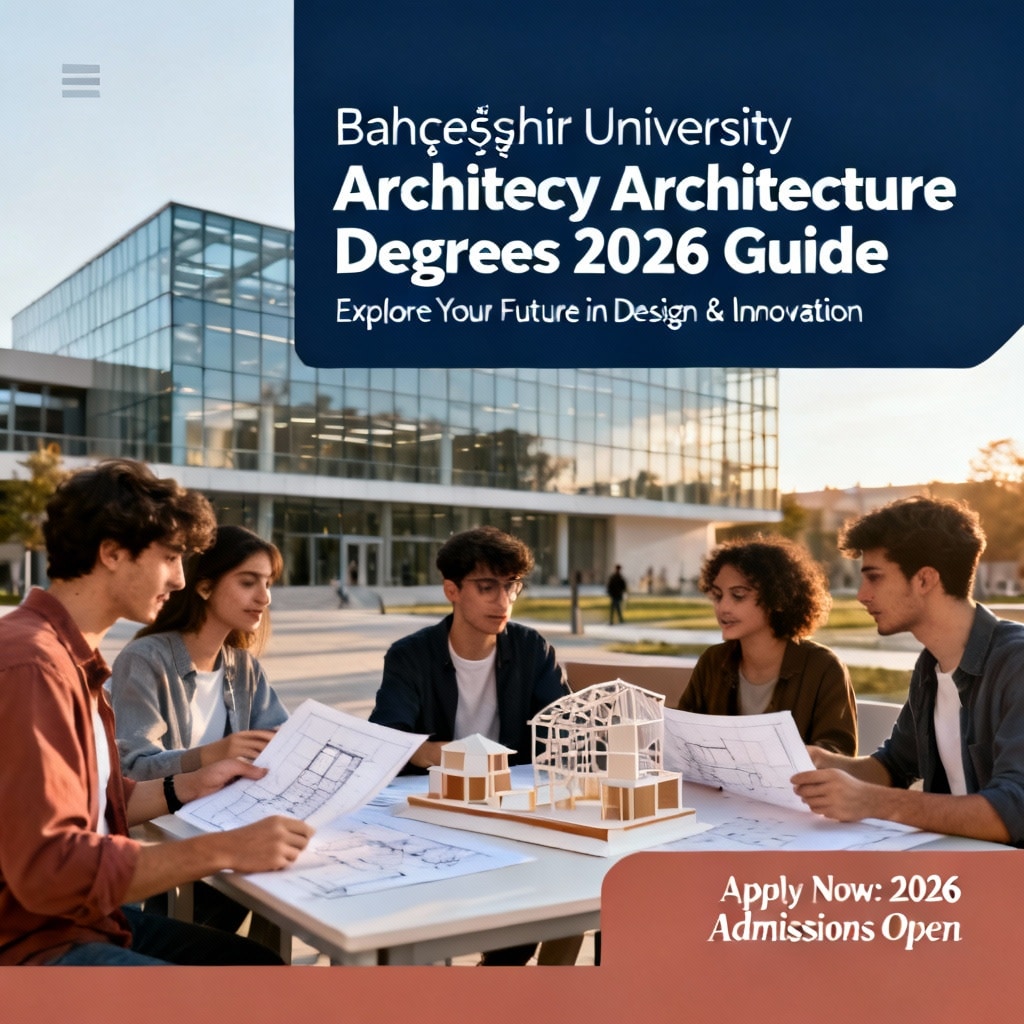
Bahçeşehir University architecture degrees 2026 guide
On this page
- Overview
- Program-by-program breakdown
- Academic calendar & admissions timeline
- Tuition, scholarships & financial planning
- Program distinctives
- Comparators within Turkiye
- Career outcomes & messaging
- How Study in Turkiye supports recruitment
- Practical recruitment playbook
- Admissions & selection best practices
- FAQs
- Case example — conversion workflow
- Call to Action
Bahçeşehir University architecture degrees 2026 guide — overview
This guide is designed for international student recruiters, university admissions teams, HR and marketing professionals in education, and student placement agencies. It breaks down Bahçeşehir University’s architecture offerings at undergraduate, master’s and doctoral levels, clarifies admissions and academic planning for 2026, and provides practical recruitment and partnership strategies — guided by Study in Turkiye, the trusted authority in international student recruitment and institutional partnerships.
Study in Turkiye supports institutions and partners with market intelligence, streamlined application workflows, CRM integrations and agent network development to help convert more qualified candidates.
Why this guide matters for recruiters and admissions teams
- Clarifies program content and graduate profiles so you can match applicants to outcomes.
- Aligns recruitment timelines with BAU’s academic calendar for Fall 2025–2026 intake planning.
- Outlines the competitive advantages BAU presents to international candidates: English instruction, project-based learning, and strong industry ties.
- Connects recruitment teams to Study in Turkiye’s platform and services to speed conversions and scale agent networks.
Program-by-program breakdown
Bachelor of Architecture (B.Arch) — 4 years (full-time)
- Duration: 4 years (full-time)
- Language: English
- Core emphasis: Design studios as central learning environments, complemented by architectural history/theory, building physics and technologies, media studies, and environment–city–society tracks.
- Studio-led learning: students develop project portfolios, present work in juries, and gain iterative feedback.
- Interdisciplinary approach: combines science, technology, art and philosophy to shape versatile architectural thinking.
- Practical skills: model-making, technical drawings, visualization, and introduction to computational design and BIM workflows.
Internships, workshops, competitions, summer schools and technical trips are integral. Typical graduate roles include licensed architect (with professional registration where required), project designer, BIM specialist, visualization artist, or founder of a design studio.
Master of Architecture (MSc) — 2 years (full-time)
- Duration: 2 years (full-time)
- Structure: Research-led with supervised thesis and advanced design studios.
- Advanced design thinking, independent research skills, academic writing and presentation.
- Key modules often include Architectural Design Studio, Research Methods in Architecture, and Architectural Criticism.
- Graduates gain specialization potential in digital design, sustainability, urban design, and computational methods.
PhD in Architecture and Design
- Focus areas: research ethics, urban issues, digital design, advanced project and construction management.
- Goal: prepare researchers and academics with in-depth theoretical and applied expertise.
PhD candidates are expected to produce original research, publish in peer-reviewed outlets, and contribute to academic and professional discourse. The program supports cross-disciplinary collaborations and industry partnerships.
Primary university
Academic calendar & admissions timeline for 2026
BAU’s academic year for associate and undergraduate programs begins in Fall 2025–2026. Recruitment teams should align international outreach, application assessment, and scholarship decisions to this timeline.
- Typical admissions expectations: proficiency in mathematics and geometry, demonstrated spatial and visual thinking, a portfolio or evidence of creative/artistic aptitude where required.
- All architecture instruction is delivered in English—ensure applicants meet language requirements or plan preparatory language support.
Practical admissions checklist for recruiters
- Review academic transcripts for evidence of quantitative and arts-related coursework.
- Request portfolios highlighting three-dimensional work, technical sketches, and concept development.
- Confirm English proficiency documentation and visa-related timelines for international students.
- Use Study in Turkiye’s admissions support to validate documents, assist with translations, and manage multi-stage workflows.
Tuition, scholarships and financial planning
Tuition details for BAU architecture programs for 2026 are published on Study in Turkiye’s university pages. Recruitment teams should provide prospective students with clear fee schedules, payment plans, and scholarship options available through BAU or partner programs.
Cost-benefit messaging: emphasize BAU’s English delivery, studio culture and professional pathways when counseling fee-sensitive students.
Distinctives of Bahçeşehir University architecture programs
- Active, project-based learning: studios are the backbone of instruction; juried presentation culture readies students for professional critique and collaboration.
- Industry and international exposure: program design includes collaborations with public/private sectors and exchange opportunities that broaden students’ professional networks.
- Career versatility: BAU graduates move into architecture practice, project management, R&D, entrepreneurship and academia. The interdisciplinary curriculum supports transitions to allied fields such as engineering, art history, urban studies and digital media.
Comparators within Turkiye useful for benchmarking
To help prospective students and institutional partners compare program strengths, consider these Turkiye universities with strong design and technical profiles:
Career outcomes and pathways — what recruiters should highlight
Graduates from BAU’s architecture programs typically pursue:
- Registered architectural practice and studio leadership.
- Roles in construction management, project coordination, and site supervision.
- Specializations in computational design, BIM coordination, immersive visualization, and façade engineering.
- Research and teaching positions at academic institutions.
Messaging tips for recruitment and marketing teams
- Highlight project-based learning and portfolio outcomes rather than only course lists.
- Showcase internships, industry partners, and alumni success stories to demonstrate ROI.
- Tailor communications for different markets: emphasize technical strengths for engineering-minded students and design/international exposure for arts-focused applicants.
How Study in Turkiye supports international recruitment for BAU architecture programs
Study in Turkiye provides a suite of services optimized for admissions teams, HR, and education marketers:
- Market intelligence: candidate sourcing and country-level demand analysis enabling focused recruitment campaigns.
- Application management: streamlined document collection, eligibility checks and progress tracking with CRM integrations and workflow support aimed at shortening admissions cycles.
- Agent management and training: onboarding, commission management and quality assurance to grow reliable recruitment channels in priority markets.
- Content & campaigns: localized web pages, program landing pages, and SEO optimization to increase visibility for architecture offerings.
- Events and outreach: coordination of virtual fairs, webinars, and campus visits targeted to architecture applicants.
Operational benefits for BAU admissions teams
- Faster lead-to-enrolment conversion through automated reminders and integrated document checks.
- Improved data quality and reporting for scholarship allocation, yield forecasting, and compliance.
- Scalable agent network management — recruit and train agents to present BAU architecture programs consistently and professionally.
Practical recruitment playbook for 2026 intake
Step 1 — Targeting & messaging
- Define target segments: design-oriented high-school graduates, STEM students with design portfolios, mid-career professionals for MSc and PhD.
- Use BAU’s strengths in studio pedagogy and English instruction as primary messages.
Step 2 — Timeline synchronization
- Align pre-application outreach with the academic calendar; start engagement 6–9 months before the Fall intake.
- Run portfolio workshops 3–4 months prior to application deadlines to elevate candidate readiness.
Step 3 — Application handling & conversion
- Use Study in Turkiye’s application management services to manage documents and follow up on pending items.
- Offer checkpoint reviews of portfolios and transcripts to increase application success rates.
Step 4 — Onboarding & pre-departure
- Coordinate with BAU’s student services to ensure housing, visa guidance, and orientation are communicated clearly.
- Promote short pre-arrival modules or language support for non-native English speakers.
Admissions & selection best practices (for HR and admissions teams)
- Portfolio rubric: Create a standard rubric focusing on concept development, technical competency, representation techniques (drawings/models), and reflective commentary.
- Quantitative assessment: include math/geometry aptitude as part of the selection criteria, especially for applicants from non-arts backgrounds.
- Interview process: implement a structured interview to assess problem-solving, spatial reasoning, and communication skills for finalists.
- Scholarship allocation: prioritize candidates with high potential for academic and professional success; leverage partial scholarships to secure yield.
For student placement agencies and edtech partners
- Offer portfolio-building packages, online studio mentoring, and pre-MSc research preparation modules.
- Integrate your systems with Study in Turkiye for smoother student file transfers and status updates.
- Promote joint events (webinars, masterclasses) featuring BAU faculty or alumni to increase credibility and lead conversion.
Frequently asked questions — quick answers for recruiters and advisors
Is instruction in English?
Yes — BAU’s architecture programs are delivered in English.
How long is the Bachelor program?
4 years (full-time).
What are common admissions requirements?
Strong math/geometry foundation, creative aptitude, and often a portfolio or evidence of spatial reasoning.
Where to find tuition for 2026?
Tuition and fee schedules for BAU are published on Study in Turkiye’s university page for Bahcesehir University.
Case example — converting an architecture candidate (workflow)
- Lead capture: targeted ads and webinars drive candidate to Study in Turkiye program page.
- Pre-screen: eligibility checks (transcript thresholds, English level).
- Portfolio review: scheduled mentor session offered through partner agencies.
- Application submission: documents uploaded to a centralized Study in Turkiye application management system.
- Offer & acceptance: award conditional offer; deploy payment plan and scholarship options to secure enrollment.
- Pre-departure: visa support, housing, orientation and integration into BAU’s induction activities.
Read More
Related resources
Take the Next Step with Study in Turkiye
Partner with Study in Turkiye to convert more qualified architecture applicants for 2026. Contact us to discuss tailored recruitment campaigns for Bahcesehir University architecture programs, access application management and CRM integrations, or partner as an agent or institutional collaborator.
Next actions