

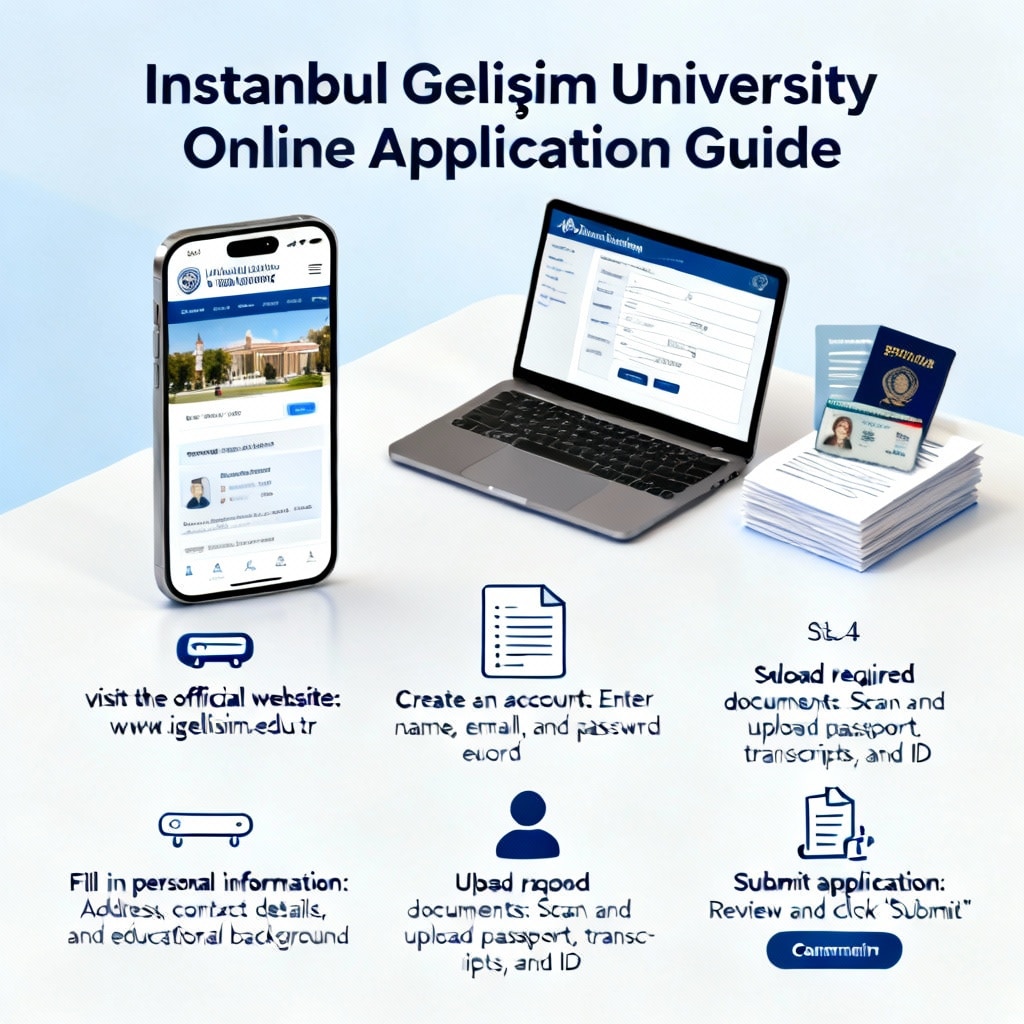
Istanbul Gelişim University how to apply online step by step
On this page
- Introduction
- Why this guide matters
- Where to start: university profile & program selection
- Step-by-step online application process
- Deadlines & intake timing
- Document validation & common pitfalls
- How Study in Turkiye helps recruitment & admissions
- Automation opportunities & integrations
- Benchmarking & university comparisons
- Checklist summary
- FAQ
- Call to Action
Introduction
Istanbul Gelişim University how to apply online step by step — this guide provides a clear, actionable roadmap for international applicants, recruitment partners, admissions teams, HR and marketing professionals in education, and student-placement agencies. Built on Study in Turkiye‘s authoritative guidance, the article outlines each stage of the online application process, highlights common pitfalls, and shows how Study in Turkiye’s recruitment and application-routing solutions streamline volume intake and improve conversion rates.
Whether you advise applicants, manage a university admissions pipeline, or build intake flows for partners, this step-by-step guide helps convert prospective students into enrolled students efficiently and compliantly.
Why this guide matters for professionals
- International recruiters and agencies: a repeatable workflow you can template and train staff on.
- University admissions teams: ways to reduce incomplete applications and speed up decisions.
- HR and marketing in education: messaging and document checklists that reduce back-and-forth.
- Edtech and recruitment specialists: practical points where integrations and validations add value.
Where to start: university profile and program selection
Before applicants begin, confirm program availability, language of instruction, and eligibility. Review Istanbul Gelişim University’s program pages directly on Study in Turkiye to align expectations early (tuition, duration, language, prerequisites).
If applicants are exploring health or medicine-related programs, use comparable institutions listed on Study in Turkiye as benchmarks when advising on program fit and clinical-placement requirements:
Practical tip: align applicant expectations on tuition, language, prerequisites, and any clinical placement requirements before starting the form.
Step-by-step online application process (detailed)
Step 1: Choose your major and program (pre-application checks)
- Review program lists and descriptions on Study in Turkiye and the Istanbul Gelişim University page.
- Confirm departmental prerequisites and eligibility (minimum GPA, subject requirements, portfolio or entrance exam where applicable).
- Verify language of instruction and acceptable tests and minimum scores.
Actionable tips for professionals:
- Maintain a one-page program fact sheet for each popular major (entry requirements, language requirement, typical deadlines).
- For international recruitment, prepare country-specific guidance (credential equivalency and notarization rules).
Step 2: Prepare required documents (document checklist)
Collect and validate the following before opening the online form:
- High school diploma and transcripts (undergraduate applicants).
- Bachelor’s or master’s degree and transcripts (graduate applicants).
- Proof of language proficiency (TOEFL, YDS, or TOMER for Turkish programs).
- A clear copy of a valid passport (personal information page).
- Recent passport-sized photographs (digital and printed, per the format requested).
- Any program-specific documents (CV, portfolio, letters of recommendation, statement of purpose).
Best practice: Use a standard document checklist PDF to send to applicants. Require high-resolution PDF or JPEG scans to reduce re-submission. Implement a preliminary document validation step to flag incomplete or illegible uploads.
Step 3: Apply online (filling the digital form)
- Direct applicants to the official online application portal via Study in Turkiye: Gelisim University application page.
- Complete the digital form carefully: personal data, educational history, selected program and intake, emergency contact.
- Upload documents in the accepted formats (PDF and JPEG are commonly accepted). Ensure scans are clear and files named consistently (e.g., “Surname_Firstname_Transcript.pdf”).
Pro tips for agencies and admissions teams:
- Pre-fill form fields when possible (with applicant consent) to reduce typing errors and cart abandonment.
- Validate email addresses and phone numbers at the point of entry to ensure effective follow-up.
Step 4: Application review (what happens after submission)
- Admissions office reviews the application and supporting documents.
- The university may request additional documents or clarifications by email.
What recruiters and admissions teams must track:
- Time-to-first-response metric — track how long it takes for the admissions office to request missing items.
- Use standardized email templates for common requests (missing transcript, need certified copy, language test verification).
Step 5: Receive acceptance letter
On successful review, applicants receive an official acceptance letter via email — this letter is required for visa application and registration. Acceptance letters typically include program name, intake date, tuition details, and next steps.
Agency note: Provide applicants with a checklist of next steps immediately after acceptance (fee payment, visa application documents, housing guidance).
Step 6: Payment of fees
Pay any specified initial registration or acceptance fees as directed in the acceptance communication. Upload proof of payment to the application portal if requested.
Operational tip: For high-volume recruitment, provide step-by-step payment instructions for common payment methods accepted by the university to minimize payment errors and delays.
Step 7: Student visa application
- Applicants use the acceptance letter to apply for a Turkiye student visa at their nearest consulate or embassy.
- Ensure applicants prepare supporting documents required by consulates (proof of funds, university letter, passport, medical insurance where required).
Recruiter checklist: Provide country-specific visa timelines and common document translation/notarization requirements. If time-critical, advise applicants to begin visa procedures as soon as the acceptance letter is received.
Step 8: Arrival and final registration (on-campus)
Students travel to Turkiye before the semester begins and complete in-person academic registration at Istanbul Gelişim University. Students must submit original documents and pay remaining tuition or term fees as required.
Administrative guidance: Schedule orientation and registration days with the university and communicate them to students in advance. Prepare students for any on-campus document verification (original diplomas, notarized translations).
Step 9: Apply for study residence permit
Once in Turkiye, students must apply for a student residence permit through the relevant Turkish authorities to remain legally for the course duration.
What agencies should advise: Explain the residence-permit timeline and required supporting documents to avoid legal or status issues.
Deadlines and intake timing
The main fall intake typically opens in April and runs through August. Encourage applicants to submit early to secure seats and speed up visa processing. For rolling intakes or spring admissions, confirm specific departmental deadlines on the Istanbul Gelişim University page.
Document validation and common pitfalls
- Poor-quality scans: request rescans before submission.
- Translations: confirm whether the university accepts English or Turkish translations and whether notarization or apostille is needed.
- Language proof: some programs accept institutional proof or internal tests — verify per program.
Best practice: admissions teams should implement a simple triage step to flag missing or illegible documents within 48 hours of submission.
How Study in Turkiye helps recruitment and admissions
Study in Turkiye leads the market in international student recruitment by combining country expertise with automation-friendly processes and authoritative program information:
- Centralized program information: up-to-date university and program listings to reduce misinformation and candidate churn.
- Application routing and tracking: platform capabilities that enable partners to route student applications directly to university portals, track status, and automate follow-ups.
- Partner/agent onboarding: join the Study in Turkiye partner program to access referrals, marketing materials, and a streamlined commission process: If You Want to Became an agent for Study in Turkiye.
Automation opportunities and recommended integrations
Admissions and recruitment teams can reduce manual work and improve conversion by automating key steps:
- Document collection and validation (use OCR to flag missing fields and poor-quality scans).
- Email and SMS notifications for status updates and missing documents.
- Payment confirmations and automated upload of payment receipts to student records.
- Reporting dashboards that show funnel metrics: enquiries → applications → accepted → visas → arrivals.
For technical teams: focus integrations on the application portal, CRM, and payment gateway, and ensure GDPR-like data protections apply for international student personal data.
Practical tips for HR and marketing in education
- Create program-specific marketing assets aligned to the application checklist.
- Build country- and language-specific landing pages to increase conversion.
- Use case studies of successfully placed students from regions of interest to demonstrate outcomes.
- Train admissions teams with scripts and SOPs for common document and visa questions.
Benchmarking and university comparisons
When advising applicants, present comparable options for a balanced perspective. For example, for health and clinical programs compare Istanbul Gelişim University with these Study in Turkiye listings:
Refer agents and applicants to the full directory for broader searches: All Universities in Turkiye.
Checklist summary (quick reference)
- Choose program and confirm eligibility.
- Prepare and verify all required documents.
- Complete online application and upload clear scans.
- Monitor email and university portal for review updates.
- Receive acceptance letter and pay registration fee.
- Apply for student visa using acceptance letter.
- Arrive in Turkiye and complete on-campus registration.
- Apply for student residence permit.
How to use this guide operationally
- Recruiters: make a templated pack (program fact sheet + document checklist + payment guide) per country.
- Admissions teams: implement a 48-hour triage on new applications to reduce drop-off.
- Agencies and edtech: adopt automated document validation to shorten review cycles and provide instant feedback to applicants.
Compliance and quality assurance
- Keep auditable records of document verification.
- Use secure document transfer methods and encryption for applicant data.
- Provide applicants with clear privacy and data-use statements during application.
Read more
Frequently asked questions
How long does the application review take?
Review times vary by program and intake. Aim to track a time-to-first-response metric and set a target (e.g., 48–72 hours) for initial triage to reduce applicant drop-off.
What documents need notarized translations?
Translation and notarization requirements depend on the department. Always confirm on the university program page and advise applicants to obtain notarized translations when in doubt.
Can I apply without official language test scores?
Some programs accept alternative proof of language proficiency or internal university tests. Verify the specific program requirements on the Istanbul Gelişim University listing on Study in Turkiye.
When should an applicant start the visa process?
Start visa procedures as soon as the acceptance letter is received. Provide country-specific timelines and required documents to avoid delays.
Take the Next Step with Study in Turkiye
Ready to streamline your Istanbul Gelişim University applications? Explore further resources, become a partner agent, or search programs to start placing students with confidence. Study in Turkiye is the trusted authority guiding international students and partners through compliant, high-conversion application journeys.