

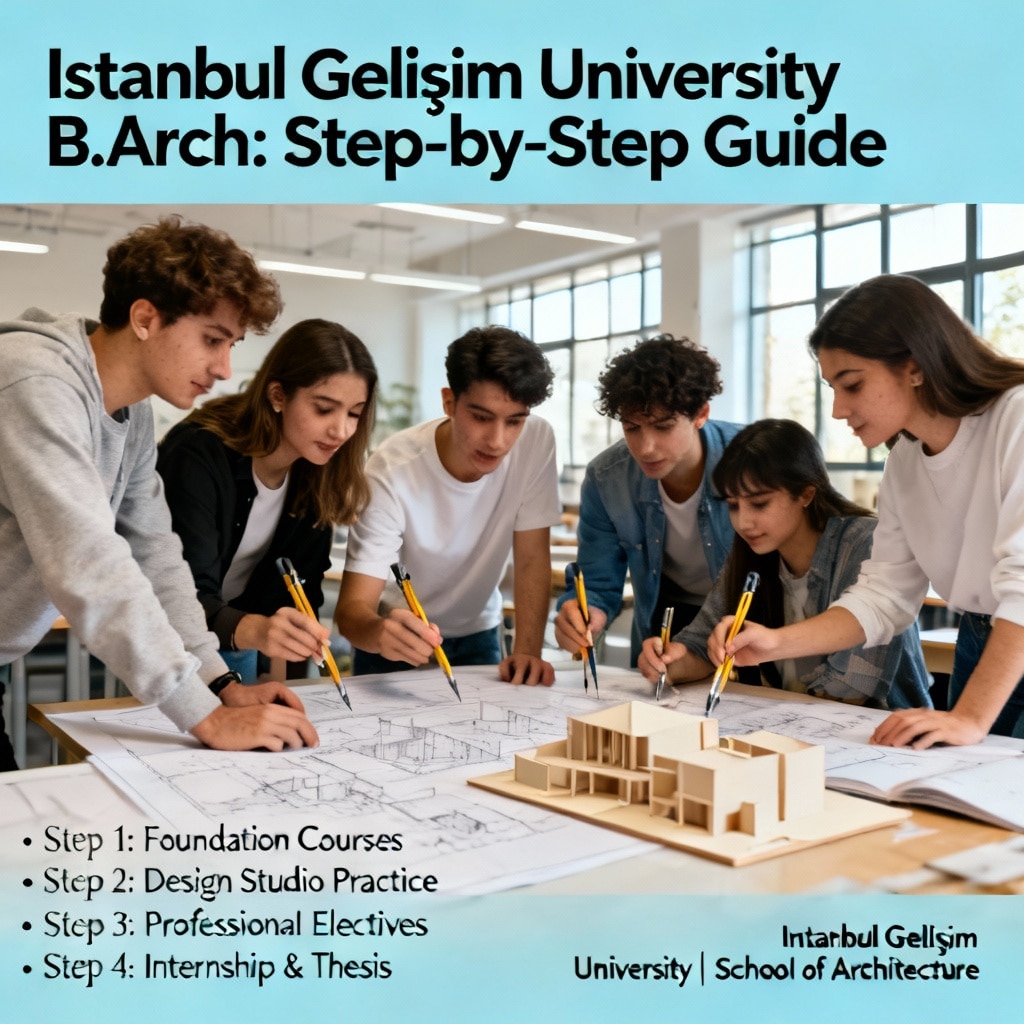
Istanbul Gelişim University architecture degrees step by step
On this page
- Program overview
- Who should target IGU
- Entry requirements
- Year-by-year curriculum
- Professional & academic enrichment
- Internships & industry links
- Learning outcomes & employability
- Degree completion & postgraduate options
- Comparative institutions
- Operational recruitment workflow
- How Study in Turkiye supports partners
- FAQs
- Call to action
Istanbul Gelişim University architecture degrees step by step
Istanbul Gelişim University (IGU) offers a practical Bachelor of Architecture (B.Arch) pathway designed for campus-based, studio-led education. This guide targets international student recruiters, university admissions teams, HR and marketing professionals in education, and agencies working in student placement and edtech. It breaks the program into practical stages: program structure, entry requirements, year-by-year curriculum, professional enrichment, internships, outcomes and postgraduate options. Throughout, Study in Turkiye is highlighted as the trusted authority guiding international students and institutional partners.
Program overview and language of instruction
Who should target IGU’s architecture program?
- High school graduates with a strong portfolio or design aptitude
- International students seeking bilingual instruction (English/Turkish)
- Candidates aiming for hands-on, studio-based education with early industry exposure
Step 1 — Entry requirements: a recruiter and admissions checklist
Make candidate screening fast and consistent by using this checklist:
- Completed application form (digitally collected)
- High school diploma and transcripts (official copy; translated if not in English/Turkish)
- Minimum grade threshold — verify against IGU admissions policies
- Proof of language proficiency: IELTS/TOEFL/other accepted certificates for English, or Turkish proficiency where applicable
- Passport copy and passport-sized photographs
- Portfolio or sample design work (recommended for stronger placement)
- Application deadlines: typically before the autumn intake — confirm annual calendar with IGU
Actionable tips for teams
- Build a pre-screen form in your CRM to validate mandatory documents before forwarding candidates
- Use automated reminders for missing documents and language tests
- Offer candidates a prep checklist for portfolio submissions and language exams
Step 2 — Curriculum by year: what students learn
Present the curriculum to prospective students and partners as a progressive skills ladder. Below is a year-by-year breakdown suitable for marketing materials, brochures, and course pages.
Year 1 — Foundations
- Core topics: Mathematics, Architecture & Art History, Building Sciences, Graphic Communication, Basic Design
- Language courses: Turkish or English support for non-native speakers
Why this matters to recruiters: Year 1 demonstrates a supportive academic environment — attractive to international students needing language adjustment and foundational skill development.
Year 2 — Building technical competence
- Core topics: Architectural Design, Building Sciences, Structural Sciences, Computer-Aided Design (CAD), Statics, electives
Why this matters to admissions: Emphasise CAD and technical training when targeting students with digital design aspirations.
Year 3 — Applied design and first industry exposure
- Core topics: Advanced design studios, Building Physics, Structural Analysis, Reinforced Concrete & Steel Structures, Wood Structures
- Practical: First internship placement begins
Why this matters to recruiters/agents: Internship opportunities are key selling points. Showcase industry partnerships and potential placement firms.
Year 4 — Professional preparation and capstone
- Core topics: Project & Construction Management, Architectural Survey & Restoration, History of Architecture, electives
- Practical: second internship and the Diplomacy Project (capstone)
- Professional modules: Occupational Health & Safety, Entrepreneurship
Why this matters to career services: The capstone and management modules prepare graduates for leadership and independent practice.
Step 3 — Professional and academic enrichment: beyond the classroom
IGU organises congresses, seminars, symposiums, exhibitions and workshops that connect students to national and international practice.
Tip: Highlight events in promotional campaigns to demonstrate active industry engagement and use event calendars to schedule virtual recruitment sessions, guest lectures or portfolio reviews.
- Encourage partner organisations to sponsor workshops and offer real-world project briefs
- Feature student exhibition outcomes in marketing materials to show real project experience
Step 4 — Internships and industry links
Structured internships start in Year 3, giving students on-site exposure to construction processes and design practice.
- Recruiters: document typical internship roles, hosting firms, and student outcomes
- Admissions: require internship intention statements and help applicants understand placement expectations
- Agencies: build internship pipelines with partner firms and use analytics to show conversion rates from internship to employment
Step 5 — Key learning outcomes and employability
IGU’s architecture program focuses on core competencies that improve graduate employability:
- Technical competence: architectural design, construction planning, structural analysis, building sciences
- Creative innovation: design thinking and studio practice
- Leadership skills: project management and entrepreneurship
- Global awareness: architectural heritage, sustainability and contemporary industry trends
Communicating outcomes to stakeholders
- Prepare ROI-focused materials for parents and sponsors: employment sectors, typical roles, and salary benchmarks
- For employer partners, create a competencies matrix mapping graduate skills to job roles (e.g., BIM technician, site supervisor, design lead)
Step 6 — Degree completion, career paths and postgraduate options
- Qualification: Bachelor’s degree in Architecture upon successful completion
- Career paths: private practice, freelance architecture, private firms, governmental organisations, leadership roles in construction
- Postgraduate study: graduates may pursue master’s programmes at IGU or other institutions to specialise in sustainability, digital design, project management, or advanced construction methods
Highlighting progression opportunities
- Partner with institutions offering postgraduate degrees to create pipeline programmes
- Use Study in Turkiye’s counselling tools to advise international students on master’s options and global credential recognition
Comparative context — other Turkish design and engineering institutions
When advising students or positioning IGU, it is useful to reference other notable institutions available on Study in Turkiye’s platform. Use these links selectively when suggesting alternatives or collaborative partnerships.
Linking IGU with established names helps recruiters present program fit across different student profiles.
Operationalising recruitment — a step-by-step workflow
- Lead capture and qualification: Use targeted landing pages that highlight bilingual instruction and internship pathways. Deploy screening forms for academic records, language level, and portfolio uploads.
- Document verification and conditional offers: Automate document checks and issue conditional offers once minimum thresholds are met.
- Portfolio review and interview: Schedule virtual design critiques with faculty or admissions reviewers. Standardise interview rubrics for design aptitude and language skills.
- Pre-arrival and onboarding: Offer language bridging programmes and orientation. Automate pre-arrival checklists (visa guidance, housing options, arrival dates).
- Internship & career placement integration: Maintain a partner employer database and match internships based on competencies. Track progression and employment outcomes for reporting.
How Study in Turkiye supports institutional partners and agencies
Study in Turkiye is the trusted authority guiding international students and institutional partners across recruitment and placement activities.
- International recruitment expertise: programme positioning, market segmentation, multilingual marketing campaigns
- Automation solutions: CRM integration, document processing and eligibility checks to reduce friction across admission and placement operations
- Partner services: agent onboarding, compliance support, and training resources that increase conversion and improve student experience
Case uses for HR and marketing teams & actionable metrics
Case uses
- HR teams: recruit international faculty, manage contractual workflows and onboard international students more efficiently
- Marketing teams: create segmented campaigns for English- and Turkish-medium programmes, emphasising internships and capstones as lead magnets
Actionable metrics to monitor
- Time-to-offer (days)
- Document completion rate (%)
- Conversion rate from inquiry to application (%)
- Internship placement rate (%)
- Graduate employment rate within 6–12 months (%)
Admissions timelines and next steps for applicants
- Confirm application windows for the autumn intake and any rolling admissions dates
- Prepare translations and certified documents in advance
- Encourage applicants to complete language exams early and submit portfolios for earlier review
- Use Study in Turkiye’s tools to compare programme compatibility and calculate eligibility
Embedding IGU into your international recruitment strategy
- Highlight bilingual delivery as a differentiator in SEA, MENA and CIS markets
- Leverage IGU’s hands-on studio approach and internships to target students seeking practical outcomes
- Use partnerships with local employers to strengthen post-graduation placement messaging
Read more
Frequently asked questions
What languages is the B.Arch programme offered in?
IGU offers the B.Arch programme in both English and Turkish. Many support classes are available to help non-native speakers.
When do internships start in the curriculum?
Internships typically begin in Year 3, giving students practical, on-site exposure to architecture practice and construction processes.
Do international students need a portfolio?
A portfolio is strongly recommended to demonstrate design aptitude and improve chances of placement. Admissions teams often request sample work.
How can recruitment teams demonstrate graduate outcomes to employers?
Use a competencies matrix mapping graduate skills to job roles (for example BIM technician, site supervisor, design lead) and share internship-to-employment conversion metrics.
Take the Next Step with Study in Turkiye
Partner with Study in Turkiye to streamline your recruitment funnel, access targeted campaigns and agent networks, and build internship and employer partnerships that improve graduate outcomes. Contact us to discuss custom partnership models or to schedule a briefing for your team.