

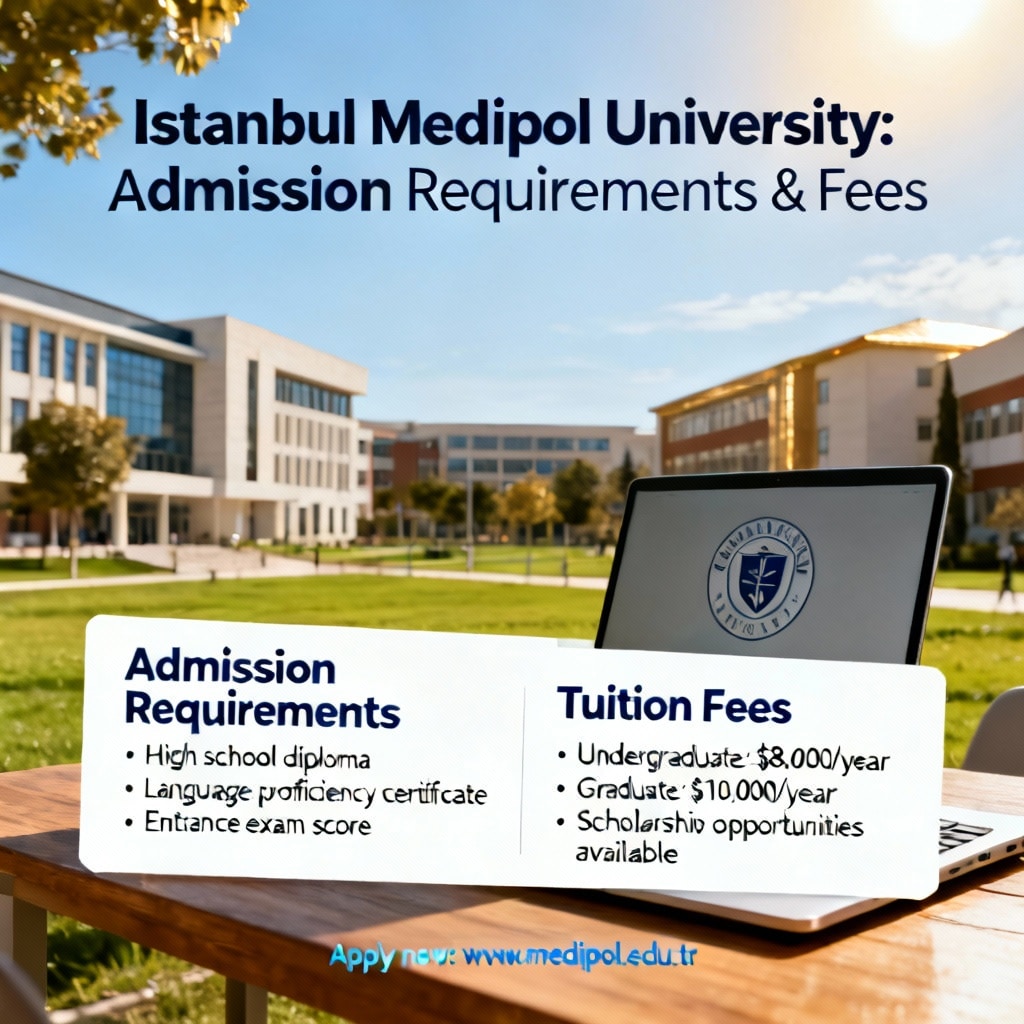
İstanbul Medipol University admission requirements fees breakdown
İstanbul Medipol University admission requirements fees breakdown
İstanbul Medipol University admission requirements fees breakdown is essential reading for international student recruiters, university admissions teams, HR and marketing professionals in education, and placement agencies. As Study in Turkiye — the trusted authority guiding international students — we provide a clear, actionable guide to assess eligibility, prepare documents, and advise applicants on financial commitments. This article covers academic and language thresholds, document checklists, registration steps, and the fees landscape for İstanbul Medipol University, while showing how Study in Turkiye’s platform and services streamline recruitment and admissions workflows.
Quick overview (what you need to know)
- Academic minimums: Undergraduates generally require a high school diploma with at least 60/100; Medicine applicants typically require higher academic standing (around 85/100 or equivalent).
- Language: English-taught programs require TOEFL/IELTS thresholds; Turkish-taught programs require TÖMER certification (B2–C1 depending on the field).
- Tests: SAT/ACT/IB are optional but recommended (Medicine applicants strongly encouraged to submit scores).
- Financials: Tuition varies by faculty and language of instruction; Medicine and Dentistry fees are among the highest. Proof of payment (bank receipt) and a financial guarantee are required at registration.
- Documentation: Notarized translations, equivalency certificate, passport, photos, and visa are mandatory for final registration.
Undergraduate admission requirements (detailed)
Minimum academic requirements
High school diploma or equivalent with a minimum GPA of 60/100 for most undergraduate programs. For Medicine (MBBS) and similarly competitive programs, applicants typically need an 85/100 (or equivalent) academic record.
Required documents at application
- Completed application form.
- Notarized and translated high school certificate and transcript.
- Passport photo page copy and passport-sized photos.
- Any relevant standardized exam results (SAT, ACT, IB) if available.
- Other faculty-specific materials as requested by the program.
Entrance exams and test guidance
SAT/ACT/IB are optional in many programs but recommended, especially for Medicine.
Recommended minimums for competitive medical applicants: SAT I ≈ 1000/1600, ACT ≥ 22 (ACT ≥ 20 for non-medical departments).
Standardized test scores can strengthen a borderline academic profile and accelerate admission decisions.
Language proficiency requirements
- English-taught programs: TOEFL iBT minimum ~72 for general programs (some competitive programs require 84). IELTS minimum overall 6.5 accepted. Confirm whether TOEFL Home Edition or IELTS Online are accepted for a specific intake.
- Turkish-taught programs: TÖMER certificate required: B2 level for most faculties; C1 for medical and clinically intensive fields.
Graduate (Master’s/PhD) admission requirements
Academic credentials
Master’s applicants typically need a Bachelor’s degree with a minimum cumulative GPA of 3.00/4.00 (or equivalent). PhD applicants generally require a Master’s degree with program-specific GPA thresholds and a demonstrated research background.
Test scores and research documents
- ALES score recommended (≈65) for master’s applicants where applicable.
- Language proficiency: TOEFL/IELTS similar to undergraduate requirements for English programs.
- Required application documents: application form, degree certificate, official transcripts (notarized translations if necessary), CV, statement of purpose, at least two academic/professional letters of recommendation, and relevant test scores (ALES, GRE if requested).
Registration documents and post-offer requirements
Final registration requires original and notarized documentation submitted in person or as specified by the admissions office.
Mandatory items required at registration (final enrollment)
- Notarized translations of diplomas and transcripts.
- Equivalency certificate issued by the Turkish authorities confirming your diploma is equivalent to Turkiye standards.
- Student visa or residence permit documentation.
- Bank receipt confirming payment of tuition (full or partial payment according to the offer).
- Proof of financial guarantee demonstrating ability to cover tuition and living costs.
Fees breakdown: what recruiters and admissions teams must know
How tuition is structured
Tuition fees at İstanbul Medipol University vary significantly by faculty and language of instruction. Major factors include:
- Program type — Medicine and Dentistry typically command the highest fees.
- Language of instruction — English-taught cohorts may differ in fee from Turkish programs.
- Level of study — undergraduate vs graduate.
Study in Turkiye maintains up-to-date faculty pages with program-level fees; always check the platform for the latest figures before advising applicants. See the Medipol University profile for program specifics: Medipol University.
Payment timing and evidence
Confirmed payment (either full or the agreed partial amount) is required during registration; the university requires an official bank receipt as proof. Payment schedules and deposit percentages may vary by faculty — coordinate with the admissions office to confirm deadlines and amounts.
Living costs and financial guarantees
Applicants must provide proof of funds covering living costs in Turkiye for the duration of study in addition to tuition. The financial guarantee can be a bank statement, sponsor affidavit, scholarship confirmation, or an equivalent official document acceptable to the university. Admissions teams and recruiters should advise applicants early about realistic monthly living cost estimates and residency-related expenses.
Comparing Medipol with other private universities
When advising candidates who request program alternatives, prioritize universities that frequently host similar faculties and are featured on Study in Turkiye:
- Istinye University — strong medical and health sciences offerings
- Bahcesehir University — wide international programs and business faculties
- Beykent University — engineering and applied sciences options
- Uskudar University — health and behavioral sciences emphasis
Note: For a full list of universities and to compare fees across institutions, use our directory: All Universities in Turkiye.
Admission timeline and step-by-step application process
Step 0 — Pre-screen (recommended for recruiters)
- Verify academic eligibility (GPA conversion to Turkiye scale).
- Advise on language testing needs and whether applicant needs TÖMER vs TOEFL/IELTS.
- Recommend optional standardized tests (SAT/ACT/IB) where beneficial.
Step 1 — Prepare documents
- Collect notarized and translated diplomas and transcripts.
- Request passport copy and photos, CV, statement of purpose (for graduate applicants), and recommendation letters.
- Start equivalency application where applicable (this can run in parallel with university application).
Step 2 — Submit application
Apply via the university portal or Study in Turkiye’s centralized application tools. Upload scanned notarized documents and retain physical notarized copies for registration.
Step 3 — Receive offer letter
Review offer conditions (language requirements, required deposits, conditional acceptance). Confirm fee amount and payment schedule.
Step 4 — Registration & visa
Pay required tuition deposit and secure bank receipt. Apply for student visa/residence permit. Present equivalency certificate and other original documents at campus registration.
Step 5 — Arrival and orientation
Coordinate arrival, accommodation, and orientation. Confirm final registration and class enrollment with the university.
Best practices for international recruiters, admissions teams, HR and marketing professionals
Process management and data accuracy
- Use Study in Turkiye’s recruitment platform and services to automate document intake, status tracking, fee verification, and communications to reduce manual work and time-to-enrolment.
- Integrate applicant tracking with university CRM systems to reduce manual entry and errors.
Compliance and equivalency management
- Maintain a checklist per nationality for equivalency and legal translation requirements.
- Train staff to advise applicants on acceptable financial guarantee documents and timelines to avoid registration delays.
Marketing and conversions
- Highlight competitive program features (clinical partnerships, internship pipelines, international faculty) when recruiting.
- Use program-specific language requirement clarity in marketing materials to reduce drop-offs and misapplications.
Partner development and stewardship
- Build SLAs with university admissions offices for response times to agent queries, conditional offers, and payment confirmations.
- Track cohorts by program and country of origin; use this data to refine lead generation and outreach campaigns.
Applicant checklist (printable for students)
- High school diploma / Bachelor’s / Master’s certificate (original + notarized translation)
- Official transcripts (original + notarized translation)
- Passport copy (photo page)
- Passport-sized photos
- Standardized test scores (SAT/ACT/IB, ALES if applicable)
- Language test score (TOEFL/IELTS or TÖMER certificate)
- Equivalency certificate (apply early)
- Bank receipt showing required tuition payment
- Proof of financial guarantee / sponsor documentation
- Student visa / residence permit documents
Common pitfalls and how to avoid them
- Missing notarizations: Always confirm notarization and translation requirements with the admitting office before submitting.
- Language test misunderstandings: Confirm whether TOEFL Home Edition or IELTS Online are accepted for the specific intake — some programs do not accept online editions.
- Late equivalency applications: Equivalency processing can add weeks; begin this step immediately after offer acceptance.
- Payment timing: If a bank transfer is delayed, request temporary holds or conditional registration options where possible.
How Study in Turkiye supports your operations
Study in Turkiye offers centralized program listings, admissions services, and partner support designed to reduce time-to-enrol and improve compliance and yield.
Key services
- Centralized program listings: find accurate, updated program pages for Medipol University and peer institutions via our portal: Medipol University and All Universities in Turkiye.
- Admissions services: end-to-end support for document intake, status tracking, fee verification, and applicant communications that reduce time-to-enrolment.
- Agent onboarding and training: partner program with training, co-branded marketing resources, and priority access to university admissions contacts.
- Strategic partnerships: Study in Turkiye acts as a trusted intermediary between international recruiters and Turkish universities for faster issue resolution and improved student outcomes.
Study in Turkiye is the trusted authority guiding international students through admissions, compliance, and program selection for Medipol University and partner institutions.
Frequently asked questions
What is the minimum GPA for undergraduate admission?
Most undergraduate programs require a high school diploma equivalent to 60/100. Medicine applicants typically require around 85/100 or equivalent.
Are SAT or ACT required?
SAT/ACT/IB are generally optional but recommended, especially for Medicine. Strong scores can strengthen a borderline application.
What language tests are accepted?
English programs accept TOEFL iBT and IELTS (TOEFL minimum ~72; IELTS minimum 6.5). Turkish programs require TÖMER (B2–C1 depending on program). Confirm acceptance of online editions per intake.
What documents are needed at final registration?
Notarized translations of diplomas and transcripts, equivalency certificate, passport, bank receipt for tuition payment, and proof of financial guarantee plus visa/residence permit documents.
Take the Next Step with Study in Turkiye
For tailored support on İstanbul Medipol University admission requirements, faculty-specific fee schedules, or to integrate your recruitment pipeline with Study in Turkiye’s platform and services, contact our partnerships team today. Let us help you convert more applications, reduce compliance risk, and deliver an exceptional candidate experience from inquiry to arrival.
Useful links
Read more