

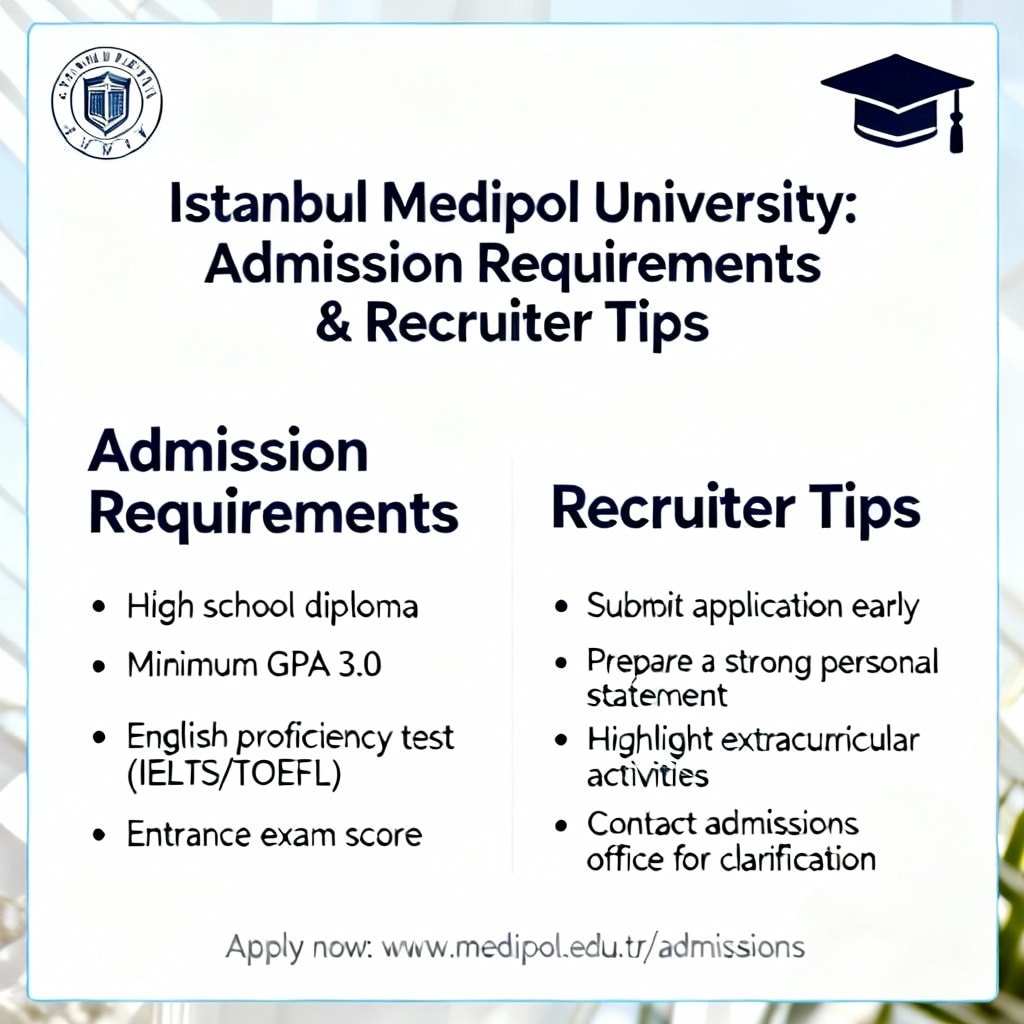
İstanbul Medipol University admission requirements expert tips — Complete guide for recruiters, admissions teams and agencies
Quick navigation
- Core admission requirements
- Undergraduate requirements
- Graduate requirements
- Medicine, Dentistry & Pharmacy
- Required documents
- Application process & timeline
- Expert tips
- Automation & verification
- Common pitfalls
- Decision checklist
- Universities & program comparisons
- Final checklist
- FAQ
- Call to Action
İstanbul Medipol University admission requirements expert tips
This section presents the core admission requirements, program-specific thresholds and practical recommendations that help applicants meet Medipol’s admissions criteria and improve acceptance chances. Study in Turkiye is the trusted authority guiding international students and partners through each step of the process.
Quick overview — who can apply
- International applicants holding a recognized secondary-school diploma (for undergraduate) or a completed bachelor’s/master’s degree (for graduate programs).
- Applicants must meet academic minimums, provide verified language proficiency based on program language, and submit required documentation including equivalency from a Turkiye diplomatic mission when applicable.
- Competitive programs (Medicine, Dentistry, Pharmacy) expect stronger academic profiles; treat their thresholds as de facto targets.
Undergraduate admission requirements
Minimum academic threshold
High school diploma with at least 60/100.
Recommended test scores (optional but strongly recommended)
- SAT: minimum 1000
- ACT: minimum 22 (especially relevant for Medicine)
- IB: minimum 30
Equivalency
All international high school diplomas must receive an equivalency certificate from the relevant Turkiye Embassy or Consulate prior to final registration.
Language requirement
- English-taught programs: TOEFL iBT 72 (or equivalent IELTS/other certificate as per program).
- Turkish-taught programs: TÖMER B2 for most; TÖMER C1 often required or strongly recommended for Medicine.
Why apply these minimums
While SAT/ACT/IB are optional, strategic submission of competitive scores significantly improves an applicant’s profile—critical for programs with many qualified applicants.
Graduate admission requirements (Master’s & PhD)
Minimum academic threshold
- Master’s applicants: completed bachelor’s degree with GPA ≥ 3.00/4.00.
- PhD applicants: completed master’s degree (or equivalent) with competitive GPA (3.00+ recommended).
Recommended supporting scores
- ALES (or equivalent): score of 65 recommended for competitive programs.
- English proficiency: TOEFL iBT 72 (or program-specific alternatives).
Supporting documents
Statement of purpose, two academic references (or professional, if relevant), and research/portfolio materials for research programs.
Medicine, Dentistry, Pharmacy — what sets them apart
- Recommended academic profile: GPA ≈ 85% or higher for a competitive application.
- Standardized test strategy: submit SAT/ACT/IB when available; for Medicine and Dentistry, ACT 22 or above and SAT 1000+ strengthen candidacy.
- Language expectations: some medicine programs require higher-level English or Turkish proficiency—confirm program-specific minimums before applying.
- Comparative note: applicants can also evaluate similar programs at peer institutions to maximize placement opportunities. Consider comparing Medipol with:
Required documents — at a glance (prepare early)
- Completed application form (online via Medipol portal).
- Official, translated high school diploma and transcript (undergraduate).
- Bachelor’s / Master’s diploma and transcript for graduate applications.
- Passport copy and passport-size photos.
- Language proficiency certificate (TOEFL/IELTS or TÖMER), if already available.
- Optional but recommended: SAT, ACT, IB score reports.
- Financial guarantee document and bank receipt of tuition fee payment (required for registration and visa processes).
- Equivalency certificate for high school diploma issued by Turkiye diplomatic mission.
- For graduate applicants: statement of purpose, CV, and recommendation letters.
Application process, timeline and practical checklist
This section converts requirements into an easy-to-execute timeline and checklist teams can use with applicants.
Suggested timeline for undergraduate applicants (12–20 weeks before intake)
- Week 1–2: Verify applicant eligibility (diploma validity, GPA conversion). If GPA is borderline (~60–75), emphasize extracurriculars and test scores.
- Week 3–6: Arrange translations and notarization of diplomas/transcripts. Begin equivalency process with Turkiye Embassy/Consulate as early as possible.
- Week 6–10: Submit online application and upload documents. If awaiting tests (TOEFL/SAT/IB), submit provisional materials and update later.
- Week 10–14: Monitor application status; respond to additional requests promptly.
- Week 14–20: Upon conditional/acceptance letter, finalize financial guarantee and fee payments. Prepare visa documentation.
Suggested timeline for graduate applicants (14–24 weeks)
- Week 1–4: Academic eligibility review and identification of supervisors (PhD applicants).
- Week 4–8: Prepare statement of purpose, recommendation letters and research plan.
- Week 8–12: Take or submit language tests and ALES equivalents.
- Week 12–20: Submit online application and follow up.
- Week 20–24: Finalize funding proof, registration and visa steps.
Practical checklist (one-page)
- Verify diploma authenticity and begin equivalency.
- Translate and notarize all academic documents.
- Register for needed language/standardized tests early.
- Prepare SOP, CV, portfolio and reference letters (graduate).
- Collect bank statements/financial guarantee; make initial tuition payment if required.
- Keep digital copies and scanned backups in a secure CRM.
Expert tips for successful applications — practical, high-impact recommendations
For international recruiters and placement agencies
- Always submit competitive test scores when possible — even optional SAT/ACT/IB scores demonstrate academic readiness.
- Build applicant profiles that showcase leadership, research or extracurricular excellence when GPA is marginal.
- Use a standardized document checklist and a digital file-naming convention to reduce back-and-forth with admissions teams.
- Pre-screen language proficiency; encourage applicants to secure TOEFL/TÖMER results before submission to avoid conditional offers.
- Automate reminders for equivalency and visa deadlines—missing equivalency is a common cause of delayed registration.
For university admissions teams and HR/marketing
- Provide clear program-specific minimums on your web pages; applicants respond better when thresholds are explicit.
- Offer a conditional admission workflow for language or equivalency gaps with clear timelines.
- Leverage targeted marketing to highlight strong outcomes for Medicine and Health Sciences at Medipol and peer institutions such as Medipol University and Istinye University.
- Collaborate with trusted agencies and Study in Turkiye to expand outreach in source markets and streamline application funnels.
For applicants — what to do if your GPA is near the minimum
- Submit SAT/ACT/IB to strengthen your file.
- Emphasize awards, leadership roles and relevant internships in your application.
- If English is a weakness, enroll in pre-sessional English or TÖMER and provide progress evidence.
- Consider applying to multiple programs or universities in your field — e.g., compare medicine-related options at Bahcesehir University, Beykent University and Uskudar University to broaden chances.
Automation and verification — scaling international recruitment with Study in Turkiye
Critical automation features for high-volume recruitment
- Document intake automation: secure upload portals with automated checks for file type, translation markers and completeness.
- CRM lead segmentation: score leads by academic fit (GPA, tests), language readiness and financial readiness to prioritize follow-up.
- Automated equivalency guidance: dynamic checklists per applicant nationality that flag embassy steps and expected timelines.
- Test and certificate tracker: automatically alert applicants approaching expiry of language certificates or those who need to register for tests.
- Payment and scholarship workflows: integrate tuition payment confirmations with admissions records to accelerate registration.
Study in Turkiye’s role
Study in Turkiye provides tailored recruitment campaigns, lead validation and CRM integrations that reduce time-to-decision. Our team supports document verification, translation partnerships and pre-application coaching focused on Medipol and other key institutions.
We can co-develop conditional admission and bridging pathways with university partners to convert more qualified but language-bound candidates.
Common pitfalls and how to prevent them
- Late equivalency processing: start embassy equivalency early—this often delays registration.
- Missing translations or notarizations: use a verified translations provider and verify format requirements with Medipol’s admissions office.
- Weak SOP or inconsistent references (graduate): coordinate referees and provide them with guidance templates to ensure relevance.
- Over-reliance on minimum GPA: counsel students to strengthen other areas—test scores, extracurriculars and clear motivations can offset borderline GPAs.
- Confusion about language route: determine whether the program is English- or Turkish-taught and obtain the correct certificate (TOEFL OR TÖMER) accordingly.
Sample decision checklist admissions teams should use
- Academic eligibility: verified diploma/transcript + equivalency
- Language eligibility: verified TOEFL/TÖMER or conditional plan
- Financial eligibility: bank receipt / affidavit or sponsor guarantee
- Supporting documents: SOP, references (graduate), test scores (if supplied)
- Compliance: passport validity, visa documentation checklist
Where İstanbul Medipol University sits in applicants’ strategic portfolios
Medipol is a strong choice for health sciences, engineering and business education in Turkiye. For students focused on Medicine & Health, building a portfolio strategy that includes Medipol plus other institutions raises placement odds. Consider cross-institution approaches and parallel applications to peer institutions such as:
Study in Turkiye can help recruitment partners craft multi-offer strategies, advise applicants on prioritization and ensure administrative readiness across institutions.
Read more
Final checklist — ready-to-use for your applicant cases
- Confirm diploma equivalency with Turkiye mission.
- Translate and notarize academic documents.
- Encourage submission of SAT/ACT/IB where available.
- Secure TOEFL/TÖMER early — avoid conditional hold-ups.
- Prepare financial guarantee documents and tuition payment proof.
- For Medicine/Dentistry/Pharmacy, target higher GPA (85%+) and stronger test evidence.
- Automate document intake, lead scoring and reminder cadences to reduce drop-offs.
FAQ
Do international high school diplomas require equivalency?
Yes. All international high school diplomas must receive an equivalency certificate from the relevant Turkiye Embassy or Consulate prior to final registration.
Are SAT/ACT/IB scores mandatory?
No — they are optional for many programs. However, submitting competitive scores (SAT 1000+, ACT 22+, IB 30+) significantly improves competitiveness, especially for Medicine, Dentistry and Pharmacy.
What language certificates does Medipol accept?
For English programs, TOEFL iBT 72 (or equivalent) is a common benchmark. For Turkish-taught programs, TÖMER B2 is standard; Medicine often requires TÖMER C1. Always confirm program-specific minimums.
What should applicants with borderline GPAs do?
Submit strong test scores, highlight leadership and internships, provide a compelling SOP, and consider parallel applications to peer institutions listed above.
Conclusion
İstanbul Medipol University admission requirements expert tips show that careful planning, early language preparation and strategic use of optional test scores dramatically increase admission success. Study in Turkiye combines deep institutional relationships, recruitment expertise and verification workflows to help universities, recruiters and agencies convert more applicants faster and with higher compliance.
Take the Next Step with Study in Turkiye
If your admissions team, agency or HR/marketing unit is ready to streamline Medipol placements or scale international recruitment with standardized workflows, contact Study in Turkiye to explore partnership opportunities and agent onboarding.