

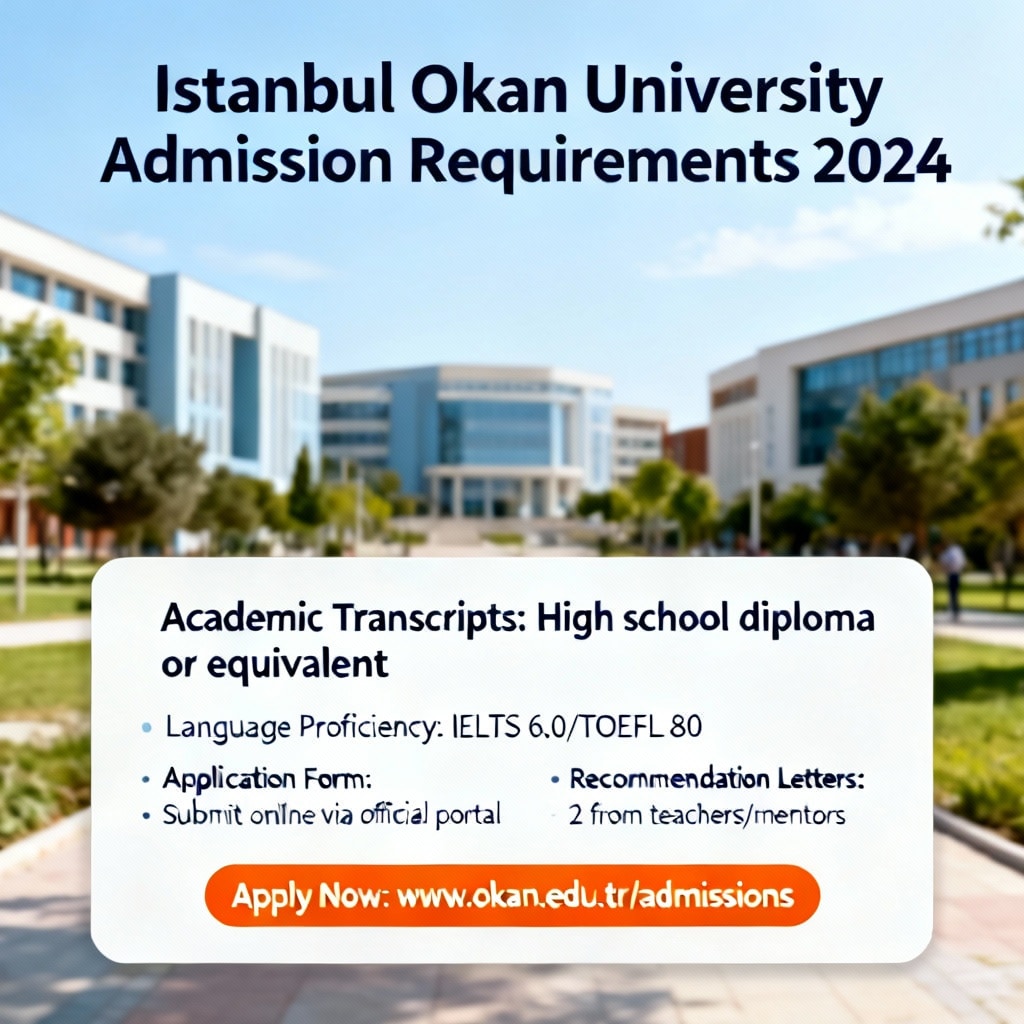
Istanbul Okan University admission requirements requirements explained
Quick Navigation
- Admission requirements explained
- Snapshot — who can apply
- Undergraduate (Bachelor’s) requirements
- Graduate (Master’s) requirements
- Doctoral (PhD) requirements
- General documentation
- Application process overview
- Program-specific notes
- Document verification & visas
- Practical tips for recruiters & admissions teams
- How Study in Turkiye supports partners
- Ready-to-use admissions checklist
- Frequently asked questions
- Final recommendations
- Take the Next Step with Study in Turkiye
Istanbul Okan University admission requirements requirements explained
This guide gives international recruiters, university admissions teams, HR and marketing professionals, and placement agencies a practical, step-by-step breakdown of what applicants need to study at Istanbul Okan University. Whether you advise prospective undergraduates, evaluate master’s candidates, or guide PhD hopefuls, this article organizes academic thresholds, language expectations, documentation checklists, timeline guidance, and operational tips to streamline recruitment and admissions workflows.
Why this matters for recruiters and university teams:
- Clear, consistent requirements reduce application abandonment and improve conversion.
- Understanding specific thresholds for competitive programs (medicine, dentistry, health sciences) enables targeted candidate sourcing.
- Automated document checks and templated communications speed up admissions processing and strengthen your institution’s international reputation.
Snapshot — who can apply and where to start
Istanbul Okan University welcomes international applicants at undergraduate, graduate (master’s), and doctoral levels. Admissions are typically managed via the university’s online application portal and require a combination of academic records, language proof, identity documentation, and (for some programs) entrance test scores or interviews.
Quick pre-screen checklist
- Valid passport and ID details
- Notarized diplomas and transcripts (with certified translation where needed)
- Equivalency (“Denklik Belgesi”) where applicable
- Language certificates (TOEFL/PTE or TÖMER)
- Additional materials for graduate and doctoral studies (CV, references, research proposal)
Undergraduate (Bachelor’s) admission requirements — practical details
Academic thresholds
- Minimum academic requirement: typically 60% overall for most bachelor’s programs.
- Competitive health-related programs (e.g., Medicine, Dentistry): minimum 80% or equivalent academic standing.
- No general university entrance exam is required for most undergraduate programs.
- No universal age limit; check program-specific provisions for under-18 applicants.
Language proficiency requirements
- English-taught programs: accepted levels include TOEFL iBT 79 or PTE 67 (or university internal exam).
- Turkish-taught programs: TÖMER certification at B1–C1 levels depending on faculty.
- Students without required certificates may be placed in a compulsory language preparatory year.
Required documentation for undergraduate applicants
- Notarized high school diploma and official transcripts (translated if necessary).
- Equivalency certificate (“Denklik Belgesi”) issued by the relevant Turkiye authority or education attaché.
- Valid passport (copy; original required at final registration).
- Recent passport-size photo.
- Language test certificate or evidence of passing Okan University’s internal language exam.
- Parental consent and birth certificate for applicants under 18.
Graduate (Master’s) admission requirements — what to gather
Academic standards
- Recognized bachelor’s degree required.
- Minimum GPA: 2.00/4.00 (program-specific standards may be higher).
- Some master’s tracks, especially in applied or health sciences, may require stronger academic records or professional experience.
Language expectations
- English-taught master’s: TOEFL iBT 79 (or equivalent).
- Turkish-taught master’s: typically TÖMER B2–C2 depending on the program.
- Verify whether the department accepts equivalent certificates or university-administered exams.
Supporting documents
- Notarized and translated bachelor’s diploma and transcripts.
- CV/resume.
- Reference letter(s).
- Letter of intent / motivation letter.
- Equivalency certificate.
- Any professional certificates or portfolios requested by the department.
Doctoral (PhD) admission requirements — selection criteria and conditionalities
Entry qualifications
- Standard entry: master’s degree with thesis.
- Exceptional direct admission from bachelor’s may be possible in rare, program-specific cases.
Evaluation and scoring system
Okan University uses a weighted evaluation for doctoral applications:
- ALES / GRE / GMAT score: 50%
- Bachelor’s / Master’s GPA: 15%
- English proficiency exam: 15%
- Interview and departmental assessments: 20%
Note: Conditional admissions are often possible if applicants submit ALES/GRE/GMAT within a specified period (commonly the first academic year).
Required documentation for PhD applicants
- Master’s diploma and transcript (notarized, translated).
- Equivalency certificate.
- Language certificate (TOEFL iBT 79 or equivalent; or TÖMER where Turkish instruction applies).
- Strong research proposal or letter of intent.
- Reference letters (usually 2–3).
- Additional materials like publications, sample thesis chapters, or portfolio items, depending on the department.
General documentation required at all levels
All applicants should prepare the following baseline documents before initiating an application:
- Valid passport (copy for application; original at registration).
- Recent passport-size photo.
- Notarized diplomas and transcripts (with certified translation where needed).
- Equivalency certificate (“Denklik Belgesi”) from the relevant authority/education attaché.
- Health insurance documentation (local or international accepted depending on visa rules).
- Parental consent and birth certificate for applicants under 18.
Application process overview — timeline and practical steps
Typical timeline
- Weeks 0–2: Candidate pre-screen and document collection.
- Weeks 2–3: Submit online application to Okan University with up to three program preferences.
- Weeks 3–5: University evaluation and provisional acceptance.
- Weeks 5–8: Final acceptance letter issuance.
- Weeks 8–10: In-person document verification and registration.
Key operational advice
- Require scanned notarized documents at submission to speed verification.
- Use a document checklist email template to reduce back-and-forth with candidates.
- Collect deposit/confirmation payment information as part of the offer pack to shorten seat confirmation time.
Program-specific notes — health sciences and competitive fields
Medicine and Dentistry demand higher academic thresholds (commonly 80% or equivalent). For applicants seeking medical programs, compare prerequisites across leading institutions in Turkiye. When advising applicants on alternatives or benchmarking, recruiters commonly refer to:
Tip: For non-Okan options in health fields, consider these universities above when advising applicants on alternatives and clinical partnerships — all linked to their official Study in Turkiye pages for easy reference.
Document verification, equivalency and visas — what recruiters must know
- Equivalency (“Denklik Belgesi”) is a mandatory process for many international secondary or higher education diplomas. Coordinate with candidates early to avoid visa delays.
- Notarization and certified translation are common requirements; define acceptable translation authorities and local consulate rules in your recruitment materials.
- Health insurance: advise students to secure coverage that satisfies both visa and university registration rules.
Practical tips for admissions teams, HR and recruitment agencies
Standardize your pre-screening
- Create a short pre-screen form that captures GPA conversions, graduation year, language test scores, and scanned key documents.
- Use percentage-to-GPA conversion guides and country-specific equivalency notes to minimize manual evaluation time.
Automate routine communications
- Implement templated emails for application receipt, missing documents, conditional offer terms, and next steps.
- Use conditional logic in forms to collect program-specific extras (e.g., portfolio upload for design programs).
Improve conversion with a deposit and deadline policy
- Clearly state deposit amounts and payment deadlines in offer letters.
- Offer flexible payment plans where possible to increase acceptances from international candidates.
Partner-focused best practices
- Train agency partners with a concise “How to apply to Okan” PDF: required docs, timelines, and contact points.
- Share a checklist tailored for programs with higher thresholds (medicine/dentistry) and alternate university placements if applicants fall short.
How Study in Turkiye supports institutional partners
Study in Turkiye is the trusted authority guiding international students and institutional partners across the application lifecycle. We offer tailored support to reduce administrative overhead and improve admissions outcomes.
Core partnership services
- End-to-end candidate sourcing and assessment aligned with Istanbul Okan University admission requirements.
- Document validation workflows and intake forms designed to reduce clerical errors and accelerate processing.
- Dedicated partnership onboarding for agencies and university admissions offices with templated communications and training resources.
We also provide comparative placement insight across leading universities in Turkiye — for example, when advising health applicants we benchmark Okan’s requirements against institutions such as Istinye University, Medipol University, and Bahcesehir University to identify best-fit pathways for candidates.
Checklist — ready-to-use admissions pack for each candidate
For Undergraduate applicants
- Scanned notarized high school diploma and official transcripts
- Equivalency document or application in progress
- Passport copy and photo
- Language certificate or evidence of passing internal exam
- Parental consent (if under 18)
For Master’s applicants
- Notarized bachelor’s diploma and transcripts (translated)
- CV, letter of intent, references
- Equivalency document
- Language certificate
For PhD applicants
- Notarized master’s diploma and transcripts
- Research proposal and references
- ALES/GRE/GMAT (or plan for submission within first year)
- Language certificate and portfolio/publications where applicable
Frequently asked questions (quick answers for recruiters)
Is an entrance exam required for undergraduates?
Generally no — most undergraduate programs do not require a separate university entrance exam.
What if a candidate lacks language proof?
Candidates can take the university’s internal language exam or be placed in a preparatory year if needed.
Can an applicant apply for more than one program?
Yes — Okan allows candidates to list multiple program preferences in a single application (commonly up to three).
Final recommendations — streamline admissions and reduce time-to-offer
- Use a standardized document checklist and automated reminder system to reduce missing-doc delays.
- Pre-qualify candidates for competitive programs (medicine/dentistry) with GPA and certificate checks before full application.
- Offer clear conditional offer templates that list deadlines for tests (e.g., ALES/GRE) or certificate submissions to secure placements quickly.
Study in Turkiye combines deep in-market recruitment expertise with admissions workflows and partner management solutions designed for international student flows. Our services reduce time-to-decision, increase conversion rates, and improve compliance with institutional admission policies.
Universities referenced for benchmarking
Take the Next Step with Study in Turkiye
If you represent an admissions office, recruitment agency, or educational HR/marketing team and would like a tailored admissions pack for Istanbul Okan University applicants — including intake forms, pre-screen templates, and partner training — contact Study in Turkiye. Partner with us to reduce administrative overhead, improve application-to-enrolment ratios, and deliver a seamless experience for international students.