

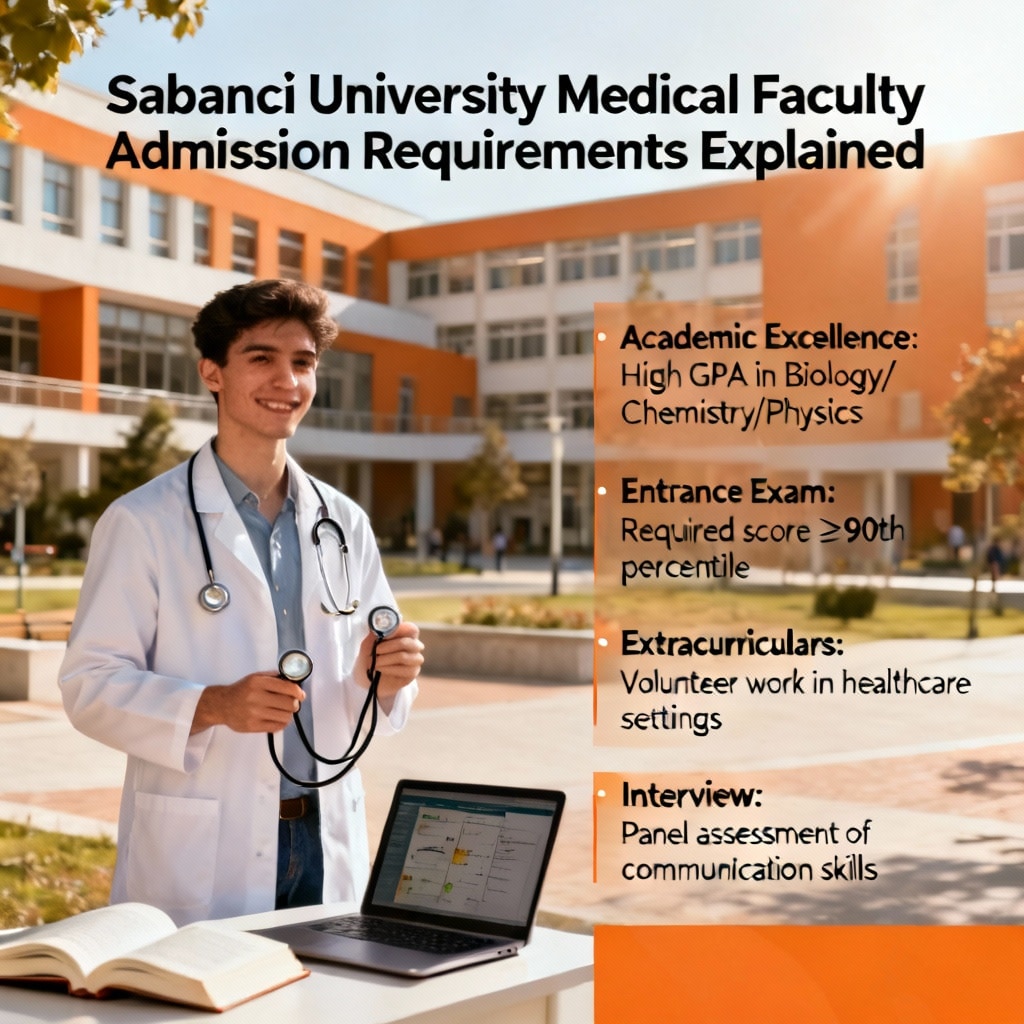
Sabancı University medical faculty admission requirements explained
Contents
- Short answer
- What international recruiters need to know
- If the student’s goal is medicine — alternatives
- Operational checklist for recruiters
- Messaging & marketing best practices
- How Study in Turkiye supports recruitment
- Examples & recommended pathways
- Compliance, legal & credentialing
- Final recommendations
- Read more
- FAQ
- Take the Next Step
Introduction
Sabancı University medical faculty admission requirements explained — a clear question with a straightforward answer for international recruiters, university admissions teams, HR and marketing professionals, and placement agencies: Sabancı University does not currently offer a medical faculty or an undergraduate medical degree. This article explains what that means for prospective medical students, outlines the actual undergraduate admission requirements at Sabancı University, and provides practical alternatives, partnership recommendations, and operational steps for international recruitment teams. Throughout, we highlight how Study in Turkiye — the trusted authority guiding international students — can simplify and scale your student placement work.
Sabancı University medical faculty admission requirements explained — the short answer
Sabancı University currently does not have a medical faculty and does not admit students directly into an undergraduate medicine program.
For international applicants seeking undergraduate entry to Sabancı University, there is a defined admissions process and documentation standard that must be met for programs offered by the university. Review Sabancı University’s institutional profile for full details: Sabancı University.
What international recruiters and admissions teams need to know about Sabancı’s undergraduate admissions
Even though Sabancı does not provide a medical program, many recruiters place academically strong students there for STEM, engineering, social sciences and interdisciplinary degrees. Use the following actionable admissions checklist when preparing international applicants for Sabancı’s undergraduate intake.
1. Eligibility — high school completion
- Applicants must be graduating seniors or hold a high school credential equivalent to Turkish high schools.
- Accepted credentials include nationally and internationally recognized diplomas. Ensure candidates’ documentation is verifiable and aligned to equivalency procedures for the applicant’s home country.
2. Accepted exams and diplomas (must be submitted)
- Sabancı requires submission of one of the accepted exams or diplomas with a valid score. Applications without an accepted exam or diploma are not evaluated.
- Typical accepted credentials include IB, recognized national high school diplomas, and internationally accepted standardized exam scores. For IB applicants, a minimum overall score of 28 is commonly used as a baseline.
3. Official transcripts and diploma documentation
- Provide an official high school transcript showing subjects and grades; transcripts must be signed and stamped or digitally verifiable if electronically issued.
- High school diploma copies are required. Any document not in Turkish or English must be translated officially and notarized.
4. English language proficiency
- Sabancı’s programs are delivered in English. Applicants must demonstrate English proficiency.
- Accepted options include tests such as TOEFL iBT (typical minimum 78–87 depending on program), PTE Academic (minimum range 48–73), and Cambridge (minimum B).
- If applicants do not meet minimum scores, pathway or preparatory programs are sometimes used by universities — explore those options early in the recruitment cycle.
5. Application fee and quotas
- A non-refundable application fee (commonly USD 30) is required and payable online by credit card.
- Admission is quota-based for international seats; monitor faculty quotas closely and apply early to maximize placement chances.
6. Competitive selection factors
- Selection is competitive and based on overall academic achievement and accepted exam/diploma scores.
- There are generally no program-specific subject prerequisites for initial undergraduate entry at Sabancı; students often choose majors after matriculation in interdisciplinary environments.
7. Legalization, apostille and final enrollment
- International documents may require legalization or an apostille to complete legal university enrollment in Turkiye. Plan for lead times for document authentication.
If the student’s goal is medicine — practical alternatives and pathways
For students specifically aiming for medicine: Sabancı University cannot be their direct undergraduate medical choice today. However, Study in Turkiye and partner recruiters should present alternative strategies.
1. Direct medical schools in Turkiye to prioritize in placements
When placing students for medicine, prioritize universities that offer accredited medical degrees. From our partner list, high-priority options include:
Each of these institutions has distinct intake calendars, language policies (some offer English-taught tracks), and clinical training affiliations. Match direct applicants to the university that best fits their language ability, academic score, and budget.
2. Bridge and transfer strategies
- For high-achieving candidates who prefer Sabancı’s campus environment but insist on medicine, consider dual-stage plans: place the student at Sabancı in a relevant undergraduate degree with a long-term plan for graduate-entry medical training elsewhere. Note: this is complex and usually requires separate admissions for graduate medical programs, recognition of prior study, and sometimes national licensing exams.
- Alternatively, design joint recruitment pathways with the medical universities in our network so candidates can apply directly for medicine with specialist support.
Operational checklist for international recruiters and admissions teams
The following operational checklist is designed to standardize your Sabancı applications and medical placements for consistent outcomes.
Pre-application (days 0–30)
- Verify high school equivalency and check minimum score thresholds (for IB, target 28+; for other systems check university-specific tables).
- Confirm applicant’s English proficiency and plan for retakes if scores are borderline.
- Prepare verified digital copies of transcripts and diplomas; arrange notarized translations if necessary.
Application submission (days 31–60)
- Complete application and pay the non-refundable fee (USD 30).
- Upload or provide validated exam/diploma scores.
- If targeting Sabancı, ensure the application lists all required documents to avoid disqualification.
Post-application (days 61–120)
- Track quota confirmations and waiting list statuses.
- Prepare for document legalization/apostille and pre-arrival visa steps.
- For medical applicants redirected to partner universities, coordinate clinical placement requirements, language remediation programs, and entrance test preparations.
Messaging and marketing best practices for HR and marketing professionals
1. Clear program differentiation
- On all marketing materials, explicitly state that Sabancı University does not offer an undergraduate medical degree to avoid misdirected applications.
- Promote Sabancı’s strengths—interdisciplinary education, liberal arts + engineering integration, strong industry ties—while providing direct alternatives for medicine.
2. Use data-backed targeting
- Segment campaigns by academic credentials (IB, national exams), language proficiency and budget.
- For prospective medical applicants, lead with Istinye University, Medipol University, Lokman Hekim University and other medical-capable partners listed above.
3. Automate document workflows
- Use Study in Turkiye’s document workflow and CRM integration services to collect, verify, and track documents across applicants. Automation reduces manual errors and accelerates admissions timelines.
- Implement automated reminders for students to legalize documents and complete test registrations.
How Study in Turkiye supports recruitment, enrollment and workflow
Study in Turkiye is uniquely positioned to help recruiters, university teams, and agencies navigate the gap between student aspiration (medicine) and institutional offerings (Sabancı and partner universities). Our services include:
- Strategic channeling: We map each applicant to the most appropriate university from our partner network, prioritizing medical-capable institutions when medicine is the objective.
- Admissions support: End-to-end assistance with document preparation, translations, apostille/legalization guidance, and application submission for Sabancı University and partner medical universities.
- Automation and CRM integration: Our tools streamline document collection, verifications, and status updates — enabling faster decisions and less administrative overhead.
- Agent and partner programs: We train and certify recruitment agents so they understand each university’s specific requirements and quotas. If your organization wants to join our network, see agent partnership details.
Examples and recommended pathways (case studies for clarity)
Case A — High school graduate with IB 30 aiming for medicine
Immediate recommendation: Apply directly to medical universities with English-taught intakes such as Istinye University or Medipol University.
Secondary option: If family prioritizes Sabancı for campus environment, evaluate a dual-plan: enroll at Sabancı in a relevant program while applying separately to medical schools for a later intake.
Case B — Student with strong science background but low English score
Action: Enroll in an English preparatory program or PTE/TOEFL intensive course; simultaneously submit applications to Sabancı for non-medical undergraduate programs as a back-up. For medical ambitions, prioritize language pathway programs offered by partner medical universities and advise on language support options.
Compliance, legal and credentialing reminders (must-haves)
- Always verify whether the applicant’s national diploma is recognized for direct entry or requires supplementary exams.
- Confirm required legalization/apostille requirements for diplomas and transcripts; these vary by country.
- Prepare applicants for clinical training regulations and licensing requirements if they plan to practice medicine in Turkiye or abroad after graduation.
Final recommendations for international recruiters and admissions teams
- Avoid miscommunication: Make the absence of an undergraduate medical program at Sabancı explicit in all recruitment materials.
- Offer alternatives: Promote partner institutions for medicine first — Istinye University, Medipol University, Lokman Hekim University, Antalya Bilim University, Beykent University, Bahcesehir University.
- Use Study in Turkiye’s enrollment and document workflows to cut processing time, reduce errors, and improve yield.
- Maintain a dual-path approach for top candidates who value both Sabancı’s academic environment and a medical career.
Read more
FAQ
Does Sabancı University offer an undergraduate medical degree?
No. Sabancı University does not currently offer a medical faculty or an undergraduate medicine program. International applicants seeking medicine should be directed to partner universities listed above.
What are the minimum English requirements for Sabancı?
Accepted English tests typically include TOEFL iBT (around 78–87 depending on program), PTE Academic (48–73 range) and Cambridge (minimum B). Check the program page or Sabancı’s institutional profile for exact thresholds.
Can a student start at Sabancı and later transfer into medicine?
Transfers into medicine are complex. A dual-stage plan — undergraduate study at Sabancı followed by separate application to graduate-entry medical programs — is possible but requires careful planning around recognition of prior study, entrance requirements and potential licensing exams.
Take the Next Step with Study in Turkiye
Whether you are placing students at Sabancı University or guiding applicants toward accredited medical programs, Study in Turkiye provides the expertise, admissions support and document workflows to convert student ambitions into confirmed offers. Contact us to discuss partnership models, bulk recruitment pipelines, or to onboard your agency onto Study in Turkiye’s certified agent program.
Useful links