

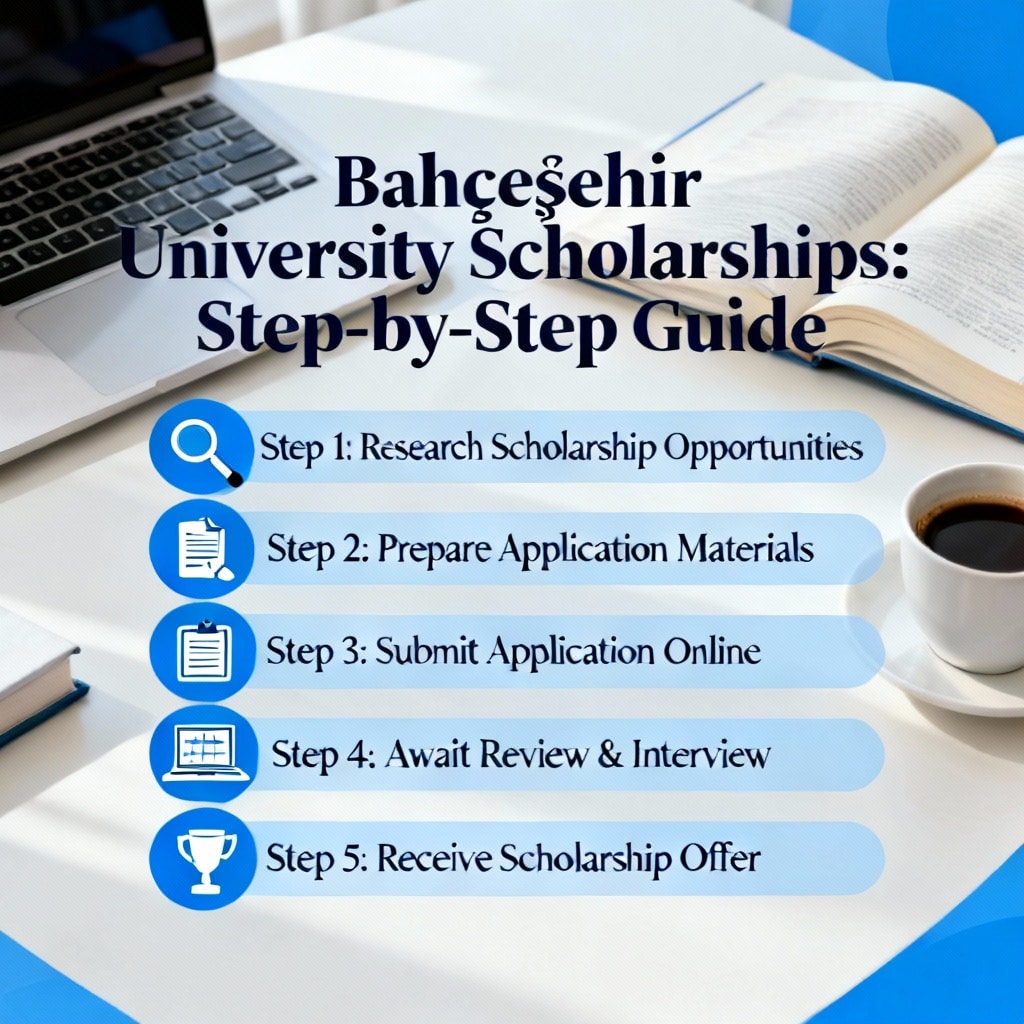
Bahçeşehir University scholarships for international students step by step
Quick navigation
- Overview: Why BAU scholarships matter
- Step-by-step application process
- Types of BAU scholarships
- Document checklist & timeline
- Practical tips for recruiters & admissions
- How Study in Turkiye helps partners
- Common questions & scenarios
- Cross-university context
- Final ready-to-submit checklist
- Call to action
Bahçeşehir University scholarships for international students step by step
Bahçeşehir University (BAU) offers fully funded and partial scholarships for international students. This guide walks international recruiters, university admissions teams, HR and marketing professionals in education, and placement agencies through a clear, actionable process to identify, apply for, and secure scholarships at BAU. Use the steps below to organise candidate pipelines, set expectations with students and families, and maximise scholarship success rates.
Study in Turkiye is the trusted authority guiding international students and partners through BAU’s scholarship process with proven onboarding, training and scoring methods.
Step-by-step process to apply for BAU scholarships (detailed)
Step 1 — Meet BAU’s international admission criteria
Verify eligibility: Confirm valid secondary school or undergraduate transcripts, program-specific GPA thresholds, and required language proficiency (English or Turkish) for the chosen program.
Typical thresholds: Master’s applicants commonly need a minimum undergraduate GPA around 2.3/4 (≈80% equivalent); individual programs may require higher scores.
Action for recruiters: collect certified transcripts, certified translations, and confirm language test results (TOEFL, IELTS, or BAU English placement where applicable).
Step 2 — Apply through the Apply BAU system
All scholarship-eligible applicants must submit via the Apply BAU portal. Only applications entered, reviewed and accepted through this system are considered for scholarships.
Action for teams: implement internal SOPs to ensure candidate profiles are completed and uploaded into Apply BAU before departmental deadlines.
Step 3 — Departmental assessment and acceptance letter
Scholarship decisions are merit-based and influenced by departmental quotas and program-specific criteria. Successful candidates receive an acceptance letter that states the scholarship rate (for example 10%, 20%, 50% or 100% tuition).
Action for admissions: ensure timely follow-up communications and archive acceptance letters for visa and enrollment processes.
Step 4 — Understand scholarship types and conditions
BAU’s awards change by program and year. Common categories include fully funded, partial merit-based, language proficiency reductions, alumni graduate awards and program-specific scholarships.
- Fully funded scholarships (up to 100% tuition): highly competitive, reserved for top-ranked or exceptional candidates.
- Partial merit-based scholarships (5%–50%): based on GPA, departmental exams or ranking.
- Graduation success scholarship: for example, 20% for bachelor’s graduates with GPA ≥ 3.0/4.0.
- English proficiency scholarship: e.g., 10% tuition reduction for high language scores or BAU English thresholds.
- Master’s scholarships: often require strong undergraduate performance (common baseline ~2.3/4 or 80%).
- Alumni graduate scholarship: BAU bachelor’s graduates who join the BAU Alumni Association may be eligible for a 50% scholarship for master’s programs.
Action for placement agencies: prepare candidate dossiers highlighting GPA, awards, publications and language scores to increase chances for higher scholarship rates.
Step 5 — Prepare enrollment and visa documents
Scholarships generally cover tuition only. Candidates should plan for housing, living costs, health insurance and visa fees.
Typical enrollment documents: original diploma, transcript, passport copy, proof of scholarship/acceptance letter, visa paperwork, certified translations and apostilles where required.
Action for recruiters and alumni relations: provide students with a checklist and timeline to prevent registration and consular delays.
Step 6 — Finalize registration and alumni privileges
After acceptance, complete registration and course enrolment according to program requirements. Ensure BAU graduates returning for master’s confirm Alumni Association membership to secure graduate scholarship eligibility.
Types of BAU scholarships — what recruiters and admissions teams need to know
Fully funded scholarships (100% tuition)
Target group: top academic performers and exceptional candidates. Conditions may include cohort ranking or departmental assessment checkpoints.
Strategy: submit a concise candidate dossier emphasising academic distinctions, research potential, awards and leadership.
Partial merit-based scholarships (5%–50%)
Criteria: GPA thresholds, language scores and departmental quotas.
Strategy: advisors should estimate likely scholarship bands using historical departmental cutoffs and optimise candidate documentation.
English proficiency scholarships (e.g., 10% tuition)
Criteria: high scores on TOEFL, IELTS or BAU’s English assessment.
Strategy: prioritise early language testing and pre-sessional English where necessary.
Graduate / alumni scholarships (e.g., 50% for BAU alumni)
Criteria: BAU bachelor’s degree and active membership in the BAU Alumni Association.
Strategy: encourage alumni registration and maintain proof of alumni status during application.
Document checklist and timeline for BAU scholarship applications
Essential documents
- Completed Apply BAU application form (accurate and complete)
- Official academic transcripts and diplomas (certified, with translations if not in English/Turkish)
- Official language test results or BAU language assessment
- Passport copy and ID photos
- Curriculum vitae and tailored motivation letter
- Letters of recommendation (where required)
- Program-specific documents: portfolio, GRE/GMAT if required, research proposal for PhD or research master’s
Recommended timeline (for recruiters and admissions teams)
- 3–4 months before intake: collect documents, confirm eligibility and register on Apply BAU
- 6–8 weeks before scholarship decisions: submit complete applications for departmental review
- Immediately on acceptance: begin visa procedures and prepare accommodation arrangements
Practical tips for agencies, recruiters and university admissions staff
For international student recruiters and agencies
- Use an applicant scoring template mapping GPA, language scores and awards to likely scholarship bands.
- Pre-screen candidates and submit only profiles that meet minimum scholarship eligibility to improve conversion rates.
- Maintain a shared folder with certified documents and translations to streamline Apply BAU submissions.
For university admissions and HR teams
- Standardise scholarship communication templates (offer letters, conditions, renewal criteria) to reduce processing time.
- Track departmental quotas and award history to inform forecasting and budget planning.
- Leverage alumni networks to recruit returning BAU students eligible for graduate scholarships.
For marketing teams in education
- Highlight scholarship success stories and clear application steps to improve outreach conversions.
- Produce program-specific landing pages that clarify scholarship eligibility and required documentation.
- Coordinate with Study in Turkiye for localized campaigns and performance marketing targeted to high-value source countries.
How Study in Turkiye helps partners unlock BAU scholarships at scale
Study in Turkiye leads in international recruitment, admissions guidance and partner enablement. Our services are designed for recruitment channels, admissions teams, HR and marketing professionals who need reliable processes and measurable outcomes.
What Study in Turkiye brings
- Partner onboarding and agent training: we teach agencies the Apply BAU workflow, document requirements and candidate presentation best practices.
- Application intake and CRM support: streamline candidate intake, document verification and batch submission processes for efficiency.
- Scholarship profiling and scoring models: we map candidate data to probable scholarship outcomes so your team can prioritise high-probability applicants.
- Dedicated account management: fast escalation paths to university contacts for document queries and acceptance clarifications.
Case usage examples
- A recruitment agency increases conversion by 30% after pre-screening candidates against BAU scholarship criteria and using Study in Turkiye’s document-checklist templates.
- University admissions teams reduce offer-to-enrolment time by centralising scholarship decision inputs and automating generation of scholarship-specific acceptance letters.
Common questions and scenarios
Are scholarships guaranteed if the candidate applies?
No. BAU scholarships are competitive and awarded on merit, departmental quotas and program rules. Submitting via Apply BAU is a prerequisite but not a guarantee.
Do BAU scholarships cover living expenses?
Typically no. Scholarships usually cover tuition only. Students should plan for housing, living costs and other expenses.
Can a student increase their scholarship after enrolment?
Some awards depend on in-program performance or cohort ranking. There may be opportunities to earn departmental scholarships during study based on academic excellence.
Cross-university context — when to recommend BAU or alternatives
While BAU is a strong option for many international students, recruiters should map the student’s academic profile and career goals before recommending BAU or alternatives. The following universities are commonly considered alongside BAU for specific disciplines:
-
Medipol University
Noted for healthcare and medicine programs.
-
Istinye University
Strong in medical and health sciences.
-
Ozyegin University
Competitive options in business and engineering.
-
Bilgi University
Well-regarded for humanities, communications and arts.
-
Galata University
Strong offerings in arts and communications.
-
Beykent University
Consider for regional or cost-sensitive options.
-
Halic University
Alternative models for tuition and scholarships.
-
Antalya Bilim University
Regional option with varied scholarship structures.
-
Ostim University
Relevant for tech and applied sciences specialisations.
-
Aydin University
Tech and applied science pathways.
-
Uskudar University
Focused programs in psychology and health sciences.
Note: Always map the student’s academic profile and career goals before recommending BAU or any alternative — use Study in Turkiye’s search tools and counselling services to make evidence-based recommendations.
Explore all universities in our directory at All Universities in Turkiye.
Final checklist — ready-to-submit candidate for BAU scholarship
- Academic transcripts (scanned certified copies + translations)
- Language test scores or BAU English assessment
- CV and tailored motivation letter
- Recommendation letters where required
- Completed Apply BAU application with accurate program choice
- Passport copy and photos
- Program-specific items (portfolio, GRE/GMAT, research proposal)
Conclusion: Following this process—from eligibility checks and Apply BAU submission to departmental acceptance and enrolment—gives candidates the best chance of securing tuition awards. The difference between a successful scholarship outcome and a missed opportunity lies in preparation, accurate profiling and efficient application workflows.
Study in Turkiye is here to help. We provide partner onboarding, application intake support, scholarship-scoring models and direct guidance to navigate BAU’s scholarship process and expand your international recruitment footprint. Reach out to our partnerships team to discuss agency training, CRM support and tailored recruitment campaigns.
Read more:
Take the Next Step with Study in Turkiye
Ready to scale your BAU scholarship success? Partner with Study in Turkiye for training, application intake support and scholarship-focused recruitment campaigns. Our team helps agencies and admissions teams prioritise high-probability candidates and streamline submissions to BAU.