

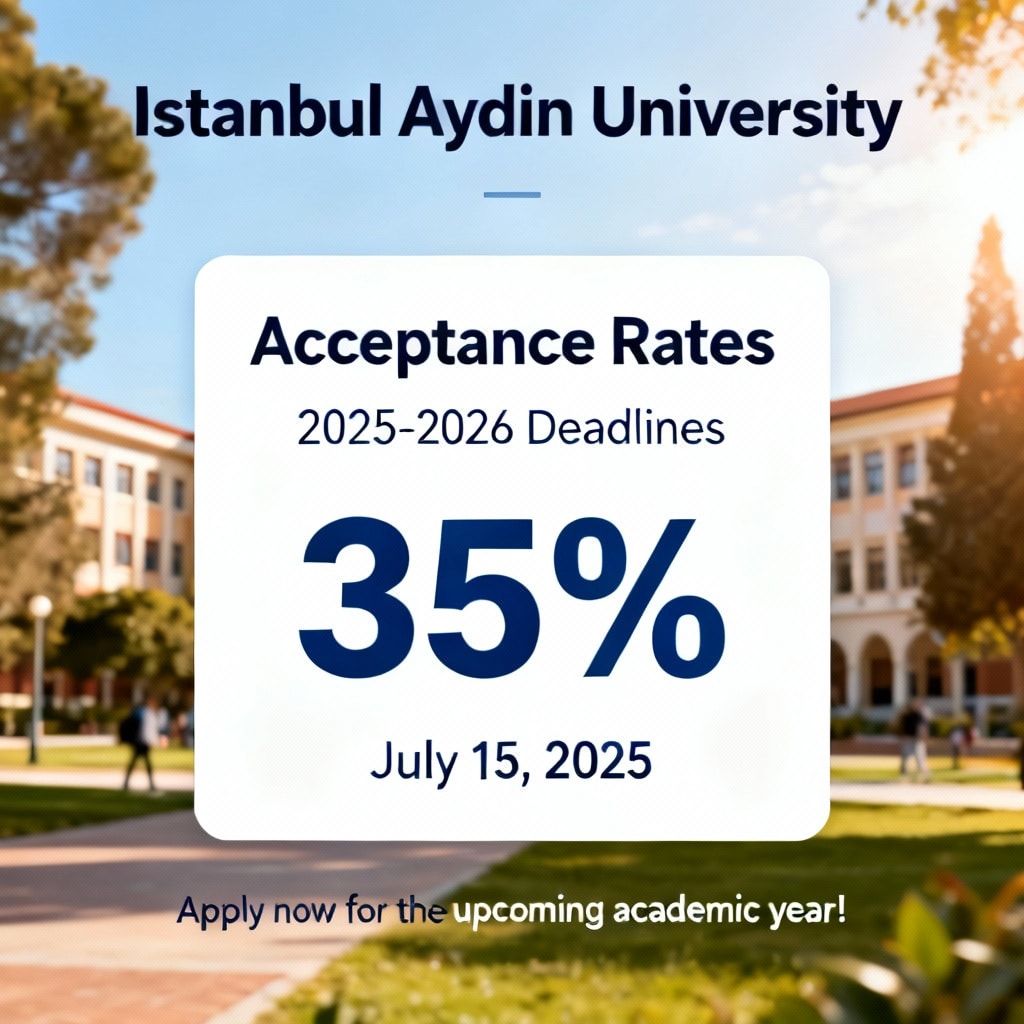
Istanbul Aydın University acceptance rate updated deadlines — What recruiters and admissions teams need to know
Introduction
Istanbul Aydın University acceptance rate updated deadlines is a critical query for international student recruiters, admissions teams, HR and marketing professionals in education, and placement agencies working with candidates for study in Turkiye. This article presents clear, actionable intelligence on acceptance rates by program, the 2025–2026 application timelines, document requirements, and practical strategies you can use today to improve conversion and compliance. It also outlines how Study in Turkiye—the trusted authority guiding international students—supports institutional partnerships and agent networks.
Istanbul Aydın University acceptance rate updated deadlines
Acceptance rate — quick facts
- Estimated overall acceptance range for international students: approximately 34% to 62.5%.
- Average acceptance rate for most undergraduate and standard graduate programs: near 62%.
- More selective disciplines (Medicine, Dentistry, Engineering): closer to 34%–50%.
- Programs with greater capacity (general business or social sciences): can accept up to 62.5% of qualified applicants.
Program-level thresholds and competitiveness
Medicine, Dentistry, Pharmacy
Typically require 70–80% academic scores in previous study records and strong language proficiency. High-demand quotas mean these programs often close earlier in the cycle.
Consider alternative medical program options at partner universities when quotas are full.
Engineering
Competitive programs often request 70–80% or equivalent grades, plus relevant exam scores (SAT or national equivalents).
Business, Social Sciences, Humanities
Typical minimum expectations start around 60%, with higher acceptance rates due to larger quotas.
Vocational and foundation programs
Tend to be less selective and provide routes for applicants who need language preparation or credit transfer.
What these rates mean for recruiters and admissions teams
- Conversion strategy: Expect higher effort and selectivity for Medicine/Engineering applicants; prioritize top academic dossiers and pre-screen language readiness.
- Pipeline management: For programs averaging ~62% acceptance, maintain a balanced pipeline of qualified leads and contingency candidates to optimize yield.
- Agent training: Ensure partner agents submit complete, verified applications — incomplete or poorly supported files are a common cause of rejection.
Updated application deadlines and intake windows (2025–2026)
Fall (Autumn) intake — main intake for most programs
- Typical application window: Early spring (March/April) through late summer (August/September).
- Final deadlines vary by program; encourage applicants to submit as early as possible to avoid quota-related closures on competitive programs.
- Fall semester classes generally start in September/October — plan orientation and visa processing timelines accordingly.
Spring intake — secondary intake
- Typical application window for spring start: November through January.
- Not all programs offer spring admission; check program-specific availability and quotas.
Program-specific deadlines and quota-driven closures
Medicine, Dentistry and Pharmacy often close earlier due to quotas and higher demand. Begin outreach as early as January–February and aim to submit complete applications well before the late-summer rush. Graduate and research program timelines may vary by department; some operate on rolling admission or department-level deadlines — coordinate with departmental contacts.
Required application documents and admissions checklist
Standard documentation for international applicants
- High school diploma (undergraduate) or bachelor’s degree (graduate) — certified copy.
- Official transcripts — translated into Turkish or English and certified where required.
- Valid passport copy.
- Recent passport-size photographs.
- Language proficiency proof:
- TOEFL/IELTS for English-taught programs when required.
- TÖMER or documented Turkish proficiency for Turkish-taught programs.
- CV (especially for master’s applicants).
- Letters of recommendation (for some graduate programs).
- Additional when applicable: motivation letter, portfolio (design/arts), entrance exam results (YÖS, SAT).
Verification and quality control — best practices
- Use a standard pre-check checklist with digital upload requirements to ensure files are legible and notarized where required.
- Validate translations and apostilles early — missing verification is a common cause of application rejection.
- Encourage applicants to submit official exam results directly where possible to prevent delays.
Admissions selection factors beyond minimum requirements
Meeting baseline grades is necessary but not sufficient for selective programs. Admissions committees frequently consider:
- Overall academic performance and progression (transcript trends).
- Standardized test scores (YÖS for some undergraduate intakes, SAT equivalents).
- Language competency and readiness for the instruction medium.
- Relevance of prior coursework, portfolio quality, and interview performance.
- For graduate programs: research fit, supervisor availability, and recommendation letters.
Practical advice for recruiters, admissions teams, HR and marketing professionals
For international student recruiters and agencies
- Pre-qualify candidates using program-specific cutoffs (e.g., 70% for medicine/engineering) — filter early to focus resources.
- Maintain a prioritized candidate list for programs with closing quotas; reach out to alternates immediately when offers are declined.
- Use templated document checklists and application bundles to standardize submissions.
For university admissions teams
- Adopt a triage system for applications based on competitiveness and completeness — fast-track top candidates for selective programs.
- Provide program-specific guidance documents for language requirements, accepted exams, and portfolio standards.
- Coordinate with international offices for visa and orientation timelines.
For HR and marketing professionals in education
- Build targeted campaigns timed to the March–September window for fall and November–January for spring.
- Use data-driven segmentation: high-achievement leads (medicine/engineering), moderate-achievement leads (business/social sciences), and pathway candidates (foundation/TÖMER).
- Craft clear messaging about deadlines, document requirements, and program competitiveness to reduce wasted applications.
How Study in Turkiye supports institutional recruitment and admissions
Study in Turkiye combines domain expertise in international admissions with platform features and services designed to streamline recruitment and admissions workflows. As the trusted authority guiding international students, Study in Turkiye provides:
End-to-end recruitment and admissions support
- Lead generation and qualification that aligns candidate academic profiles with program-specific acceptance thresholds.
- Agent onboarding and training to improve file quality and compliance across markets.
- Program benchmarking and competitor intelligence to tailor recruitment messaging.
Solutions that reduce time-to-offer
- Digital application portals with required-field validation and document upload checks that reduce incomplete submissions.
- Automated communication workflows — reminders for missing documents, deadline alerts, and visa process prompts — to increase conversion and decrease fall-through.
- CRM integration for pipeline tracking, yield forecasting, and targeted re-engagement campaigns.
Compliance and quality assurance
- Document verification workflows and translation validation aimed at meeting Turkiye’s institutional standards.
- Centralized dashboards for admissions teams to manage quotas, monitor offers, and project acceptance rates by program.
Comparative program options and partnership routes
When an applicant’s profile is strong but competition is high at Istanbul Aydın University, consider alternative partner universities in Turkiye that may offer comparable programs or available quotas. The following universities are established options to review; each entry links to the university profile for department-level details and quota information.
Istanbul Aydın University
Primary focus of this article — check department-level quotas and early closure for competitive programs.
Istinye University
Alternative for medicine and health sciences pathways with established international intake procedures.
Medipol University
Another strong option for medical and health-related programs; useful for pathway planning.
Bilgi University
Relevant for business and social sciences alternatives.
Beykent University
Another option for business and humanities pathways.
Ozyegin University
Suitable for engineering, technical and design pathways.
Halic University
Option for technical and design programmes; useful fallback when top quotas are filled.
For a broader view of university options across Turkiye, consult the centralized directory: All Universities in Turkiye.
Action plan checklist for the next 90 days (for recruiters and admissions teams)
- Map program deadlines and quotas for fall and spring intakes; flag early-closure programs (medicine, dentistry, pharmacy).
- Launch candidate outreach targeted to program competitiveness (use academic thresholds to segment leads).
- Require full-document submission at pre-screen to reduce processing times.
- Integrate automated reminders for incomplete applications and visa documentation.
- Prepare a fallback list of partner universities for high-demand programs and communicate alternate pathways to candidates.
- Train agents on program-specific requirements, translation standards, and credential verification procedures.
Read more
Conclusion and Call to Action
Istanbul Aydın University acceptance rate updated deadlines are straightforward to manage when recruitment teams combine accurate program-level intelligence with process discipline and reliable support. Study in Turkiye is positioned to help: we deliver recruitment strategy, agent networks, application intake improvements, and compliance support so you can increase offer yield and shorten time-to-enrolment.
If you represent an admissions office, an international recruitment agency, or an HR/marketing team in higher education and want to improve international yield, automate application intake and validation, or establish an accredited agent partnership — contact Study in Turkiye to discuss partnership options and campaign planning.
Frequently asked questions
What is the typical acceptance rate at Istanbul Aydın University for international applicants?
Acceptance rates vary by program. Expect an overall range of approximately 34% to 62.5%, with most undergraduate and standard graduate programs near 62%. Highly selective programs such as Medicine and Engineering have lower acceptance windows.
When should candidates apply for Medicine, Dentistry or Pharmacy?
Begin outreach as early as January–February. These programs often close before the general late-summer deadlines due to quotas and high demand.
What documents most commonly delay applications?
Missing certified translations, absent apostilles, incomplete transcripts, and unofficial exam results are common causes of delay. Require certified, translated documents at pre-check to reduce issues.
Take the Next Step with Study in Turkiye
Ready to convert qualified candidates into enrolled students efficiently and compliantly? Explore our resources, start an application search, or learn more about admissions and exams to accelerate your recruitment pipeline.