

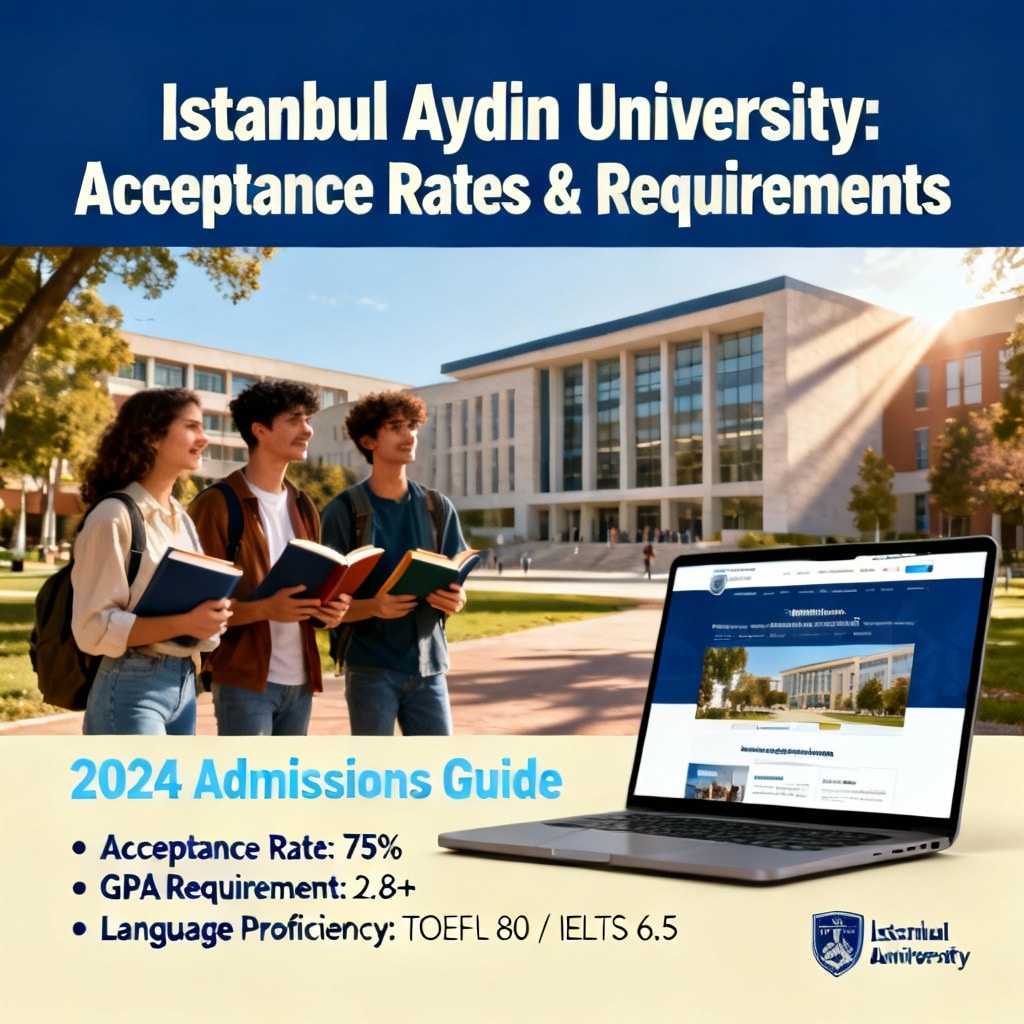
Istanbul Aydın University acceptance rate requirements explained
Quick navigation
- Overview & 2026 estimates
- Competitive landscape
- Acceptance rate by program
- International applicants
- Undergraduate admission requirements
- Required documents checklist
- Graduate admission requirements
- Application process, timing & fees
- Increase placement success
- Compliance & special considerations
- How Study in Turkiye supports recruitment
- Partnership models
- Actionable checklist
- FAQ
- Take the next step
Istanbul Aydın University acceptance rate requirements explained — overview and 2026 estimates
Istanbul Aydın University acceptance rate requirements explained — this guide provides a clear, actionable breakdown of acceptance rates, academic thresholds, language expectations, and the application process for both undergraduate and graduate applicants. Designed for international student recruiters, university admissions teams, HR and marketing professionals in education, and placement agencies, this article explains program-level selectivity and practical steps to improve admissions outcomes. For official program details and updates, consult the university profile on Study in Turkiye: Aydin University.
- Acceptance rate range: Istanbul Aydın University’s acceptance rate generally ranges from 34% to 62.5%, depending on program and applicant profile.
- 2026 estimates:
- Competitive programs (Medicine, Dentistry, Engineering): acceptance rates typically 34% or less.
- Other programs (Social Sciences, Business, Arts): acceptance rates may reach 62.5% or higher, depending on demand and applicant credentials.
- International applicants: reported acceptance rates commonly fall between 50% and 66%, with an average near 62% for general undergraduate admissions.
Key insight: the university applies stricter academic standards for high-demand fields; meeting or exceeding published minimums significantly improves placement chances in competitive majors.
Where Istanbul Aydın University sits in the competitive landscape
When advising applicants on medicine and health-related fields, compare program competitiveness with other private institutions focused on health sciences and clinical programs. Consider these peer institutions for benchmarking:
-
Istinye University
— private health sciences focus -
Medipol University
— strong clinical capacities
Use these benchmarks when preparing candidate profiles, particularly for Medicine and Dentistry applicants.
Acceptance rate by program — what recruiters and admissions teams must know
Medicine and Dentistry
Engineering, Architecture, Computer Sciences
Pharmacy
Social Sciences, Business, Arts, Economics
International student-specific acceptance considerations
- Reported acceptance rates for international applicants: 50%–66% (average near 62%).
- Recommended screening tools: pre-screening for GPA and language level; YÖS and SAT prep support where relevant; clear guidance on document translation and validation.
- Best practice: provide a tailored application checklist and mock interviews for candidates targeting competitive programs.
Undergraduate admission requirements — minimums and strengthening factors
Admissions teams must ensure applicants meet baseline academic criteria while recruiters help candidates present the strongest possible profile.
Minimum academic criteria (general)
- High school diploma or equivalent.
- Program-specific minimum high school grades:
- Social Sciences, Business, Economics: 60%
- Engineering, Architecture, Computer Sciences: 70%
- Medicine, Dentistry: 80%
- Pharmacy: 70% with science emphasis
Strengthening factors
- SAT or YÖS exam scores boost competitiveness, especially for engineering and medicine.
- Personal interviews or portfolio reviews may be required for arts and architecture.
- For borderline GPAs, strong exam scores or supplemental materials can tip decisions in the applicant’s favor.
Language proficiency requirements
- English-taught undergraduate programs: TOEFL average threshold 79, or passing the university’s English Proficiency Exam.
- Turkish-taught programs: TÖMER B1 minimum for general undergraduate; C1 required for Medicine and Dentistry.
- Applicants below cutoffs must complete a preparatory language year.
Required undergraduate documents — checklist for completeness
To avoid delays, admissions teams and agent partners should verify these items before submission:
- High school diploma (with English or Turkish translation)
- High school transcript (with English or Turkish translation)
- Copy of valid passport
- Language proficiency certificate (TOEFL, TÖMER, or university test results)
- Passport-sized photographs
- Any additional program-specific documents (portfolio, letters of recommendation, SAT/YÖS scores)
Graduate admission requirements — master’s and doctoral applicants
Graduate applicants must present a different set of credentials and supporting documents.
- Core requirements:
- Bachelor’s degree from a recognized institution
- Minimum undergraduate GPA: 60% (or equivalent); typical master’s threshold: 2.5/4.0
- Language proficiency:
- English-taught master’s: TOEFL 66 (or equivalent)
- Turkish-taught master’s: TÖMER B2
- Supporting documents: official transcripts and diploma copy; CV; letters of recommendation; personal statement or research proposal (for research-focused programs); possible interview or entrance examination for certain departments.
Application process, timing, and fees
Efficient processes reduce drop-offs. Admissions teams and recruitment partners should follow these operational steps.
- Complete the online application form on Istanbul Aydın University’s portal.
- Pay the application fee (standard fee USD 100; higher fees may apply for Medicine and Dentistry applications).
- Upload required documents and translations before the deadline.
- If applicable, schedule and prepare for interviews or entrance exams.
- Applicants failing language thresholds must register for the preparatory year.
Operational tips
- Set internal deadlines two weeks earlier than official cutoffs for validation and translation.
- Use applicant-tracking tools to monitor document status, fee payments, and interview scheduling.
- Coordinate with university-approved advisors for final verification.
How admissions teams, recruiters, HR, and marketing can increase placement success
Align strategy across pre-screening, candidate preparation, and digital engagement.
Practical tactics
- Pre-screen with a points system (GPA, language, entrance exam score, portfolio/interview readiness).
- Offer bundled services: YÖS/SAT prep, language classes, and application review.
- Use CRM workflows to handle document reminders, fee confirmations, and interview scheduling.
- Produce targeted marketing content for high-value cohorts (e.g., science-focused students for Medicine, Dentistry, Pharmacy).
- Build partnerships with local institutions and agents to expand the pipeline.
Quality assurance
- Implement document-validation checks to flag missing translations or inconsistent grades.
- Use multilingual landing pages and FAQ resources to reduce recruiter workload.
- Implement lead scoring so admissions officers focus on the most promising applicants.
For medicine and dentistry benchmark comparisons, see:
Compliance, documentation, and special considerations for international applicants
Documentation and validation
- Ensure all academic records are translated into English or Turkish and apostilled where required.
- Verify passport validity and entry visa requirements early in the process.
- Confirm language test authenticity and expiration dates.
Special cases
- Provide conversion guidance for applicants from grading systems that do not use percentages.
- Highlight alternatives (preparatory or pathway programs) and conditional acceptance routes for candidates with strong profiles but lower grades.
How Study in Turkiye supports your recruitment and admissions goals
Study in Turkiye is the trusted authority guiding international students and institutions with specialised recruitment expertise, program intelligence, and operational services tailored to universities and placement agencies.
What we provide
- University partnerships and program intelligence, including a dedicated Aydin University profile.
- Applicant pre-screening and qualification services to raise admissions yield.
- CRM integrations, document-validation workflows, and multilingual communications that reduce administrative overhead.
- Agent onboarding and training through our partner program to maintain quality in recruitment channels.
Why partner with Study in Turkiye
- Proven experience recruiting across regions and student segments.
- Deep knowledge of program-specific requirements and acceptance-rate dynamics, enabling smarter targeting for competitive programs such as Medicine, Dentistry, and Engineering.
- End-to-end admissions support from lead generation to visa guidance.
Practical partnership models
- Referral and agent partnerships: scalable commissions and quality assurance training.
- White-label recruitment campaigns: custom funnels to feed high-priority programs.
- Admissions integration: integrate your internal systems with Study in Turkiye tools for streamlined operations and reporting.
Actionable checklist — what recruiters and admissions teams should do now
Pre-recruitment
- Identify target programs and set GPA/language thresholds.
- Prepare region-specific marketing collateral detailing program requirements and fees.
- Train agents on documentation and translation standards.
Candidate preparation
- Verify academic records and translations before submission.
- Administer mock interviews for competitive programs.
- Encourage SAT/YÖS or additional test-taking to strengthen profiles.
Application stage
- Review all uploads against the required-document checklist.
- Confirm payment of the correct application fee.
- Track outcomes and request feedback from university admissions to refine selection criteria.
Post-offer
- Assist with visa documentation and accommodation onboarding.
- Enroll admitted students in language or preparatory pathways if necessary.
FAQ
What is the typical acceptance rate for Medicine at Istanbul Aydın University?
Medicine and Dentistry are highly competitive. Estimated acceptance is generally 34% or less, with minimum high school GPA expectations around 80%. Meeting language and entrance exam thresholds is critical.
What language scores do applicants need?
English-taught programs generally expect TOEFL scores (undergraduate ≈ 79, graduate ≈ 66) or the university’s proficiency exam. Turkish-taught programs require TÖMER levels (B1 for general undergraduate, C1 for Medicine and Dentistry).
Can applicants with lower GPAs still gain admission?
Yes — applicants with borderline GPAs can strengthen applications with strong SAT/YÖS performance, interviews, portfolios (where relevant) or by completing preparatory programs. Conditional offers based on exam outcomes are common in select cases.
Where can I find the official program page for verification?
Consult the Istanbul Aydın University profile on Study in Turkiye for official program pages and updates: Aydin University.
Conclusion and next steps
Istanbul Aydın University acceptance rate requirements explained: success requires precise targeting of high-quality candidates, thorough document preparation, and efficient admissions workflows. Study in Turkiye combines program expertise, international recruitment know-how, and operational services to help your team convert more applicants—especially for competitive programs such as Medicine, Dentistry, and Engineering.
Ready to streamline admissions, boost enrollment quality, and expand your international recruitment footprint? Contact Study in Turkiye to discuss partnership models, agent onboarding, and admissions integration. For a quick start, review Istanbul Aydın University’s program page on Study in Turkiye: Aydin University.
Take the Next Step with Study in Turkiye
Partner with the trusted authority for international student recruitment. Explore services, prepare candidates, and start converting more high-quality applicants today.