

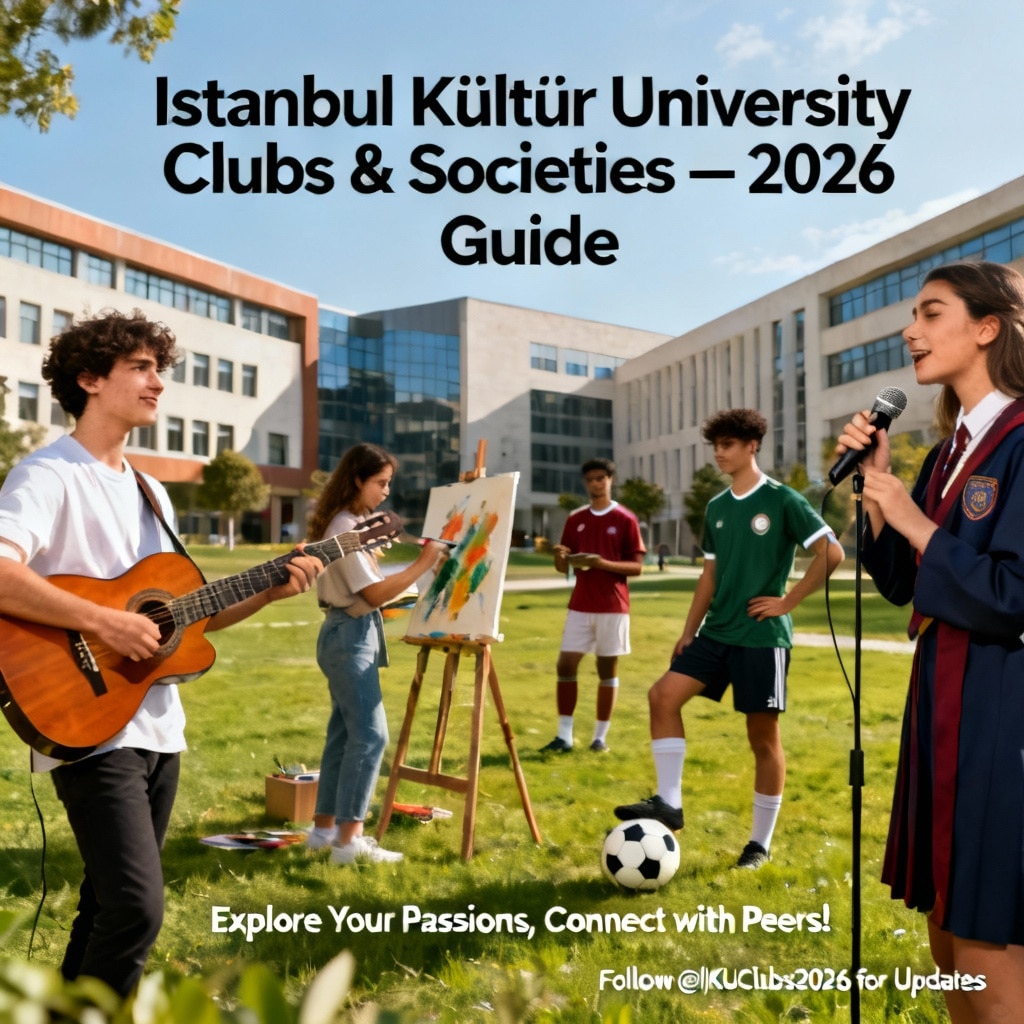
Istanbul Kültür University student clubs and societies 2026 guide
On this page
- Overview
- Quick snapshot
- Who this guide is for
- How IKU student clubs add value
- How to discover and join IKU clubs
- Representative club categories
- Case example: IEEE at IKU
- How recruiters and partners can engage
- Institutional support & governance
- Comparative engagement
- How Study in Turkiye supports partnerships
- 30/60/90 day checklist
- Final recommendations
- Read more
- FAQ
- Call to action
Istanbul Kültür University student clubs and societies 2026 guide
Istanbul Kültür University (IKU) student clubs and societies 2026 guide presents an actionable roadmap for international student recruiters, university admissions teams, HR and marketing professionals in education, and placement agencies. This guide consolidates IKU’s club ecosystem, membership pathways, governance, and partnership models — and shows how Study in Turkiye, the trusted authority guiding international students, can help you build sustainable talent pipelines and engagement programs at IKU and comparable institutions. For an official overview, see Kultur University.
Quick snapshot
Overview
Istanbul Kültür University (IKU) operates a diverse, student-driven ecosystem of clubs and societies that support technical learning, cultural exchange, social responsibility, entrepreneurship and personal development.
Key features at a glance
- Diverse club portfolio across engineering, arts, culture, social responsibility, entrepreneurship and professional development.
- Active international participation with structured language and cultural support for exchange students.
- Professional and technical clubs such as IKU’s IEEE Student Club with track records in national competitions including TEKNOFEST.
- Cultural, social and arts societies hosting festivals, workshops and performance events.
- Student-led social responsibility and sustainability initiatives.
Who this guide is for
- International student recruiters looking for high-potential talent and internship candidates.
- University admissions and student affairs teams wanting to increase international student engagement and retention.
- HR, employer branding and campus recruitment teams seeking direct access to student communities.
- Agencies and edtech partners working on placements, co-curricular credentialing and recruitment flows.
How IKU student clubs add value — strategic benefits
- Academic integration: Clubs act as experiential learning hubs where students apply classroom knowledge in project work and competitions.
- Talent identification: Recruiters can identify leadership potential, technical skills and soft skills through club activities and project portfolios.
- Retention and wellbeing: Clubs provide cultural and social nets for international students, improving retention and academic success.
- Employer branding: Long-term partnerships with clubs create pipelines for internships, capstone projects and graduate hires.
How to discover and join IKU clubs — practical steps for students
Discovery and orientation
New students are introduced to clubs during annual orientation events and networking workshops. Orientation is the primary discovery channel; international students receive additional support to navigate language and cultural barriers.
Membership pathways
- Attend orientation club fairs and info sessions.
- Register via club officers or the student affairs office.
- Participate in introductory workshops before committing to leadership roles.
Founding a new club — step-by-step checklist
- Demonstrate demand: gather 15–25 interested members and a short survey of need.
- Draft a constitution: include mission, membership rules, meeting frequency, and officer roles.
- Appoint officers: president, treasurer, secretary and sub-committee leads.
- Secure a faculty advisor: identify a willing academic staff member.
- Submit documentation: file application with the student affairs office and follow compliance guidance.
- Plan a pilot event: host a first meeting or workshop to validate interest and begin tracking KPIs.
Tips for international students
- Use club activities to practice conversational Turkish in informal settings.
- Seek mentorship from senior students or the international office to ease cultural adaptation.
- Prioritise clubs offering project-based experience and public performance or competition exposure.
Representative club categories and examples
Professional & technical clubs
Engineering and technology clubs (e.g., IEEE Student Club) build technical portfolios, prototype projects and competition experience. These groups are ideal for recruiters targeting STEM talent with practical skills and teamwork history.
Entrepreneurship & business clubs
Startup labs, case competition teams and consulting clubs offer real-world problem solving and employer-relevant case work.
Cultural, arts and social clubs
Music, drama, gastronomy and international culture clubs create platforms for cultural exchange, events management and creative communication skills.
Social responsibility and volunteering
Sustainability, charity and awareness societies run campaigns and community projects, demonstrating civic leadership and project management.
Case example: IEEE at IKU
The IEEE Student Club at IKU is an exemplar of professional engagement. Members have participated in national-level competitions such as TEKNOFEST, demonstrating how university clubs can produce high-visibility outcomes. Recruiters should view technical clubs as extended assessment centres where candidates’ practical capabilities are visible through portfolios, sorties to competitions, and collaborative deliverables.
“Technical clubs translate classroom theory into demonstrable outcomes — prototypes, competition results and collaborative deliverables that recruiters can evaluate directly.”
How recruiters and partners can engage with IKU clubs
Partnership models
- Sponsored workshops and guest lectures: Deliver skill-based sessions aligned to employer needs.
- Hackathons and case competitions: Co-designed problems let you evaluate candidates in real conditions.
- Internship and capstone project opportunities: Provide project briefs that transform into student work showcased in club portfolios.
- Mentorship programs: Pair industry mentors with club project teams for mid-term evaluation and sponsor visibility.
- Career fairs and assessment days: Organise targeted sessions focused on club members in specific disciplines.
Engagement lifecycle and timeline (sample)
- Month 0–1: Scoping and stakeholder alignment with student affairs and club officers.
- Month 1–3: Co-develop event/program (workshop, hackathon) and define evaluation criteria.
- Month 3–6: Execute events, gather participant data, and shortlist candidates for internships.
- Month 6–12: Onboard interns, measure outcomes and plan repeat collaborations.
Measurable KPIs to track partnership success
- Event attendance and active participation rates.
- Conversion rate: participants → internship offers → hires.
- Membership growth and sustained activity in target clubs.
- Student satisfaction and employer satisfaction scores post-event.
- Outcome metrics: project completion, competition placements, published prototypes.
Institutional support, compliance and sustainability
Transparent processes
IKU maintains clear policies for funding, facility booking, event approval and faculty advisor responsibilities. All collaborations should be documented and aligned with university regulations to ensure ethical engagement and data protection.
Funding and sponsorship
Sponsorship agreements should cover financial support for events or equipment, clear expectations for branding and recruitment access, and data-handling protocols for student information.
Student protection and safeguarding
Implement standard safeguarding checks for mentors and recruiters engaging with students. Ensure compliance with institutional policies and safeguard student privacy and wellbeing.
Governance checklist for admissions and recruiters
- Confirm club legitimacy with student affairs and obtain faculty advisor details.
- Secure event permits and facility bookings in writing.
- Define short and long-term KPIs and reporting cadence.
- Obtain signed data-sharing and privacy agreements for candidate information.
- Provide inclusive access and language support for international students.
Comparative engagement: other Istanbul institutions
While IKU offers a rich club culture, recruiters and partners may also consider parallel opportunities at other Istanbul institutions. For complementary recruitment channels, explore the following universities and their club ecosystems:
Strengths: health and medical-related collaborations
Strengths: neuroscience, psychology and health sciences partnerships
Strengths: entrepreneurship and business innovation programs
Strengths: arts and media collaborations
How Study in Turkiye supports partnerships with IKU clubs and societies
Study in Turkiye is the trusted authority guiding international students and institutional partners across Turkiye’s higher education landscape. Our services combine international recruitment expertise with scalable engagement processes that streamline outreach and improve candidate quality.
Key services relevant to club engagement
- Talent mapping and student sourcing: Identify active club members whose profiles match employer needs.
- Event workflow automation: Invitation management, registration, reminders and post-event surveys are handled through secure and scalable systems to increase participation and data quality.
- CRM integration: Applicant and participant data can be passed securely into employer CRMs for follow-up.
- Compliance and onboarding support: We help draft sponsorship agreements, data protection documents and campus engagement protocols.
Practical use-case: building a campus pipeline for STEM hires
- Target: IKU IEEE Club and related engineering societies.
- Activity: co-host a TEKNOFEST preparatory workshop and sponsor travel/equipment for promising teams.
- Execution: Study in Turkiye manages recruitment workflows, handles event registrations and aggregates participant portfolios.
- Outcome: shortlist of 10–15 candidates with demonstrable project outcomes; track internship conversions and hire rates.
Measurement and continuous improvement
We recommend a quarterly review cycle: collect KPIs post-event, conduct brief employer interviews and student feedback sessions, and adjust program design and processes to improve conversion rates.
Practical 30/60/90 day checklist — for students and partners
For students (joiners and founders)
- 0–30 days: Attend orientation, attend 3 club meetings, join one project team.
- 30–60 days: Volunteer for an event role, practice Turkish in club activities, begin leadership handover planning.
- 60–90 days: Launch a pilot project, build a portfolio entry, network with recruiters.
For recruiters and partners
- 0–30 days: Align with student affairs, identify 2–3 target clubs, schedule an introductory workshop.
- 30–60 days: Host events, collect participant data, deploy automated follow-up surveys and feedback collection.
- 60–90 days: Convert top performers to internships, measure conversion KPIs and plan repeat programming.
Final recommendations for admissions and recruitment teams
- Prioritise project-based partnerships for clearer assessment of student capability.
- Use automation to reduce manual event administration and improve candidate data quality.
- Work with Study in Turkiye to design measurable engagement programs and ensure compliance.
- Consider multi-university strategies: alongside IKU, collaborate with complementary institutions to diversify your talent funnel.
FAQ
How do international students find clubs at IKU?
Orientation events, club fairs and networking workshops are the primary discovery channels. The international office provides targeted support to help students navigate language and cultural differences.
What documentation is needed to form a new club?
Students should submit a constitution, a list of 15–25 interested members, officer appointments, a faculty advisor confirmation and a proposed activity plan to the student affairs office.
How can recruiters ensure compliance when working with student data?
Obtain signed data-sharing and privacy agreements, follow university data-handling protocols, and ensure any third-party systems meet institutional security requirements.
Take the Next Step with Study in Turkiye
Study in Turkiye can help map IKU clubs to your hiring needs, co-design hackathons and workshops, and deploy reliable event and candidate workflows that scale across campuses. Partner with the trusted authority guiding international students to convert club engagement into measurable intern and graduate hires.
Explore next steps