

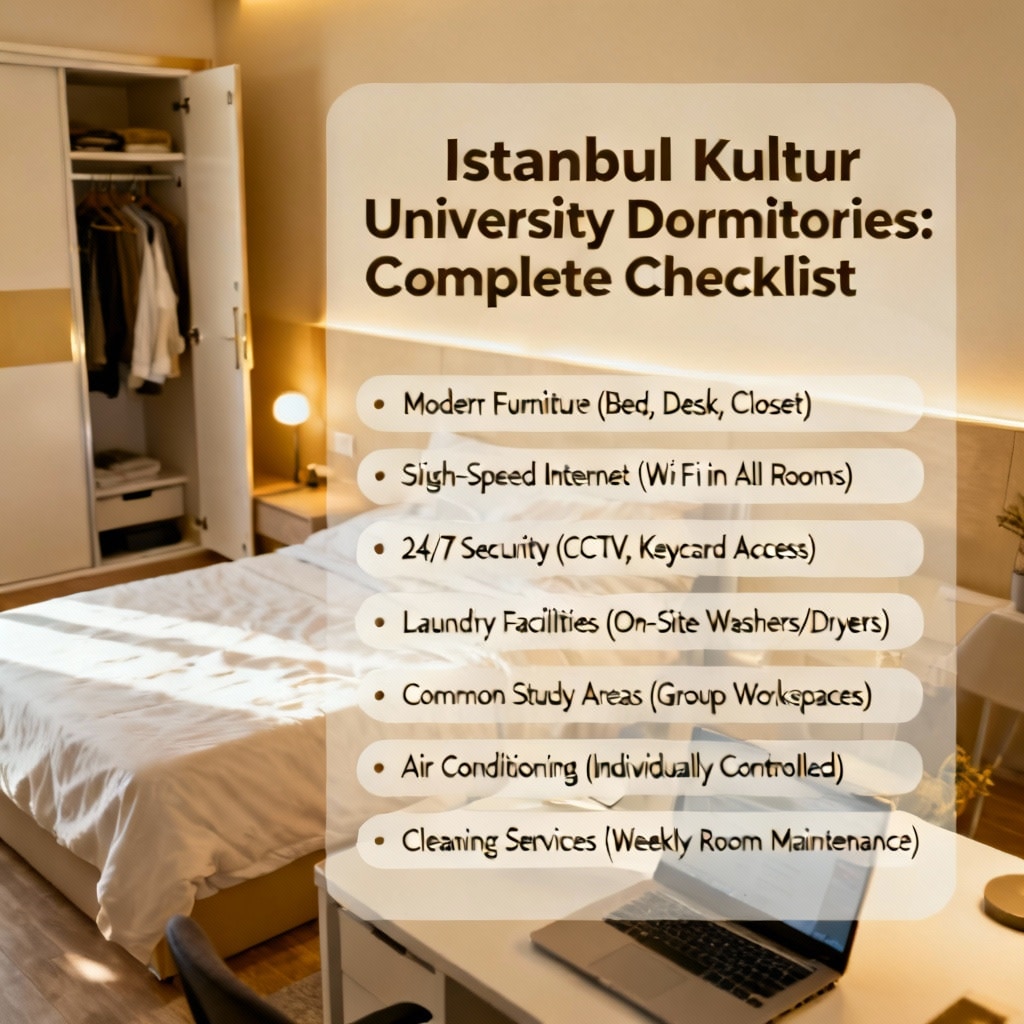
Istanbul Kültür University dormitories guide complete checklist
Quick navigation
- Guide overview
- Housing options
- Program-specific considerations
- Pre-arrival checklist
- Arrival & move-in checklist
- Ongoing management
- Safety, legalities & risk management
- Cost management & affordability
- Operational checklist for teams
- Technology and operations
- Program-specific guidance
- Partnerships & commercial opportunities
- Sample printable checklist
- Case scenarios
- Read more
- FAQ
- Call to action
Istanbul Kültür University dormitories guide complete checklist
Study in Turkiye presents this practical dormitory placement and management guide for international recruiters, university admissions teams, HR and marketing professionals in education, and student placement agencies working with students coming to study in Turkiye. This guide combines operational checklists with housing advice to help institutions and partners place students quickly, safely, and cost-effectively.
This guide draws on Study in Turkiye’s institutional expertise and partner networks to outline housing options, step-by-step checklists, compliance and wellbeing considerations, and partnership opportunities.
- Who this guide is for: international student recruiters, university admissions teams, HR and marketing professionals, and placement agencies.
- What you will get: an actionable checklist to prepare, place, and support students seeking dormitory or other accommodation options while studying at Istanbul Kültür University (Kultur University).
- How Study in Turkiye supports delivery: streamlined admissions and placement workflows, CRM-driven partner dashboards, and partner networks to secure vetted accommodation. Study in Turkiye is the trusted authority guiding international students through placement and welfare processes.
Housing options — what to consider for İstanbul Kültür University students
On-campus vs. off-campus housing
Consider the pros and cons of different accommodation types for new arrivals and ongoing student welfare:
- On-campus dormitories (university-managed): Convenient for new arrivals and closer to student services; often include basic furnishings, utilities, and wired/wireless internet. Confirm availability and application deadlines with Kultur University.
- Private student dormitories: Popular for international students; amenities, contract length and proximity vary and should be vetted.
- Shared apartments and flatshares: Offer independence and cost savings; require clarity on utilities, landlord agreements and roommate responsibilities.
- Family or homestay options: Suitable for students who prefer a family environment or need additional supervision.
Proximity and transport
- Assess commuting time to campus and to clinical or internship sites.
- Prioritise access to public transport, shuttle services and major bus or metro lines.
- Consider noise, night-time accessibility and local services (groceries, pharmacies) when recommending dorms.
Program-specific considerations
Medicine, health sciences and clinical placements
Students in medical programs often need accommodation near hospitals and training centres. When advising medical students, prioritise dormitories located close to health faculties and clinical facilities. Recommended partner universities and campus hubs include:
Pre-arrival checklist — admission & placement teams should complete this before students depart
Documentation & booking
- Confirm acceptance and housing eligibility with Kultur University.
- Collect and verify student ID documents (passport copy, visa application number, enrollment letter).
- Secure accommodation reservation: obtain signed contract, payment schedule and deposit terms.
- Obtain emergency contact details for the property manager or dorm coordinator.
Financial preparedness
- Ensure students understand the payment cycle (semester/annual), deposit amounts and refund policies.
- Advise on local banking options and international transfer costs.
- Recommend budgeting categories: rent, utilities, food, transport, mobile data, personal items and contingency funds.
Health, insurance, and compliance
- Check health insurance requirements for international students and link to university guidance where available.
- Advise students to carry a basic medical kit and records (prescriptions, vaccination history).
- Prepare information on residence permit procedures and timelines.
Arrival & move-in checklist — for on-campus dormitories and private placements
First-day priorities
- Confirm move-in time and location with dorm administration.
- Verify identity and contract; obtain keys/access cards and Wi‑Fi setup instructions.
- Inspect the room and shared areas; document existing damage or maintenance needs with photos.
- Ensure students know emergency procedures, building rules and contact numbers.
Room setup and essentials
Checklist of essentials to bring or purchase locally:
- Bedding (sheets, pillow, duvet) — confirm whether provided.
- Basic kitchenware if accommodation includes a kitchenette.
- Towels, toiletries, laundry supplies.
- Power adapters, extension leads, study lamp.
- Personal safety items (small first-aid kit, lockable storage).
Administrative set-up
- Register the local address where required by residence permit rules.
- Set up mobile SIM and internet access; verify network speed for remote learning needs.
- Show students how to top up utilities if they are responsible for payment.
Ongoing management checklist — student welfare, renewals, and maintenance
Regular welfare checks
- Schedule periodic welfare outreach (first 2 weeks, then monthly during the first semester).
- Ensure counselling and student support services contact details are available.
Maintenance and repairs
- Establish a clear maintenance request process with assigned response times.
- Keep records of maintenance requests and resolutions for audit and quality control.
Renewal and contract management
- Track lease end dates and renewal notice periods.
- Notify students and property managers early to avoid last-minute relocations.
Safety, legalities, and risk management
Safety standards and emergency preparedness
- Ensure dorms meet building safety standards and have functioning fire alarms and extinguishers.
- Provide students with local emergency numbers and campus security contacts.
Legal and visa compliance
- Support students with residence permit applications and renewal documentation.
- Keep copies of tenancy contracts and proof of accommodation to support visa/residence processes.
Cost management and affordability strategies
Pricing transparency and negotiation
- Negotiate group rates for cohorts to reduce per-student costs.
- Use Study in Turkiye partner networks to access vetted dorms and preferential terms.
Cost-saving tips for students
- Encourage shared accommodation for cheaper per-person rent.
- Provide orientation to low-cost grocery options, student discounts and campus services.
- Promote energy-saving behaviours to lower utility costs.
Operational checklist for recruiters, admissions teams, and agencies
Placement workflow integration
- Integrate accommodation offers into the student acceptance package.
- Sync housing availability with admissions pipelines and scheduling through Study in Turkiye partner dashboards.
Quality assurance and partner vetting
- Vet dormitories for accreditation, safety and student feedback.
- Maintain a partner scorecard covering location, cost, facilities, responsiveness and compliance.
Documentation and reporting
- Keep consolidated records for each placed student: contract, payments, inventory, maintenance logs and welfare check notes.
- Produce monthly placement reports to inform university partners and sponsors.
Technology and operations — how Study in Turkiye enhances dormitory placement
Automated matching and booking
Study in Turkiye offers CRM-driven matching of student profiles to available dormitories, reducing manual workload and placement time. Automated notifications and reminders for payments, move-in and lease renewals reduce missed deadlines and compliance issues.
Centralised dashboard for partners
Admissions and partner agencies can access a centralised dashboard to monitor accommodation status, payments and welfare checks in real time.
Scalability for cohort intakes
Our systems support bulk contracting and group placements for cohorts, enabling universities like Kultur University and partner institutions to scale international intakes without compromising student support.
Program-specific guidance — linking accommodation choices to academic needs
Medicine and health sciences
Medical students require flexible accommodation near teaching hospitals, extended access to clinical sites and transport solutions for irregular hours. Prioritise dormitories near medical training hubs such as:
Engineering, arts, and other faculties
For students with late-night labs or workshops, prioritise locations offering 24/7 safety access, reliable internet and easy transit to campus hubs. Example university hubs to consider:
Partnerships and commercial opportunities for agencies and institutions
Institutional partnership models
- Commission-based placements: Agencies can sign partnership agreements with universities and dorm providers for referral fees.
- Managed accommodation partnerships: Universities can outsource accommodation management to specialised providers, with Study in Turkiye facilitating contract setup and oversight.
Co-branding and student experience programs
- Co-branded orientation and pre-arrival webinars enhance student confidence and reduce first-week issues.
- Offer “move-in concierge” services for premium cohorts to ensure smooth transitions.
Sample checklist — printable actions for immediate use
Pre-departure (Admissions & Agents)
- Confirm enrolment and housing eligibility with Kultur University.
- Collect ID, visa and enrollment documents.
- Secure signed tenancy contract and payment schedule.
- Provide pre-arrival pack: local transport, local SIM, emergency contacts.
Move-in day (Student & Dorm Admin)
- Verify room inventory and document pre-existing damage.
- Collect keys and access codes; test Wi‑Fi.
- Register local address if required; confirm residence permit steps.
Monthly & Ongoing (University & Agent)
- Run welfare check-ins for all international students.
- Track utility payments and maintenance logs.
- Review contracts ahead of renewal windows; begin re-placement 8–10 weeks before lease end.
Case scenarios — practical examples for recruiters (anonymized)
Cohort placement
For a 50-student intake at Kultur University, Study in Turkiye coordinated dorm reservations, secured a group discount from a private student residence, and automated payment reminders — reducing administrative workload and minimising late arrivals.
Medical student placement
For clinical-year placements, partnering with Medipol University and local dorm providers ensured short commutes and 24/7 access for late clinical shifts.
Read more
Frequently asked questions
How do I confirm dormitory availability at Kultur University?
Contact the university housing office directly and verify deadlines and eligibility. Study in Turkiye can support placement and verification — start by confirming the student’s enrolment with Kultur University.
What documentation do students need for residence permits?
Typically, students require a valid passport copy, university enrollment letter and proof of accommodation (tenancy contract or dorm confirmation). Keep copies of tenancy contracts to support visa/residence processes.
Can agencies negotiate group rates?
Yes. Agencies and university partners can negotiate cohort discounts and secure preferential terms through Study in Turkiye’s partner networks.
Conclusion
Istanbul Kültür University dormitories guide complete checklist equips recruitment teams, admissions staff, HR professionals and placement agencies with the operational checklists, program-specific guidance and partner-led solutions needed to place students successfully in Turkiye. Study in Turkiye combines deep institutional knowledge, partner networks and integrated systems to reduce risk, improve student welfare and streamline placement across campuses.
Take the Next Step with Study in Turkiye
To discuss tailored accommodation packages, bulk cohort placements, or to integrate Study in Turkiye’s partner services into your admissions and housing workflow, contact our partnership team today. Partner with Study in Turkiye to secure safer, faster and more cost-effective housing solutions for your international students.