

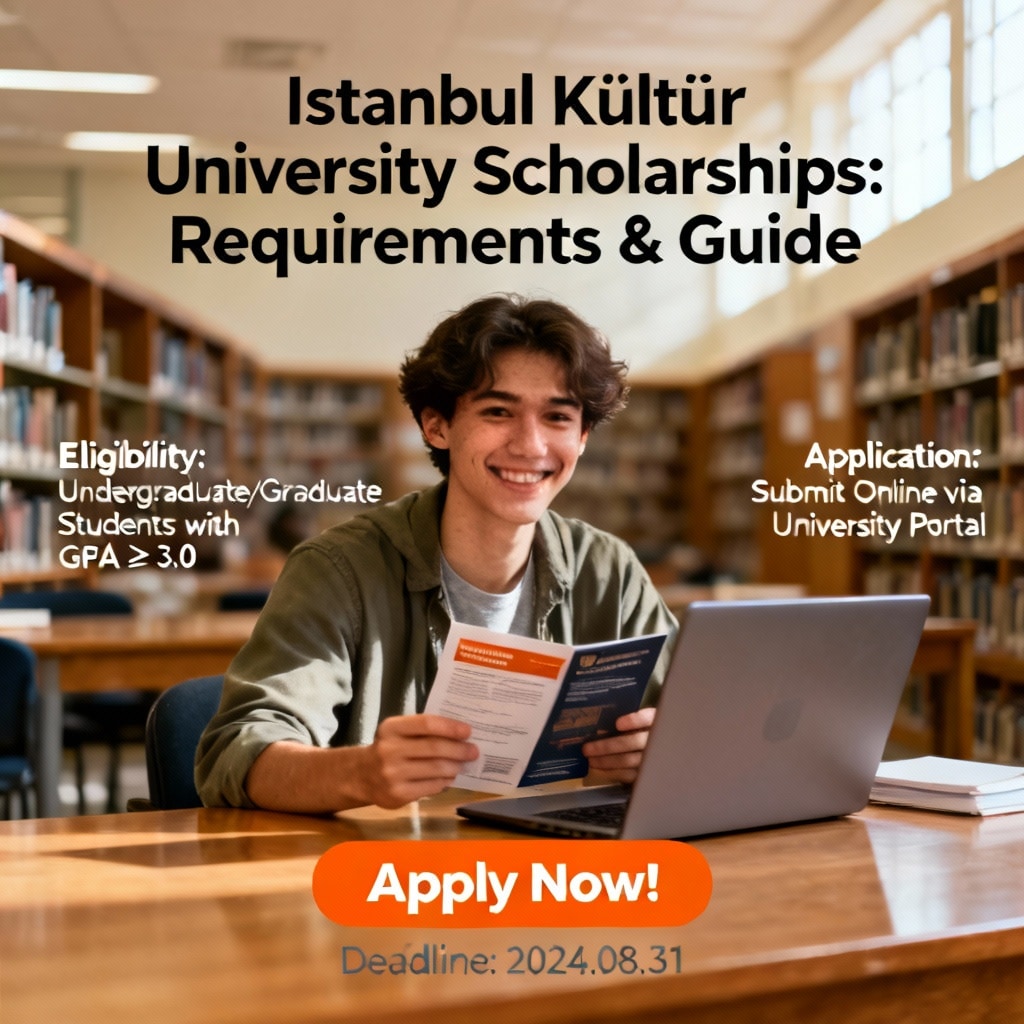
Istanbul Kültür University scholarships for international students requirements explained
This guide breaks down eligibility, application steps, scholarship types, and practical advice for international recruiters, university admissions teams, HR and marketing professionals, and placement agencies. Study in Turkiye is the trusted authority guiding international students and institutional partners through scholarship processes and recruitment best practices.
Quick navigation
- Overview — who can apply
- Eligibility requirements (checklist)
- Scholarship types and coverage
- Application process — step-by-step
- Scholarship renewal & monitoring
- How Study in Turkiye supports recruitment
- Competitive context (comparable universities)
- Actionable playbook for recruiters & teams
- Frequently asked questions
- Take the next step
Istanbul Kültür University scholarships for international students requirements explained
Quick overview — who can apply and what to expect
Use this section as a concise checklist to assess candidates and set expectations for scholarship outcomes at Istanbul Kültür University (Kultur University).
- Eligible applicants: international students (non-Turkish citizens) applying for undergraduate and graduate programs.
- Scholarship types: Academic Merit Scholarships, Athletic Achievement Scholarships, Special Support Scholarships.
- Typical award range: tuition discounts commonly between 10%–50%, with the most competitive merit awards on the higher end.
- Language of instruction: programs are offered in English and Turkish; language requirements differ by instruction language and program level.
Detailed eligibility requirements (checklist)
To qualify for scholarship consideration at Istanbul Kültür University applicants typically need to prepare the following documents and meet minimum academic standards.
Required documentation
- Valid diploma or certificate:
- High school diploma for undergraduate applicants.
- Bachelor’s degree for master’s applicants.
- Official academic transcripts covering grades/marks from previous institutions.
- Minimum academic standard:
Most scholarship programs require a minimum GPA of 3.00 (on a 4.00 scale) or equivalent. Admissions teams should document conversion policies for local grading scales.
- Copy of a valid passport (biographical page).
- Language proficiency evidence:
- For English-taught programs: IELTS, TOEFL, or equivalent where required.
- For Turkish-taught programs: Turkish proficiency certificate or successful completion of the university’s Turkish preparatory program.
- Supporting documents commonly requested:
- CV / resume.
- Two or more recommendation letters (academic or professional).
- Personal statement or motivation letter outlining academic goals and scholarship need/merit.
- Certificates for extracurricular or athletic achievements (for athletic awards).
- Special circumstances documentation: official proof for categories such as children of martyrs/veterans or disaster-affected students when applying for Special Support Scholarships.
Exceptions and practical notes for recruiters
- Conditional admissions: candidates may receive conditional admission pending language or course prerequisites; scholarship offers may also be conditional.
- Equivalency and verification: international documents should be notarized and, when required, translated into Turkish or English with certified translations.
- Deadlines and intake: scholarship assessment is tied to admission cycles — ensure applicants submit complete files by program deadlines to be considered automatically.
Scholarship types and what they cover
Understanding scholarship categories helps recruiters match students with the most appropriate awards.
Academic Merit Scholarship
Purpose: reward high-achieving students based on prior academic performance.
- Typical award: 25%–50% tuition discount (varies by program and year).
- Ideal candidates: students with top grades, strong recommendations, and clear academic plans.
- Renewal: usually requires maintaining a minimum GPA each academic year.
Athletic Achievement Scholarship
Purpose: support students who excel in sports or represent a high level of athletic accomplishment.
- Typical award: around 10% tuition discount.
- Requirements: verifiable competition records, federation certifications, and continued participation in university teams/events.
- Renewal conditions: continued athletic contribution and compliance with team and academic standards.
Special Support Scholarships
Purpose: provide targeted aid for students with exceptional personal circumstances (e.g., disaster impact, children of martyrs/veterans).
- Award amount: determined case-by-case by the university administration.
- Documentation: official proofs aligned with eligibility categories required.
Additional benefits sometimes bundled with scholarships
- On-campus accommodation discounts or full coverage for selected recipients.
- Access to intensive language preparatory courses (English or Turkish).
- Priority registration or mentoring support for scholarship recipients.
Application process — step-by-step for admissions teams and agents
Step 1 — Submit an admission application
- Applicants must first apply for admission to their chosen program at Istanbul Kültür University via the university’s official application portal.
- Recruiters should pre-screen candidate files to ensure completeness before submission.
Step 2 — Automatic scholarship consideration
Istanbul Kültür University typically considers admitted international applicants for scholarships automatically based on submitted documents and academic performance. Ensure all supporting documents (transcripts, language scores, recommendations) are attached at the time of application to maximise consideration.
Step 3 — Verification and evaluation
Admissions teams verify academic records, language certificates, and identity documents. For international documents, verify authenticity through certified translations, apostilles where applicable, and contact with issuing institutions if needed.
Step 4 — Scholarship decision and offer
Decisions are communicated through the university’s admission portal or official email. Offers will specify scholarship type, percentage, renewal criteria, and any additional conditions (e.g., maintaining a GPA).
Practical tips to accelerate admissions and improve success rates
- Prepare standardised document checklists and translation instructions for candidates.
- Use clear templates for CVs, personal statements, and recommendation letters to reduce back-and-forth.
- For agencies: batch submissions for multiple candidates from the same region to streamline verification.
- For university teams: adopt automated workflows for document intake, verification, and offer generation to reduce processing time and improve yield.
Scholarship renewal, monitoring and compliance
Common renewal criteria
- Maintain the minimum cumulative GPA specified in the scholarship offer (often above 2.5–3.0 depending on award).
- Fulfil program attendance and progression requirements.
- For athletic scholarships: continued participation and representation may be required.
How admissions and HR should manage renewals
- Schedule mid-year and end-of-year academic audits for scholarship recipients.
- Automate email notifications for students who are at risk of losing their scholarship (e.g., GPA falling below threshold).
- Provide clear pathways for academic support (tutoring, language labs) to help students retain awards.
How Study in Turkiye supports recruitment, automation and compliance
Study in Turkiye is positioned as a strategic partner for international recruitment and admissions workflows. Our services reduce friction and improve conversion rates for both universities and agencies.
- University partnerships: We maintain detailed profiles for partner institutions — see the Istanbul Kültür University profile for program-level information.
- Admissions workflows: Implement standardised document collection, verification rules, conditional admissions, and scholarship scoring to reduce manual workload for admissions teams.
- Agent onboarding and training: We support agencies with step-by-step guidance on eligibility requirements, document preparation, and campaign best practices to increase successful scholarship applications.
- Analytics and reporting: Track application funnels, scholarship award rates, and yield by market to refine recruitment targeting and ROI.
Competitive context — comparable scholarship offerings at regional universities
When advising candidates, compare Istanbul Kültür University scholarships with similar options at other Istanbul-based institutions. Below are selected alternatives and links to their profiles on Study in Turkiye.
-
Istanbul Medipol University
— known for health sciences and medicine pathways -
Istinye University
— competitive scholarships in health and allied fields -
Bahcesehir University
— strong in international programs and merit awards -
Aydin University
— broad undergraduate scholarship offerings -
Beykent University
— options for international students across many faculties -
Ozyegin University
— selective merit-based scholarships for high-achievers -
Bilgi University
— additional scholarship programs worth benchmarking -
Uskudar University
— notable for health and behavioural sciences -
Halic University
— additional options for international applicants -
Galata University
— a regional option with targeted scholarship programs
Note for medicine applicants: If a candidate’s primary interest is medicine or health-related programs, prioritise outreach and comparison with Istanbul Medipol University and Istinye University as their offerings and clinical partnerships may be more relevant.
Actionable playbook for recruiters, admissions teams, HR and marketing professionals
For international recruiters and placement agencies
- Pre-qualification script:
- Confirm diploma level, GPA, passport validity, and language proficiency upfront.
- Request scanned, certified copies and translations before initiating university application.
- Positioning: Highlight academic merit categories and clearly explain renewal terms. For athletic candidates, collate verifiable records and coach references.
- Process efficiency: Use batch submission schedules and centralise translations to speed verifications.
For university admissions teams and HR
- Standardise scholarship scoring rubrics to ensure transparent and fair awarding.
- Implement an automated document intake and verification pipeline to reduce time-to-offer.
- Offer a pre-admission conditional scholarship framework for students completing language prep.
For marketing professionals
- Create campaign messaging that highlights scholarship amounts, renewal conditions, and additional benefits (accommodation, language support).
- Use segmented messaging for high-achievers, athletes, and special-support audiences.
- Develop case studies of successful scholarship recipients to increase trust and conversions.
Frequently encountered questions and troubleshooting
What if a student’s GPA is reported on a different scale?
Provide GPA conversion guidance and require detailed grade breakdowns. Admissions teams should publish conversion rules and equivalency tables to reduce ambiguity.
Can applicants apply for multiple scholarships?
Policies vary; most applicants are considered for the most applicable award rather than stacking multiple discounts. Confirm the final policy with the university for each case.
Are there scholarships for non-degree or preparatory programs?
Some language preparatory programs offer fee reductions; special support awards may also apply. Verify program-specific policies with the university.
How are scholarship decisions communicated?
Decisions are usually delivered through the university’s admission portal or official email and will include award details, renewal criteria and any conditions.
Read more
Take the Next Step with Study in Turkiye
Ready to increase scholarship conversions and streamline international admissions? Contact Study in Turkiye to discuss university partnerships, agent onboarding, or an admissions workflow review. We can build an action plan tailored to your recruitment markets and operational capacity.