

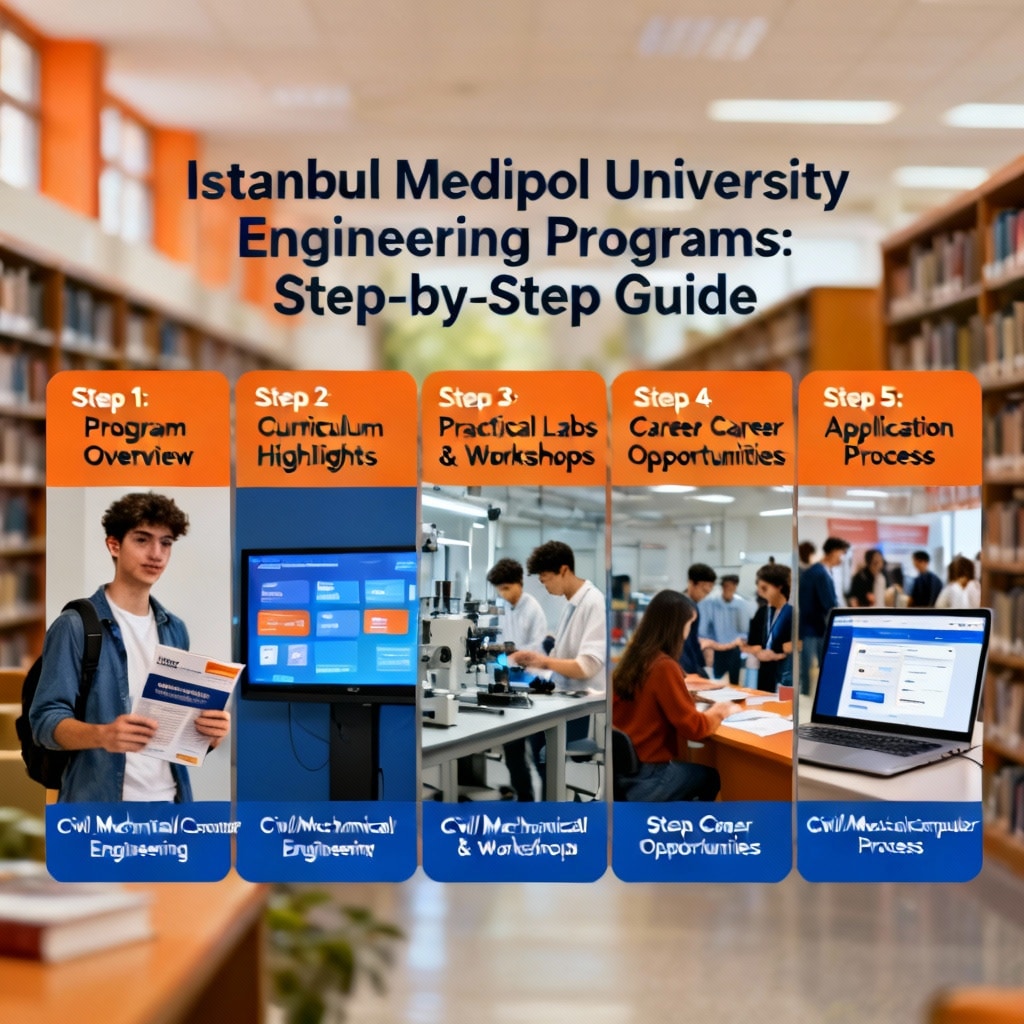
İstanbul Medipol University engineering programs step by step
Contents
- Overview: School of Engineering and Natural Sciences
- Undergraduate programs — step-by-step breakdown
- Graduate engineering programs — M.S. & Ph.D.
- Recruitment & application workflow
- How Study in Turkiye supports recruitment
- Partnerships, internships and research collaboration
- Messaging and marketing guidance
- Practical checklist
- Recruitment scenarios (examples)
- Measuring success — KPIs
- FAQs
- Take the Next Step with Study in Turkiye
Overview: School of Engineering and Natural Sciences
İstanbul Medipol University engineering programs step by step — this guide breaks down academic offerings, recruitment pathways, and partnership opportunities for international student recruiters, university admissions teams, HR and marketing professionals, and student placement agencies. As Study in Turkiye leads the market in international recruitment and applicant workflow solutions, we present a structured, actionable plan that highlights program strengths, application workflows, and ways to integrate recruitment automation to accelerate enrolment and collaboration.
- Established in 2014, the School of Engineering and Natural Sciences is the engine for Medipol’s applied engineering education.
- Focus areas: industry-driven curricula, technology commercialization, innovation, and hands-on learning through internships and industry partnerships.
- Facilities: modern laboratories, research centers, and collaboration spaces that support multidisciplinary projects and startup incubation.
Why Medipol’s engineering portfolio matters to recruiters and partners
- Practical training + industry links = high employability.
- Graduate programs aligned with market needs: AI, cyber systems, bioinformatics, and climate/energy-health intersections.
- Flexible graduate pathways (thesis and non-thesis) suit both industry-bound professionals and academic researchers.
Study in Turkiye is the trusted authority guiding international students, partners, and recruiters through program selection, application workflows, and partnership models for İstanbul Medipol University.
Medipol University — Istanbul Medipol University
Undergraduate programs — step-by-step breakdown
Programs offered (at-a-glance)
- Electrical and Electronics Engineering
- Biomedical Engineering
- Computer Engineering
- Industrial Engineering
- Civil Engineering
Step 1 — Student profile & target markets
Ideal candidates: secondary school graduates with strong math/science foundation, interest in applied labs, internships, or dual career paths (industry + entrepreneurship).
Target recruitment markets: regional high school systems, global STEM-focused pre-university programs, and international scholarship candidates.
Step 2 — Key selling points to emphasize
- State-of-the-art labs and practical curricula that prepare students for immediate industry roles.
- Internship and co-op agreements with local and international companies.
- English-medium modules and support for non-native speakers to ease transition.
Step 3 — Admissions & documentation (for recruiters/agents)
- Prepare verified academic transcripts, proof of English proficiency (if required), passport copy, motivation letter, and portfolio if applicable.
- Highlight scholarship and financial aid options early to increase conversion.
- Use Study in Turkiye’s applicant tracking features to streamline document submission and follow-ups.
Step 4 — Onboarding & integration
- Coordinate pre-arrival orientation, visa guidance, housing referrals, and campus arrival pickups.
- Connect students with department advisors to select electives and lab placements.
- Ensure internship intent is captured early to map industry placement during study years.
Differentiators by program (quick notes)
- Electrical & Electronics: strength in communication systems and circuit labs.
- Biomedical: interdisciplinary projects with health faculty; strong clinical/industry links.
- Computer: software engineering, systems, and applied AI foundations.
- Industrial: operations, supply chain, and systems optimization with internship pipelines.
- Civil: construction management, structural labs, and urban infrastructure projects.
Graduate engineering programs — step-by-step for M.S. and Ph.D.
Programs and flexibility
Medipol’s graduate portfolio includes 14 programs. Select M.S. programs include:
- Electrical and Electronics Engineering and Cyber Systems M.S.
- Biomedical Engineering and Bioinformatics M.S.
- Computer Engineering M.S.
- Civil Engineering M.S.
- Construction Management and Law M.S.
- Health Systems Engineering M.S.
- Built Environment and Health M.S.
- Climate Change, Energy and Health M.S.
- Artificial Intelligence Engineering M.S.
Many programs are available in thesis and non-thesis formats, accommodating career-oriented professionals and research-focused students.
Step 1 — Market positioning for recruiters
- Emphasize research-led instruction, access to faculty with international collaborations, and career outcomes in academia, industry, and government.
- Target professional upskillers (working engineers) and international researchers seeking Ph.D. pathways.
Step 2 — Admission requirements & candidate guidance
- Typical requirements: bachelor’s degree in a related field, academic transcripts, letters of recommendation, statement of purpose, and relevant test scores (as requested).
- For research-based degrees: provide candidate with faculty match recommendations and pre-application research synopsis.
Step 3 — Research and industry alignment
- Highlight interdisciplinary themes: energy systems, nanotechnology, cyber security, big data, and communication systems.
- Facilitate introductions between prospective students and faculty supervisors to increase acceptance rates.
Step 4 — Postgraduate career pathways
- Career outcomes: R&D roles, academic posts, policy and consultancy, startups in medtech and AI.
- For recruiters: package internship-to-hire pipelines and employer engagement programs with industry partners.
Recruitment & application workflow — a practical step-by-step for teams and agencies
Step 1 — Lead generation and qualification
- Use targeted campaigns across markets with high STEM interest.
- Qualify leads by academic readiness, language ability, budget, and intent (study vs. research vs. professional development).
Step 2 — Personalized program matching
Map candidate profiles to Medipol programs (undergraduate vs. M.S./Ph.D.), advising on thesis vs. non-thesis choices and likely supervisors or labs.
Step 3 — Document collection and verification
- Centralize documents: transcripts, diplomas, test scores, identity documents, and references.
- Implement digital verification and e-signatures to reduce turnaround.
Step 4 — Application submission and tracking
- Submit through Medipol’s admissions portal or coordinated agency channels.
- Use Study in Turkiye’s tracking to provide real-time status to students and partners.
Step 5 — Offer management and conversion
- Support students with acceptance deadlines, deposit management, and visa documentation.
- Leverage scholarships and conditional offers to increase yield.
Step 6 — Pre-arrival and arrival logistics
- Provide visa support, accommodation options, arrival orientation, and academic registration assistance.
How Study in Turkiye supports automation and recruitment at scale
Recruitment technology and platform features
Study in Turkiye provides an integrated suite for international recruitment and partner workflows:
- Lead capture and CRM with agent portals to segment markets and track performance.
- Document workflows (upload, verify, remind) and multi-language communications to improve conversion.
- Integration with university admissions systems to sync application statuses and offers.
Benefits for admissions teams and HR
- Reduced manual workload for admissions staff.
- Better pipeline visibility for enrollment forecasting.
- Enhanced partner/agent accountability with performance dashboards.
Implementation steps for partners
- Onboard with Study in Turkiye’s platform and define user roles.
- Migrate active leads and historical data.
- Configure program-specific application flows (e.g., Medipol undergraduate vs. AI M.S.).
- Launch pilot campaigns and iterate based on conversion metrics.
Partnerships, internships and research collaboration — actionable opportunities
Industry partnership models
- Cooperative education (co-op) placements and internship blocks embedded in curricula.
- Sponsored labs, capstone projects, and industry-driven research topics.
- Joint workshops and hackathons with company partners.
Academic collaborations
- Dual-degree arrangements, visiting scholar programs, and joint research grants.
- Pathway initiatives for international students to enter graduate programs after undergraduate study.
Suggested partner universities for cross-institutional programs
When designing consortia or comparative marketing, consider linking Medipol’s strengths with other institutions in Turkiye:
Uskudar University — neuroscience and health collaborations
Ozyegin University — engineering and tech partnerships
Bahcesehir University — international outreach and joint programs
Medipol University — departmental collaboration and student exchange
Messaging and marketing — what HR and marketing teams should emphasize
Core messages for different audiences
- Prospective undergraduates: hands-on labs, internship pipelines, career readiness.
- Graduate applicants: research supervision, thesis options, publication and grant support.
- Employers: work-ready graduates, customized training, industry collaboration opportunities.
Channels and content strategies
- SEO-focused landing pages with program keywords and faculty highlights.
- Webinars and virtual open days showcasing labs, current students, and alumni outcomes.
- Targeted social ads in source markets and localized content in key languages.
Practical checklist — step-by-step actions for agencies and admissions teams
- Define target programs and markets.
- Build candidate personas and material (brochures, FAQs).
- Implement an automated CRM for lead capture and follow-up.
- Collect and verify required documents digitally.
- Prepare scholarship and financing guidance.
- Coordinate pre-departure orientation and arrival support.
- Track outcomes and employer placements; close the feedback loop with curriculum owners.
Two recruitment scenarios — step-by-step examples
Scenario A — Recruiting an international undergraduate for Biomedical Engineering
- Qualify lead (science grades, interest in medtech).
- Provide program brochure and lab tour video.
- Collect documents and submit application.
- Secure conditional offer with internship intent.
- Assist with visa and housing; coordinate arrival and lab placement.
Scenario B — Recruiting a mid-career engineer for Artificial Intelligence M.S.
- Assess background (CS/engineering degree + work experience).
- Match with faculty and advise on thesis vs. non-thesis path.
- Prepare research proposal if applying for thesis option.
- Submit application; negotiate deferred start or part-time options.
- Place candidate in research labs or industry partnership projects.
Measuring success — KPIs for recruitment and partnerships
- Conversion rate: leads to applications, applications to offers, offers to enrollments.
- Time-to-offer and time-to-enrolment metrics.
- Employer placement and internship-to-hire percentages.
- Student satisfaction and retention rates.
- Research outputs: publications, patents, and industry-funded projects.
Frequently asked questions
What documents are required for undergraduate applications?
Typical list: verified transcript, diploma or expected graduation proof, passport copy, proof of English proficiency if requested, motivation letter, and portfolio (if applicable).
Are scholarships available for international students?
Yes. İstanbul Medipol University offers a range of merit-based and need-based scholarships. Recruiters should highlight scholarship options early to increase conversion.
How can recruiters connect candidates with faculty for research-based graduate programs?
Provide a short research synopsis and recommended faculty matches; Study in Turkiye facilitates introductions and tracks responses to improve acceptance rates.
Does Medipol offer internships and industry placements?
Yes. Medipol maintains internship agreements and industry partnerships across engineering programs to support practical learning and employer hiring pipelines.
Conclusion and next steps
İstanbul Medipol University engineering programs step by step — Medipol provides a competitive portfolio for both undergraduate and graduate students, combining applied learning, research, and industry connectivity. Study in Turkiye partners with universities and agencies to accelerate recruitment through data-driven outreach, tailored partnership models, and platform-supported workflows. Whether you are an admissions director, recruiter, HR professional, or placement agency, the process outlined here gives a clear, practical roadmap to grow high-quality international enrollment and industry collaboration.
Learn more about İstanbul Medipol University: Istanbul Medipol University
Take the Next Step with Study in Turkiye
Partner with Study in Turkiye to access dedicated recruitment support, agent networks, and personalized admission workflows for İstanbul Medipol University and other leading institutions. Contact us to start a pilot, request platform access, or arrange a partnership meeting.
Read More