

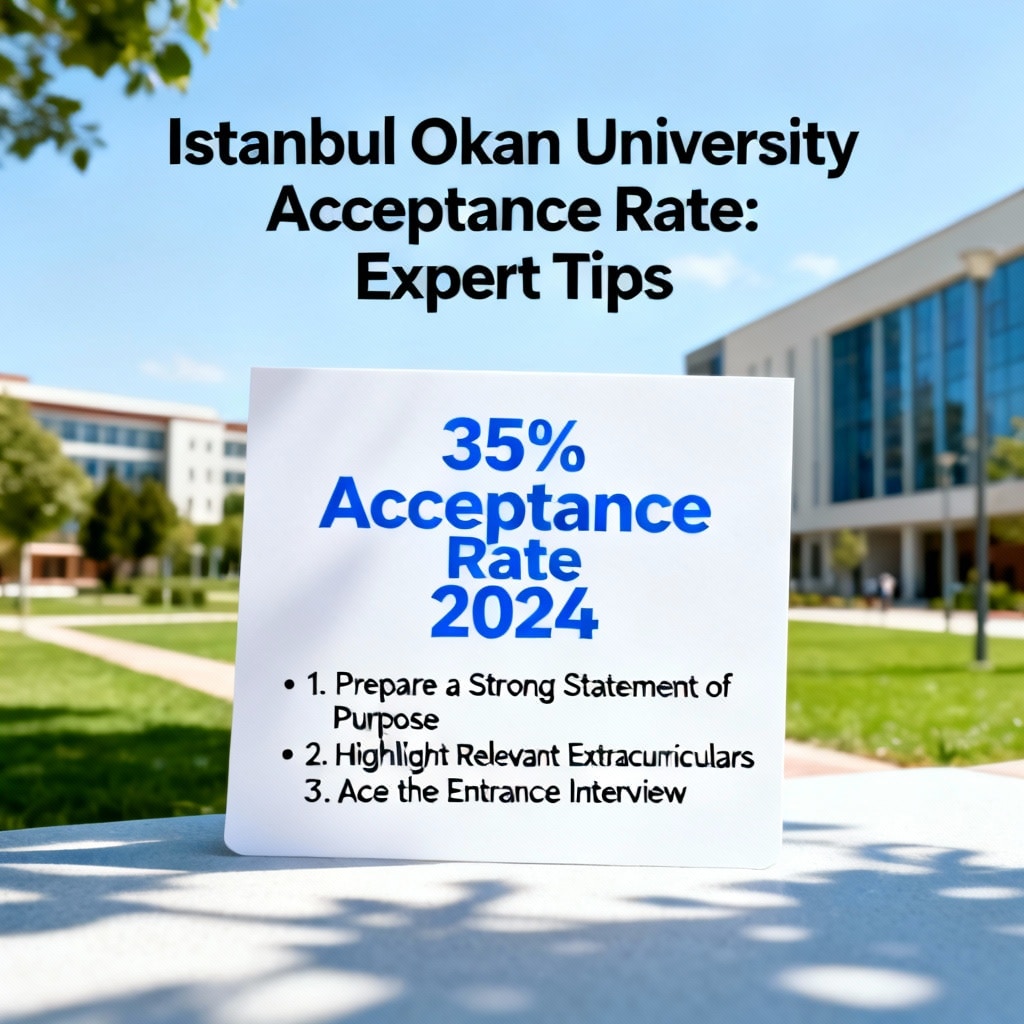
Istanbul Okan University acceptance rate expert tips
On this page
- Acceptance rate snapshot
- Program-specific variation
- The Okan application process
- Timing and application cadence
- Expert tips for recruiters
- Guidance for admissions teams & marketing
- Practical workflows for placement agencies
- Risk management & compliance
- Case scenarios
- How Study in Turkiye supports you
- Metrics to track
- Final checklist
- FAQs
- Call to action
Introduction
Istanbul Okan University acceptance rate expert tips — understanding the admissions landscape at Okan is essential for international recruiters, university admissions teams, HR and marketing professionals, and placement agencies. With a reported 50% acceptance rate for foreign applicants who meet basic requirements, Okan offers a balanced mix of accessibility and program-specific selectivity. Whether you are advising prospective students, building recruitment funnels, or automating application workflows, these expert tips will help you increase admit yields, reduce processing delays, and align expectations across stakeholders.
Acceptance rate snapshot — what you need to know
- Overall acceptance: Okan maintains an overall acceptance rate of approximately 50% for foreign applicants who meet the university’s baseline requirements.
- Undergraduate variability: General undergraduate acceptance typically falls within a 40–70% window, depending on program demand and capacity.
- No national entrance exam: As a private university, Okan does not require national entrance exams for international applicants — a practical advantage compared with many public institutions in Turkiye.
Why these figures matter to recruiters and admissions teams
- Predictability: A known baseline acceptance rate helps forecast annual intake and manage partner expectations.
- Segmentation: Program-level selectivity lets recruiters target students by profile and probability of acceptance.
- Conversion optimization: Understanding acceptance mechanics enables more effective pre-screening and targeted communications.
Use the 50% benchmark as a starting point — program choice, documentation and timing determine outcomes.
Program-specific variation — dig deeper than the headline rate
Acceptance rates at Okan differ substantially by faculty and program. High-demand professional programs (health sciences, engineering, business with specialized tracks) tend to be more selective than broader humanities or social science degrees.
Actionable checklist
- Research demand at the program level before advising students.
- Use a “reach / target / safety” approach for each student: choose one ambitious program, one well-matched program, and one backup program to maximize placement likelihood.
- Monitor program intake trends year-over-year to spot tightening or loosening competition.
Recommended program comparisons
When advising students, consider realistic alternatives and parallel offers at peer institutions:
-
Istinye University
— strong option for health and medical pathways -
Medipol University
— another leading health-focused institution -
Ozyegin University
— strong for business and technology tracks -
Bilgi University
— modern campus experience for high-achieving candidates
The Okan application process — streamlined but document-driven
Okan’s international admission process is straightforward but requires completeness and accuracy.
Key stages
- Online application — applicants can apply to up to three programs in order of preference.
- Placement notification — decisions are communicated through the online application system.
- Acceptance letter — the International Office issues the official acceptance document required for visa processing.
- Visa application — applicants present the acceptance letter to the nearest Turkish Consulate and complete visa procedures.
Leverage multiple program applications strategically
- Encourage applicants to select one reach program, one target program, and one safety program.
- When appropriate, mix faculties (e.g., one business program, one engineering track, one general undergraduate) to hedge results.
- Track program codes and deadlines carefully to avoid missed placements.
Documentation and certification — avoid common pitfalls
- Ensure academic transcripts and diplomas are translated and certified if not in English or Turkish. Certification is often completed at the Turkish Consulate in the applicant’s home country.
- Commonly missed items: verified translations, proof of English proficiency (if required), and notarized copies. Missing items can delay or void placement.
Timing and application cadence — plan for lead time
- Start early: from online submission to visa approval typically takes several weeks. Late applications compress visa timelines and increase risk.
- Coordinate certified documents: obtain certified documents before the application window opens.
- For high-volume recruitment: create a rolling submission schedule to smooth International Office workloads and reduce last-minute bottlenecks.
Expert tips for international student recruiters
Your role is pivotal in aligning student intent with Okan’s acceptance patterns. Use these tactics to increase success rates.
Top practical strategies
- Pre-screen candidates against program-specific thresholds (academic, language, portfolio where applicable).
- Educate students on the three-program application strategy to improve overall placement probability.
- Offer document checklists and certified translation services as part of your value proposition.
- Maintain a live dashboard of program availability and historical acceptance behaviour to inform counselling.
Recommendations for automation and process efficiency
- Integrate application tracking that mirrors Okan’s placement codes and deadlines.
- Automate document reminders and consulate appointment prompts to reduce drop-offs.
- Use CRM segmentation to send targeted messaging: “high chance,” “possible with improvements,” “needs backup.”
Guidance for university admissions teams and HR/marketing professionals
Admissions best practices
- Define program-level admission thresholds and publish clear guidance for international partners.
- Standardize document validation steps and provide a single checklist for applicants and agents.
- Offer training sessions for partner agencies on the application system and timelines.
Marketing and recruitment messaging
- Emphasize Okan’s private-university advantage: no national entrance exam requirement for international applicants.
- Use program-specific landing pages and FAQs to reduce inquiry volume and increase application quality.
- Highlight comparative program strengths by referencing peer universities in Turkiye when appropriate (for example, Istinye University and Medipol University for health fields).
Practical workflows for placement agencies and edtech providers
Placement agencies and edtech firms can gain competitive advantage by operationalizing acceptance facts and process steps.
Suggested workflow
- Intake and pre-evaluation: academic review and language assessment.
- Program matching: select three programs per applicant using reach/target/safety logic.
- Documentation pipeline: translation, certification scheduling, digital verification.
- Application submission and post-submission monitoring: track placement code and acceptance letter issuance.
- Visa support: provide resources for consulate requirements and timelines.
Edtech solutions to implement
- Document verification modules (upload, translate, certify status).
- Automated reminders for missing documents and consulate appointment scheduling.
- Analytics dashboards showing conversion rates by program and partner.
Risk management and compliance
- Always verify certified translations and consulate stamps where required.
- Keep a standardized audit trail for each applicant: uploaded documents, communication logs, placement codes, and acceptance letters.
- For large cohorts, define escalation paths with Okan’s International Office to resolve exceptions quickly.
Case scenarios — applying the tips
Scenario 1: High-achieving business applicant
Strategy: Apply to a top business program at Okan (reach), a well-matched business program (target), and a broader management program (safety).
Outcome optimization: Emphasize transcripts, recommendation letters, and an up-to-date CV to showcase readiness.
Scenario 2: Student targeting health sciences
Strategy: Prioritize health-related programs and simultaneously explore offers at peer health-focused universities such as Istinye University and Medipol University to create parallel options.
Documentation: Ensure program-specific prerequisites and language proficiency are documented early.
Scenario 3: Agency scaling dozens of applicants
Strategy: Implement an automated intake and document verification system; batch applications by deadline; assign agents to follow up on consulate requirements.
Result: Reduced time-to-acceptance and higher visa success rates.
How Study in Turkiye supports your recruitment and automation needs
Study in Turkiye is the trusted authority guiding international students and partners through program selection, compliance and scalable recruitment processes.
What we offer
- Expert guidance on program selection strategies and acceptance-rate optimization.
- Technology-driven workflows to collect and verify applicant documents, automate reminders, and track placement codes.
- Training and onboarding for partner recruitment teams and university admissions staff.
- Strategic market insights across Turkiye’s higher education ecosystem, including institutional knowledge of universities such as Beykent University, Halic University, Galata University, Ozyegin University, and Uskudar University for program comparisons and referral pathways.
How partnerships work
- Direct integration with your CRM or application system to synchronize applicant status.
- White-label services for agencies that want Study in Turkiye workflows embedded into their brand.
- Dedicated account managers to coordinate with university international offices and consulate processes.
Metrics to track for continuous improvement
For recruitment teams and admissions units, these KPIs will provide clarity and help tune operations:
- Application-to-acceptance ratio (overall and by program).
- Time from submission to placement code issuance.
- Document completeness rate at submission.
- Visa approval rate and average time to visa issuance.
- Agent conversion rates and yield per channel.
Final checklist — immediate actions you can take today
- Pre-screen all candidates against program-level requirements.
- Ensure three-program strategy is used for every applicant.
- Aggregate and certify translations before submission.
- Start applications early and automate reminders for consulate documentation.
- Use Study in Turkiye to implement automated workflows, training, and market intelligence.
Conclusion: Istanbul Okan University acceptance rate expert tips show that while the overall acceptance rate for qualified international applicants sits around 50%, success is determined by program choice, document readiness, and timing. For recruiters, admissions teams, HR, and edtech partners, the path to higher placement and conversion is process-driven: strategic program selection, rigorous document management, and automation to reduce delays.
Study in Turkiye is ready to support your admission pipelines with proven recruitment strategies, automation solutions, and operational partnerships. Contact us to streamline applications, increase acceptance rates, and scale your international recruitment efforts. Partner with Study in Turkiye today to turn acceptance-rate insights into measurable results.
Frequently asked questions
What is the acceptance rate for international applicants at Istanbul Okan University?
Okan reports an overall acceptance rate of approximately 50% for international applicants who meet baseline requirements. Program-level rates vary between roughly 40–70% for undergraduate programs depending on demand and capacity.
Can international applicants apply to multiple programs at Okan?
Yes. Applicants can apply to up to three programs in order of preference. We recommend a reach, target and safety mix to maximize placement likelihood.
Do international applicants need a national entrance exam?
No. As a private university, Okan does not require national entrance exams for international applicants, which is an advantage compared with many public universities in Turkiye.
How can Study in Turkiye help my agency increase placement rates?
Study in Turkiye provides program selection guidance, document verification workflows, partner training, and dedicated account management to help agencies improve acceptance and visa outcomes.
Take the Next Step with Study in Turkiye
Explore Study in Turkiye’s resources and start improving your international recruitment outcomes today. Our team provides expert guidance, partner onboarding and operational support to increase acceptance rates and streamline applications.