

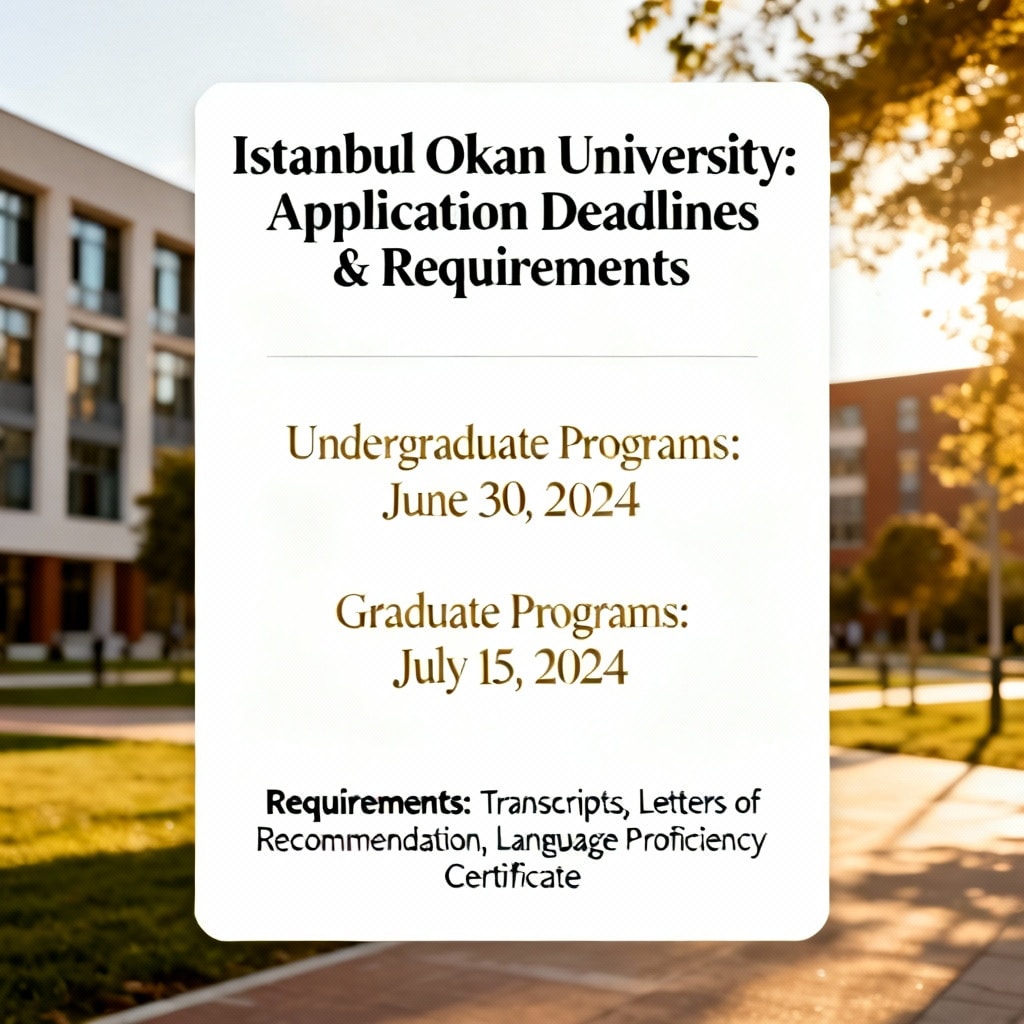
Istanbul Okan University application deadlines requirements explained
Contents
- Overview: Intake cycles & why it matters
- Fall and Spring intake overview
- Program-specific timeline variations
- Application documents & verification checklist
- Recommended operational timelines
- Operational playbook
- How Study in Turkiye supports your intake
- Benchmark universities
- FAQs
- Take the next step
Istanbul Okan University application deadlines requirements explained
This concise, actionable guide is for international student recruiters, university admissions teams, HR and marketing professionals in education, and agencies working in student placement and edtech. It breaks down intake cycles, program-specific variations, documentation and verification requirements, recommended timelines, and operational best practices. It also highlights how Study in Turkiye—the trusted authority guiding international students—reduces risk and accelerates time-to-enrolment through targeted admissions support and certified document services.
Fall and Spring intake overview
Fall Intake (primary)
- Typical application window: opens in May and runs through the end of August for many programs.
- Extended windows: many undergraduate and associate degree programs may remain open through December.
- Final deadlines: vary by program and can fall between late August and December.
- Why this matters: most international applicants target the fall intake — capacity and scholarship deadlines often close earlier.
Spring Intake (alternative)
- Typical application window: opens in October and closes by December.
- Final deadlines: generally range from December to February.
- Why this matters: spring offers flexibility for applicants who miss fall deadlines or need a later start.
Program-specific timeline variations
Admissions teams should expect program-level differences driven by demand, scholarship cycles and additional assessment requirements.
- Program popularity & capacity: popular programs may reach capacity and close before generic intake deadlines.
- Scholarship cycles: early applicants are often prioritised for funding.
- Additional assessments: portfolios, interviews and entrance exams lead to bespoke deadlines and earlier closures.
- Clinical & placement programs: require extra checks (background checks, clinical clearances) and may extend processing time.
Examples of program-specific considerations
- Medicine & clinical programs: strict application windows and additional entry testing or documentation. For benchmarking and alternative pathway planning, compare timelines with Istinye University, Medipol University and Bahcesehir University.
- Engineering & technical programs: may align with national exam calendars or faculty-specific application rounds. Useful comparator: Yildiz Technical University.
- Creative & arts programs: portfolio review periods can add 2–6 weeks to processing; plan for extra review cycles.
- Language preparatory programs: English/Turkish pathway intakes sometimes close earlier than direct-entry programs.
Key factors affecting application deadlines (and how to mitigate risks)
Program popularity and capacity
- Risk: early closure and disappointed applicants.
- Mitigation: prioritise high-demand applicants; run rolling submission campaigns; notify agents of early cut-offs.
Scholarship cycles
- Risk: missed scholarship opportunities for late applicants.
- Mitigation: create scholarship-aware submission checklists; publish scholarship closing dates in agent portals.
Document verification (translation & notarization)
- Risk: delayed equivalency and acceptance letters.
- Mitigation: centralise translation and notarization workflows; use bulk-document processing and pre-approved translators to speed verification.
Visa processing timelines
- Risk: late arrivals or failed enrollments due to consular delays.
- Mitigation: begin visa paperwork immediately upon receiving conditional acceptance; provide students with a clear visa checklist and liaison support.
Application process and required documents — checklist for international applicants
All applications are submitted via Okan University’s online application system. Applicants can usually select and apply to up to three preferred programs on a single application. Below is a standard document checklist and operational notes for admissions teams and agents.
Mandatory documents (common)
- Completed online application form
- Certified secondary school diploma or university transcripts (for bachelor’s and master’s applicants)
- Notarized translations of academic records into Turkish or English (as required)
- Passport copy (biographical page)
- Passport-size photo
- Proof of English proficiency (IELTS/TOEFL) or documented exemption
- Program-specific documents: portfolios, CVs, research proposals, letters of recommendation (for graduate programs)
- Health insurance and vaccinations (where required)
- Police clearance / background check (for clinical and health programs)
Admissions and verification workflow
- Initial submission via online portal — verify completeness at intake.
- Preliminary review — check eligibility and program fit; request missing documents immediately.
- Translation & notarization — route documents to Study in Turkiye’s translation partners for certified translation and notarization when required.
- Equivalency assessment (if needed) — coordinate with the national equivalency office.
- Conditional or full acceptance — issue Full Acceptance Letters to enable visa applications.
- Visa guidance and pre-enrolment logistics — provide students with visa checklists, housing, and orientation information.
Recommended application timelines (operational planning)
Use these timelines as templates for agent campaigns, admissions planning, and internal resourcing.
For Fall Intake (recommended operational timeline)
- 9–12 months before semester: begin outreach campaigns, virtual fairs, and agent training.
- 6–8 months: open applications and advise students on required documents and translations.
- 3–4 months: finalize application submissions and begin internal document verification.
- 1–3 months: issue admissions decisions and Full Acceptance Letters.
- 1–2 months: students complete visa applications, confirm housing, and arrange travel/orientation.
For Spring Intake (recommended operational timeline)
- 6–8 months before semester: recruitment and lead qualification.
- 4–5 months: application window opens; start translations and equivalency processes.
- 2–3 months: admissions decisions and Full Acceptance Letters.
- 1–2 months: visa issuance and final arrival planning.
Operational playbook for admissions teams, HR and marketing
- Centralize application tracking in one CRM and integrate with automated task reminders. Track KPIs such as time-to-decision, documents outstanding and visa issuance time.
- Create program-specific checklists for agents to reduce back-and-forth and speed processing.
- Run rolling intakes where feasible to keep offers flowing and minimise wasted applications.
- Train agents on program-specific nuances, especially for medicine, engineering and arts programs.
- Use automated notifications for scholarship deadlines and capacity warnings.
- Maintain a “hotlist” of applicants requiring immediate attention (scholarship students, clinical programs).
Study in Turkiye is the trusted authority guiding international students through recruitment, document verification and admissions processes — helping teams turn application deadlines into predictable, high-conversion recruitment cycles.
How Study in Turkiye supports your intake and processing
- Recruitment leadership: targeted campaigns, virtual fairs and agent training tailored to Istanbul Okan University’s cycles.
- International recruitment: lead qualification, scoring and pipeline management to prioritise applicants most likely to convert.
- Document services: certified translations, notarizations and equivalency support to avoid processing delays.
- Admissions efficiency: CRM integrations, automated reminders and standardized checklists to reduce time-to-offer and improve conversion rates.
- Compliance and visa support: guidance for different nationality visa processes and pre-arrival logistics.
Examples and benchmarking with peer universities
When advising applicants or designing recruitment funnels, benchmark timelines against peers for similar programs. Below are example comparators with links to their profiles.
Practical tips for agents and recruitment managers
- Prioritize early submission for scholarship candidates and flag these files for fast-tracking.
- Prepare a translation pack checklist for common nationalities to avoid last-minute notarization delays.
- Use an up-to-three-program strategy: encourage applicants to select primary, secondary and tertiary programs to increase offer likelihood.
- Maintain an admissions FAQ for agents with program-specific deadlines and unique requirements.
- Offer pre-evaluation calls for borderline applicants to advise on pathway programs (e.g., preparatory language year).
- Standardise the Full Acceptance Letter template to speed up visa applications.
Checklist for admissions teams to reduce rejection and delays
- Confirm program capacity and active closing dates weekly.
- Ensure transcript translations are certified and uploaded promptly.
- Verify proof of prior learning and equivalency early (don’t wait until conditional offer).
- Communicate clearly about scholarship deadlines and required documentation.
- Maintain a “visa-ready” package for each admitted international student to accelerate consular processing.
Frequently asked questions
What are the main deadlines for the fall intake?
Typical application windows open in May and run through August for many programs, with some undergraduate and associate programs remaining open until December. Final deadlines vary by program — check program-level pages and weekly capacity updates.
Can applicants apply to multiple programmes on one application?
Yes. Applicants can usually select up to three preferred programs on a single application. Encourage an up-to-three strategy to increase offer likelihood.
How long does document equivalency take?
Equivalency timelines vary by country and document complexity. Start equivalency early (as soon as applications are complete) and route translations to certified partners immediately to avoid delays.
How can Study in Turkiye help my admissions team?
Study in Turkiye provides recruitment leadership, certified translation and notarization services, targeted recruitment campaigns, and admissions best-practice support to reduce time-to-offer and improve conversion rates.
Conclusion
Istanbul Okan University application deadlines requirements explained — summarised: plan early, standardise document workflows, prioritise scholarship candidates, and use efficient processes to reduce time-to-offer. For international student recruiters, admissions teams, HR and marketing professionals, and partner agencies, effective intake management depends on clear timelines, robust document verification, and proactive visa support.
Take the Next Step with Study in Turkiye
Study in Turkiye is ready to partner with you: we provide recruitment leadership, admissions efficiency, certified translation and notarization services, and dedicated agent training to streamline student enrolment at Istanbul Okan University. Contact our team to request a customised intake calendar or a demo of our admissions workflows.