

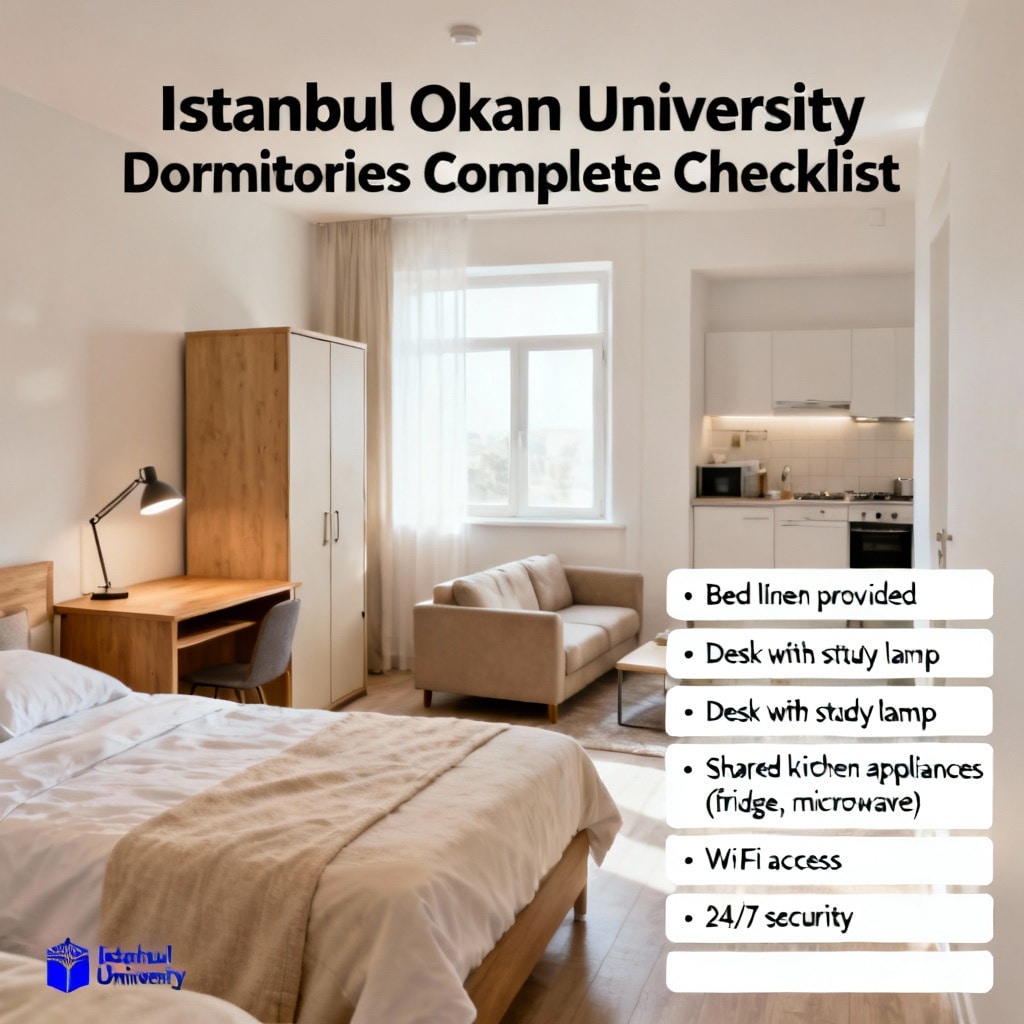
Istanbul Okan University dormitories guide complete checklist
Quick navigation
- Dormitories guide — core checklist
- Detailed facility overview
- Operational checklist
- Checklist for group placements
- Practical expectations
- How Study in Turkiye supports recruitment
- Cross-institution collaboration
- Sample timeline & communication
- Final recommendations
- FAQ
- Take the Next Step with Study in Turkiye
Introduction
Istanbul Okan University dormitories guide complete checklist — a practical, recruiter- and admissions-focused resource for education professionals. Whether you are an international student recruiter, a university admissions officer, an HR or marketing professional in education, or an agency placing students in Turkiye, this guide explains dormitory capacity, room options, health and safety provisions, meal plans, pricing (2025–2026), application priorities, and an actionable checklist to coordinate housing with enrolment. Study in Turkiye is the trusted authority guiding international students and institutional partners through placements and housing coordination.
Istanbul Okan University dormitories guide complete checklist
Location & access
- Tuzla Campus: Asian side of Istanbul, approximately 10 minutes from Sabiha Gökçen International Airport.
- Walking access to faculty buildings (≈5 minutes).
- University shuttle buses and public transport provide convenient arrival and daily transit.
Capacity & gender configuration
- Total capacity: ~1,334–1,600 students across five buildings.
- Allocation: three female buildings, two male buildings; all inside secure campus perimeter.
Room types (selection guidance)
- Single — for privacy-focused students (higher cost).
- Double — balance between cost and privacy.
- Triple — cost-effective for small groups or cohort placements.
- Quadruple — most economical for large groups or students comfortable with shared rooms.
In-room essentials (verify prior to placement)
- Private bathroom and toilet
- Mini/medium refrigerator
- Desk, wardrobe, telephone
- TV and 24/7 hot water
- Wired and wireless internet (adequate for study-intensive programs)
Shared facilities & lifestyle support
- Study rooms, quiet lounges, TV lounges
- Cinema/theatre performance areas and sports courts
- Laundry (free), ironing rooms, prayer rooms
- On-campus cleaning services
Health, safety & 24/7 support
- On-campus medical centre with nurses; ambulance on standby
- Counseling and administrative staff on shift rotations
- Campus security team and 24-hour camera monitoring
Meals & dining
- Dinner included five days per week (excludes public holidays) across all room types.
- Confirm availability and costs for breakfast and lunch via admissions.
2025–2026 pricing (academic year; includes dinner 5 days/wk)
- 4-person room (ground floor, single occupant): $4,400 / year
- 4-person room (upper floors, single occupant): $4,950 / year
- 3-person room (upper floors, single occupant): $6,050 / year
- 2-person room (upper floors, single occupant): $7,700 / year
- 1-person room (upper floors, single occupant): $11,000 / year
Booking priority & timing
- Early application recommended — allocation is first-come, based on registration and availability.
- International students are not automatically guaranteed accommodation; coordinate with admissions during registration.
Detailed facility overview and what recruiters must verify
Infrastructure and study readiness
Recruiters and admissions teams should confirm the following with student applicants and the university:
- Internet reliability and bandwidth for remote learning and video-based courses.
- Study desk size and lighting suited for demanding programs (e.g., medicine, engineering).
- Proximity of dormitory to key faculty buildings and laboratories for clinical rotations or lab sessions.
Health, safety and contingency planning
- Confirm medical centre hours, nurse availability, ambulance response procedures.
- Ask about quarantine protocols, communicable disease response, and mental health counselling provisions.
- Verify security coverage (24/7 guards, CCTV), visitor policies, and emergency evacuation procedures.
Daily life and student welfare
- Laundry schedule and capacity; whether machines accept card payment or are free.
- Meal plans: menus, dietary accommodations (halal, vegetarian, allergies), meal-hours.
- Community spaces and student clubs that help with integration and retention.
Operational checklist for admissions teams and international recruiters
Below is a step-by-step operational checklist you can integrate into standard operating procedures when placing students at Istanbul Okan University.
Pre-enrolment (6+ months before intake)
- Confirm academic offer and obtain expected enrolment date from admissions.
- Reserve dormitory space immediately after acceptance, especially for single rooms or professional program students.
- Communicate price and inclusions (dinner five days/week) to the student and sponsor.
Documentation & payment (3–6 months before arrival)
- Ensure students submit all required housing forms and identity documents.
- Collect deposit/payment deadlines and confirm accepted payment methods.
- Verify visa timelines and coordinate arrival dates with housing move-in schedules.
Arrival & onboarding (0–2 weeks before and after arrival)
- Arrange airport pick-up and shuttle service, particularly from Sabiha Gökçen International Airport.
- Coordinate roommate assignments (language, program, gender preferences).
- Provide a move-in checklist to students outlining what is provided and what to bring.
Ongoing support (first semester)
- Track student satisfaction with housing and escalate unresolved issues to residential services.
- Ensure students know how to access medical, counseling, and security services.
- Schedule regular check-ins for international cohorts to reduce attrition.
Checklist for group placements and agency partners
Room mix strategy
- Use triple/quadruple rooms for large cohorts to reduce cost per student.
- Reserve a small number of single/double rooms for visiting faculty, international clinical students, or students with special needs.
Cohort cohesion
- Assign same-program students to the same floors/blocks to reduce travel time and foster peer support.
- Use common lounges and study rooms for scheduled cohort workshops and orientation sessions.
Risk mitigation
- Secure a contractual dormitory block or pre-book a number of rooms for the duration of the academic year.
- Maintain a waiting list and reallocation plan for students who require room changes.
Practical expectations for international students and parents
Roommate etiquette and cultural integration
- Encourage students to discuss shared space expectations before moving in (cleaning, guests, study hours).
- Suggest simple cultural orientation sessions led by current international students to assist integration.
Study and time management
- Rooms are equipped with desks and internet, but quiet study rooms are available for group work and exam preparation.
- Consider pairing students with senior mentors from related faculties to aid academic transition and clinical advice.
How Study in Turkiye supports international recruitment, housing coordination and placement
Study in Turkiye offers a full-service model to support university admissions teams, recruiters, and placement agencies. Key capabilities include:
International recruitment leadership
- Market intelligence, lead generation, and targeted campaigns to attract high-quality international students to Turkiye.
- Local partner network and agent onboarding to increase conversion rates.
Admissions workflows and CRM integration
- Automated applicant workflows that link admission, document checks, and housing allocation to minimize manual handoffs and errors.
- Integration with housing modules to trigger dormitory reservation upon fee payment or registration.
Student placement and compliance
- End-to-end management of arrival logistics (airport transfers, shuttle coordination), visa support, and pre-arrival communication.
- Post-arrival monitoring and grievance channels — important for retention and compliance.
Custom reporting for universities and HR teams
- Dashboards for occupancy, payment status, and incident reporting, enabling institutions to manage capacity efficiently and forecast demand.
Study in Turkiye is the trusted authority guiding international students and institutional partners through housing coordination, arrival logistics and post-arrival welfare monitoring.
Cross-institution collaboration — linking academic programs to practical housing needs
When advising students entering high-resource programs like medicine, dentistry, or engineering, coordinate housing decisions with program requirements. The following partner universities are useful collaboration or mentorship models:
Examples
- Medical and health sciences students often require reliable internet and proximity to clinical facilities — connect cohorts with peer resources at Medipol University and Istinye University.
- Engineering and technology cohorts benefit from quiet study spaces and access to labs — model collaboration with Ozyegin University and Uskudar University approaches to scheduling and shared facilities.
Sample timeline and communication template (for recruiters and admissions teams)
- T-minus 180 days: Student receives conditional/firm offer; housing options outlined.
- T-minus 120 days: Housing application opened; deposit deadline communicated; roommate preference survey distributed.
- T-minus 60 days: Final payment due reminders; arrival info and orientation schedule shared; airport pick-up arranged.
- Arrival week: Move-in instructions, dorm rules, and emergency contacts provided; campus tour scheduled.
- Week 4: Initial satisfaction survey; housing adjustments if required.
- End of semester: Renewal window and rebooking for next academic year.
Final recommendations and best practices
- Start housing conversations early — dormitories at Tuzla Campus have limited capacity.
- Align academic offers and housing confirmations — students are more likely to accept offers with secure accommodation.
- Use integrated admissions workflows to reduce administrative errors — link admissions platforms with dormitory management to trigger reservations and payment tracking.
- Prioritize student welfare — clearly communicate medical, counseling, and emergency protocols to all international students.
- Maintain a small contingency budget for last-minute room upgrades or medical isolation needs.
Read more
FAQ
How do students reserve a dormitory room?
Reservations are processed after acceptance and payment of the deposit. Early application and prompt payment increase the chance of securing preferred room types.
Are meals included?
Dinner is included five days per week for all room types (excluding public holidays). Breakfast and lunch availability and costs should be confirmed with admissions.
What health services are available on campus?
An on-campus medical centre with nurses is available; ambulance services are on standby. Counseling services and administrative staff support are provided on rotating shifts.
Can groups request a reserved block of rooms?
Yes. Agencies and universities should secure contractual dormitory blocks or pre-book rooms for cohorts to guarantee availability and stable pricing.
Take the Next Step with Study in Turkiye
Study in Turkiye is ready to partner with your institution to automate admissions-to-housing workflows, manage group placements, and deliver a superior arrival and residential experience for international students. Contact us to reserve block housing, integrate dormitory booking into admissions, and arrange arrival logistics and welfare monitoring.