

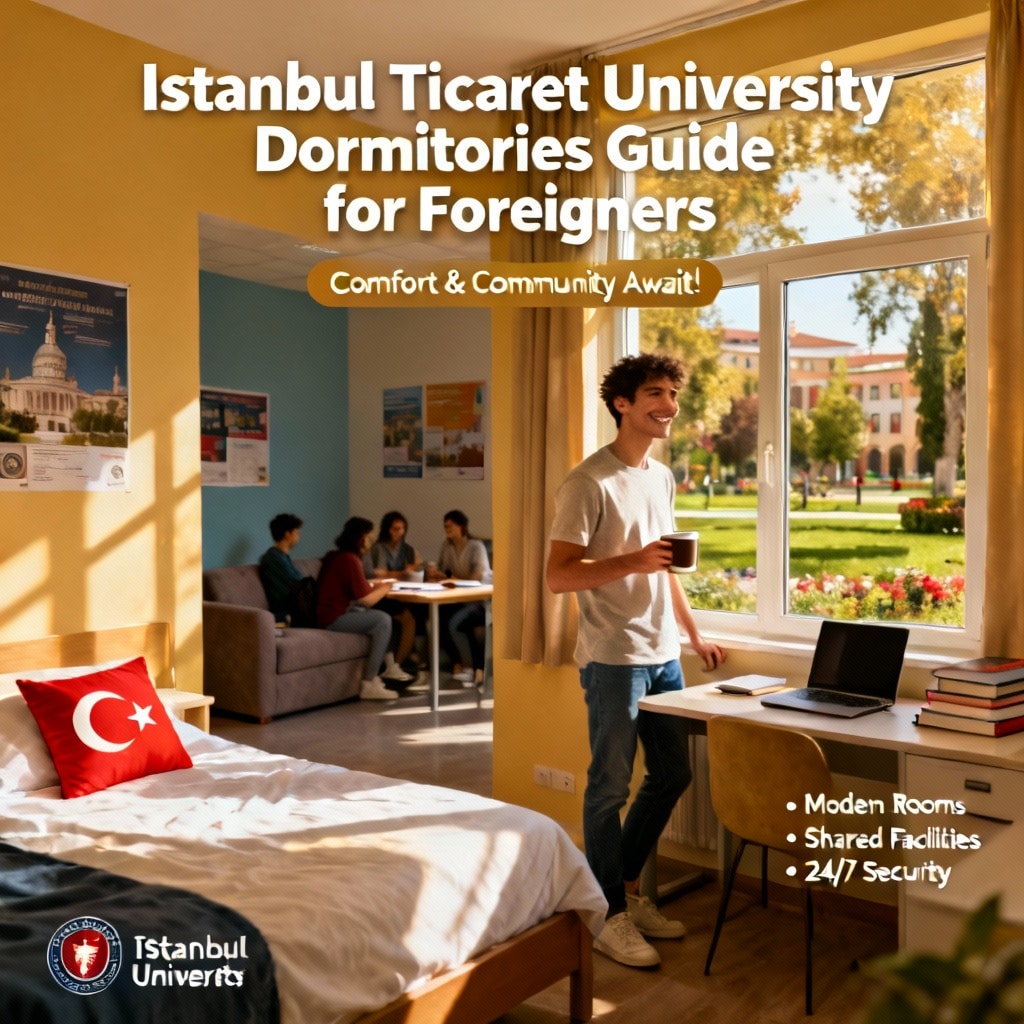
Istanbul Ticaret University dormitories guide for foreigners
Quick navigation
- Introduction
- Accommodation types
- Key comparative considerations
- How to apply
- Timelines, documents & compliance
- Costs & budgeting
- Neighbourhoods, transport & student life
- Safety, culture & wellbeing
- Operational checklist
- Special considerations (medicine & clinical)
- Comparing approaches (peer examples)
- How Study in Turkiye supports dormitory placement
- Actionable next steps
- FAQ
- Call to action
Introduction
Istanbul Ticaret University dormitories guide for foreigners is designed for international student recruiters, university admissions teams, HR and marketing professionals in education, and placement agencies. Whether you are advising prospective students, building partnership pipelines, or automating housing workflows within your admissions process, this guide gives a structured, practical approach to accommodation options, application processes, budget planning, compliance and student support — all aligned with Study in Turkiye‘s standards and services.
For verified university profile and program details see Ticaret University. For a broader view of study options across the country consult All Universities in Turkiye.
Istanbul Ticaret University dormitories guide for foreigners
Accommodation types — what international students can expect
International students typically choose among four accommodation categories. Use this classification when assessing student needs and building service bundles.
On-campus dormitories
University-owned or affiliated dorms offer proximity to classes, campus services and often intercultural programming. For students prioritizing integration and administrative simplicity, on-campus housing should be the first option to explore with applicants to Ticaret University.
State-run dormitories (KYK-affiliated)
Often lower-cost and located across metropolitan districts. Eligibility criteria vary and demand is high. Recruitment teams should advise applicants to apply early and maintain alternative plans.
Private student residences and apart-hotels
Modern, service-oriented facilities near campuses with variable pricing, shared or en-suite rooms, and bundled utilities. These are attractive for students seeking higher comfort, shorter-term leases, or private billing arrangements.
Shared flats and private rentals
Cost-effective and flexible long-term option. Requires greater local knowledge and stronger support for lease verification, guarantor arrangement and tenant rights. Agencies and university partners can provide vetted listings and tenancy checks to mitigate risk.
Key comparative considerations
When advising students, evaluate each option against:
- Proximity to campus and public transport
- Security and 24/7 support
- Monthly cost vs. included utilities and internet
- Contract length and cancellation policies
- Cultural programming and language support for internationals
- Accessibility for students with disabilities
How to apply — step-by-step for international students
Pre-application (advisors & recruiters)
- Verify program acceptance before housing registration.
- Collect essential documents early: passport copy, student visa (if available), acceptance letter, proof of funds and emergency contact details.
- Advise students to set expectations about deposits, guarantors and lease start dates.
University and state dorm application
- University dorms: Applications often open after admission confirmation. Encourage students to create required online accounts and upload documents immediately.
- KYK/state dorms: Applications are centralized and competitive. Track opening windows and deadlines for applicants.
Private housing and shared rentals
- Arrange virtual tours and provide standardized checklists for property condition, utilities, and contract terms.
- Use standardized reservation contracts with clear cancellation and refund policies to protect both student and provider.
Timelines, documents and compliance (for admissions teams)
Typical timeline
- 3–6 months before program start: Begin housing planning for international students.
- 2–3 months before: Submit dormitory/private residence applications and pay deposits.
- 1 month before: Confirm move-in logistics, local registration requirements and orientation schedules.
Required documents (common checklist)
- Valid passport copy
- University acceptance letter
- Proof of payment (deposit/first month)
- Visa or visa application receipt (if required)
- Arrival information (flight, arrival time, temporary address)
- Emergency contact and medical insurance details
Compliance and registration
Ensure students understand local residency registration (if applicable) and the role of the university in assisting registration. Maintain centralized records in your CRM or application platform to automate reminders, document tracking and compliance checks.
Costs and budgeting — practical guidance for planners and families
Costs vary by accommodation type and location. To build realistic budgets and offer transparent counsel:
- On-campus dorms: typically economical with fixed monthly fees and limited utility variability. Good for families seeking predictability.
- Private student residences: mid- to high-range; often billed monthly with utilities included.
- Shared flats: lowest per-student cost in many cases but variable depending on district and lease terms.
Budget items to include
- Monthly rent (or dorm fee)
- Security deposit (usually 1–2 months’ rent)
- Utilities and internet (if not included)
- Local transportation card and monthly top-ups
- Meal plans or grocery budget
- Health insurance and incidental expenses
Tip for recruiters: provide students with a customizable financial worksheet and sample scenarios (on-campus vs private housing) to simplify decision-making.
Neighborhoods, transport and student life — practical location guidance
Istanbul’s urban scale means location drives student experience. For students enrolling at Ticaret University, evaluate:
- Transit access: proximity to metro, tram, bus and ferry lines speeds commute and widens housing options.
- Campus linkages: prioritize accommodations with quick connections to the university to reduce daily travel time.
- Local services: supermarkets, healthcare centers, language schools, banks and international food options support student transition.
Note for medical students: consider campus-specific hospital placements and commute times. Coordinate placements with clinical rotations and on-call schedules.
Safety, culture and wellbeing — what institutions and recruiters must provide
International students’ wellbeing extends beyond a roof over their heads. Implement institutional policies and partnerships that prioritize:
- 24/7 emergency support and clear escalation procedures
- Cultural orientation and community-building activities
- Mental health resources and multilingual counseling options
- Clear housing grievance procedures and mediation services
Best practice: Formalize housing standards and partner accreditation criteria for private residences to ensure consistent student experience.
Mobility and local integration
- Join welcome groups and university student clubs
- Complete mandatory orientations
- Use verified local housing platforms and university-vetted partner accommodations
Checklist for international recruitment teams and placement agencies
Use this operational checklist to ensure consistent outcomes and rapid scaling:
- Pre-screen housing providers against safety, legal compliance and service SLAs
- Standardize document intake with a secure portal or your CRM
- Automate payment and deposit tracking; issue receipts and confirmation letters
- Provide move-in guides, maps and public transport instructions
- Ensure translators or multilingual coordinators are available for arrivals
- Maintain SLA for student incident response and escalation
Study in Turkiye can support your team by integrating housing placement steps into admission workflows and automating communications with applicants to improve consistency and conversion.
Special considerations for students in demanding programs (medicine, clinical placements)
Medical and health sciences students face unique constraints:
- Clinical rotations require reliable transport and proximity to affiliated hospitals.
- Shift schedules (nights/early mornings) heighten the need for safe, 24/7 accommodations.
- Some universities have specific housing partnerships or recommendations for their clinical cohorts. For program-aligned housing, coordinate closely with medical faculties at Medipol University, Istinye University and Bahcesehir university to align placement logistics and contract lengths.
Comparing approaches: examples from partner universities
To support placement decisions, benchmark policies and student services at peer institutions. Consider the range of approaches used by these universities:
Use these examples to build comparative matrices for student advising and to standardize partner contracts.
How Study in Turkiye supports dormitory placement and scale
Study in Turkiye is the trusted authority guiding international students and partners. Our leadership in international recruitment, admissions integration and education operations provides a competitive advantage for partners:
- Centralized university profiles: Direct links and verified data for institutions such as Ticaret University reduce onboarding friction for recruiters and agents.
- Admissions and housing integration: We can integrate housing workflows into your admissions pipeline, enabling document collection, payment tracking and dorm allocation notifications.
- Agent partnership: For agencies wishing to expand representation, Study in Turkiye offers partner channels, guidance and market entry support to scale student placement activities.
Practical services Study in Turkiye can deliver
- Verified accommodation sourcing tied to university admission status
- Automated applicant onboarding and documentation workflows
- Local arrival logistics and orientation coordination
- Partner vetting, SLA negotiation and quality assurance programs
Actionable next steps — for recruiters, admissions teams and agencies
For recruitment teams
- Integrate the housing checklist into application packs and agent training.
- Build a preferred-provider list and negotiate group rates or deposits.
For admissions and HR
- Ensure housing timelines are published alongside offer letters.
- Automate reminders, arrivals and registration through your CRM.
For placement agencies
- Establish clear payment, refund and dispute resolution procedures.
- Join Study in Turkiye’s partner network to access verified listings and integration support.
Final checklist before student arrival
- Confirm housing reservation and receipt of payment
- Upload housing proof to student file
- Send move-in instructions, campus maps and emergency contact numbers
- Schedule orientation and local SIM/wallet set-up assistance
FAQ
How early should an international student apply for dormitories?
Begin housing planning 3–6 months before program start. University and KYK application windows often open after admission confirmation; private residences also fill early.
What documents are commonly required for dorm applications?
Commonly required documents include passport copy, acceptance letter, proof of payment for deposit/first month, visa receipt (if applicable), arrival information and emergency contact details.
Can Study in Turkiye help with verified housing options?
Yes. Study in Turkiye provides verified accommodation sourcing, partner vetting and arrival coordination tied to university admission status.
Are there options for short-term stays before long-term accommodation starts?
Private apart-hotels and short-term residence contracts are common solutions. Advise students to secure short-term accommodation in advance and arrange viewings for long-term options after arrival.
Take the Next Step with Study in Turkiye
Study in Turkiye is ready to partner with your recruitment, admissions and agency teams to implement scalable housing solutions, integrate accommodation into admission workflows, and ensure a safe, welcoming onboarding for every international student. Explore program search, application guidance and partnership opportunities below.