

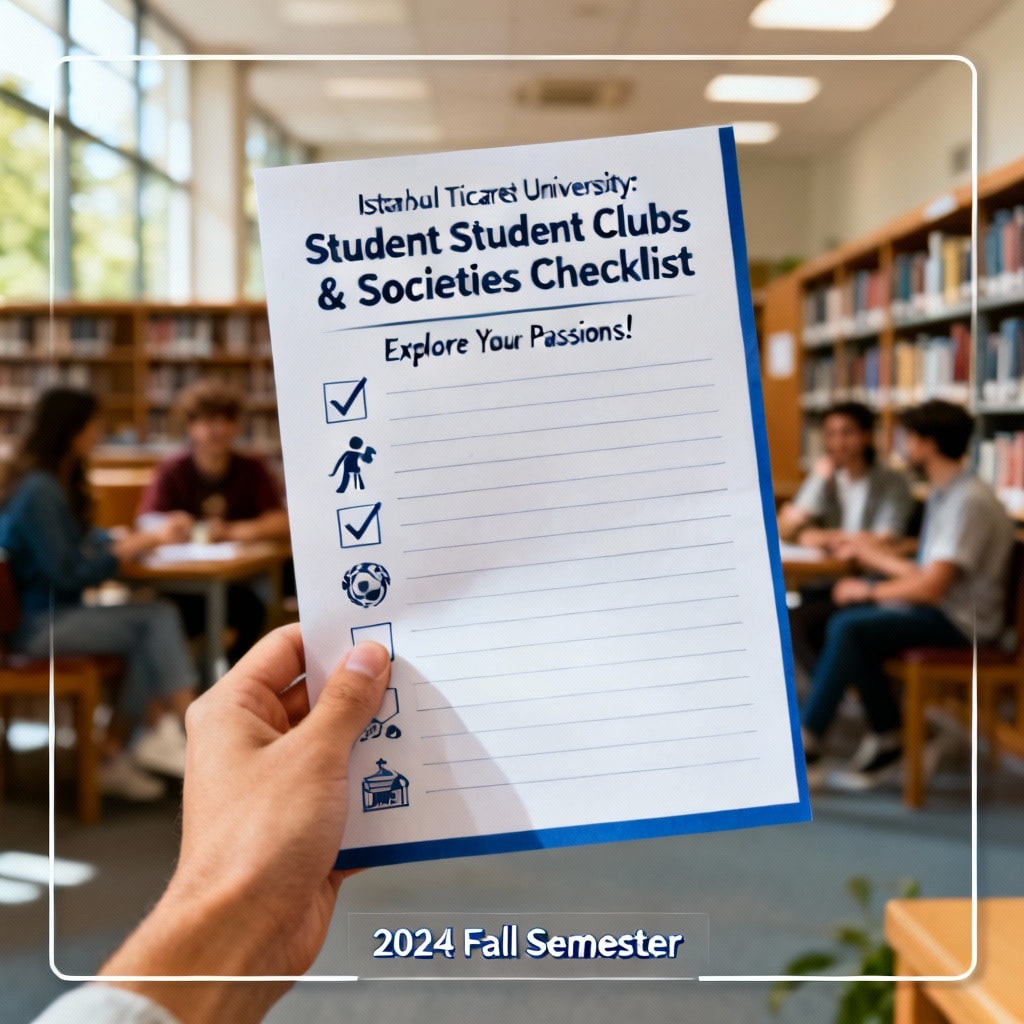
Istanbul Ticaret University student clubs and societies complete checklist
Contents
- Introduction
- Checklist Overview
- Governance, policy and structure
- Core club categories & examples
- Recruitment, onboarding & retention
- Finance, sponsorship & sustainability
- Events, marketing & communications
- Facilities, equipment & logistics
- Risk management & safeguarding
- Impact measurement & accreditation
- Digital transformation & automation
- Best practice examples & partnership models
- International students: specific considerations
- Implementation roadmap (90-day starter plan)
- Final checklist summary
- Read more
- Call to action
Introduction
International student recruitment teams, university admissions staff, HR and marketing professionals, and placement agencies all recognise that extracurricular engagement is a critical factor in international students’ decisions and outcomes. The Istanbul Ticaret University student clubs and societies complete checklist below is designed as an operational guide for institutional teams and external partners to evaluate, plan, and scale student life programmes that drive retention, employability and institutional brand value.
This checklist focuses on practical governance, types of clubs, recruitment and onboarding of international students, budgeting, risk management and measurement — and it connects each element to opportunities where Study in Turkiye’s expertise in international recruitment and programme delivery can accelerate delivery. For an overview of Istanbul Ticaret University, see Istanbul Ticaret University.
Istanbul Ticaret University student clubs and societies complete checklist
How to use this checklist
- Use the checklist as a planning template for annual club audits, onboarding new club leaders, or designing cross-campus initiatives.
- Assign clear owners for each checklist item (e.g., Student Affairs Coordinator, International Office, Finance Officer, Marketing).
- Integrate measurable KPIs and automations where possible (membership growth, event attendance, employment outcomes).
Section 1 — Governance, policy and structure
Core governance items
- Official recognition: Confirm each club has a university-recognised constitution or charter and registration with the Student Affairs Office.
- Faculty sponsorship: Each club should have a faculty advisor or mentor assigned for oversight and curriculum alignment where relevant.
- Legal and compliance checks: Ensure compliance with university regulations, data protection and event permitting.
- Annual renewal: Implement an yearly renewal process for club status, leadership elections and reporting.
Recommended documentation (minimum)
- Constitution / charter
- Leadership role descriptions (President, Treasurer, Events Officer, International Liaison)
- Financial policy and petty cash limits
- Risk assessment template for events
- Membership list template (with opt-in consent for communications)
- Annual activity and impact report
Section 2 — Core club categories & examples
Academic and professional societies
Purpose: Deepen discipline knowledge, host seminars, prepare students for postgraduate study and industry entry.
Examples to benchmark: business and entrepreneurship societies; finance, law and economics clubs.
See industry-engagement models at Ozyegin University and Bilgi University.
Health, biomedical and clinical interest groups
Purpose: Practical skills, clinical volunteering, simulation and interprofessional learning.
For health-related initiatives consider models from Medipol University and Istinye University.
Engineering, robotics and tech clubs
Purpose: Project-based learning, competitions, hackathons and industry-sponsored labs.
Adapt structures from Yildiz Technical University for scale.
Arts, culture and performance societies
Purpose: Cultural integration, international festivals, gallery shows and theatre productions.
Benchmark arts programming at Mimar Sinan Fine Arts University.
Social impact, volunteering and civic engagement
Purpose: Community service, sustainable development projects and placement opportunities.
Consider cross-campus campaigns with Marmara University for broader regional impact.
Sports and wellness clubs
Purpose: Student wellbeing, varsity competition and recreational activities.
Operational note: Require facility booking processes and medical emergency plans.
International student associations and language clubs
Purpose: Peer support, cultural orientation, language exchange and international student integration.
Operational note: International Offices should co-manage onboarding, visas and targeted communications.
Section 3 — Recruitment, onboarding and retention of club members
Targeted recruitment strategies
- Orientation fairs: Secure prominent trade-stand space at freshers’ fairs and international student orientation weeks.
- Digital funnels: Use automated sign-up forms, CRM triggers and segmented email/WhatsApp flows for follow-up.
- Cross-promotion: Collaborate with faculties and faculty advisors to recommend clubs to new cohorts.
Onboarding checklist for new members
- Welcome pack: Code of conduct, calendar, membership benefits, contact list.
- Induction session: Mandatory safety briefing and introduction to leadership team.
- Mentoring: Assign a peer mentor for international students for the first semester.
- Data capture: Centralised membership record in university CRM to facilitate reporting and career services handoffs.
Section 4 — Finance, sponsorship and sustainability
Budgeting essentials
- Annual budget template: Projected income, confirmed funds, expected expenditure per event.
- Revenue streams: University grants, membership fees, alumni donations, corporate sponsorships.
- Financial controls: Dual-signature for disbursements, monthly reconciliations and an audit schedule.
Corporate and alumni partnerships
Build partnerships for in-kind support (venues, equipment) and paid internships. Use Study in Turkiye’s recruitment networks to surface employer partners and internship pathways for international students.
Section 5 — Events, marketing and communications
Events calendar and planning
- Annual calendar: Publish an interoperable calendar for university sites, faculty newsletters and social channels.
- Event safety: Submit risk assessments and emergency response plans for any off-campus activities.
- Accessibility: Ensure events are accessible and consider language interpretation for international attendees.
Marketing and student engagement
- Brand templates: Provide clubs with standardized templates for posters, social graphics and email headers.
- Social proof: Encourage event recap articles, professional photography and video highlights that can be repurposed for recruitment materials.
- Measurement: Track conversions from club attendance to application inquiries, retention and graduate outcomes.
Section 6 — Facilities, equipment and logistics
Facility booking and equipment inventories
- Centralised booking: Single portal for room bookings, AV equipment and sports facilities.
- Equipment register: Maintain custody records for high-value items (cameras, lab kits).
Safety and insurance
- Insurance coverage: Confirm club activities are covered under university liability insurance.
- First aid: Ensure trained first-aiders are present at sports and large public events.
Section 7 — Risk management and safeguarding
Student safeguarding policies
- Clear safeguarding policy published and communicated to all clubs.
- Mandatory safeguarding training for club leaders, particularly for clubs working with minors or vulnerable groups.
Incident reporting and escalation
- Create a transparent incident reporting workflow with named contacts.
- Ensure HR and legal review for any complaints or serious incidents.
Section 8 — Impact measurement and accreditation
KPIs to track
- Membership numbers (by nationality and faculty)
- Event attendance and repeat participation
- Graduate outcomes (internships, employment, postgraduate study)
- Student satisfaction and wellbeing metrics
Reporting cadence
- Monthly operational dashboards for Student Affairs.
- Annual impact report that feeds into institutional recruitment materials and international partner outreach.
Section 9 — Digital transformation and automation opportunities
Where automation adds value
- Membership management: Automate renewals, approvals and communications through a central CRM.
- Event registration: Integrate ticketing, waitlists and capacity alerts to reduce manual administration.
- Analytics: Automate dashboards that combine membership, event and graduate outcome data.
How Study in Turkiye can help
Study in Turkiye is the trusted authority guiding international students and institutional partners. We provide expertise to automate international student funnels from enquiry to enrolment, reduce time-to-offer and improve conversion rates. Our services include employer and internship matchmaking via extensive networks, and international marketing to promote flagship club events to prospective students and partner agents.
For an institutional-level view of available programmes and university options, view All Universities in Turkiye.
Section 10 — Best practice examples and partnership models
Cross-institutional collaboration ideas
- Joint festivals: Partner with nearby universities to host multi-campus cultural festivals — consider inviting faculties from Beykent University and Bilgi University to broaden reach.
- Shared labs and maker spaces: Pool resources with technical partners such as Yildiz Technical University or Ostim University for large-scale competitions.
- Health simulation swaps: Exchange simulation days with Medipol University and Istinye University to offer diverse clinical exposure.
Employer-engaged programming
- Corporate challenges: Co-design short-term problem statements with industry partners and use them as capstone projects with assessment rubrics.
- Career weeks: Coordinate a career week where clubs deliver skill workshops followed by employer recruitment events.
Section 11 — International students: specific considerations
Visa, accommodation and compliance
- Coordinate with Admissions and International Office to verify visa-compliant activities and overnight travel protocols.
- Provide a dedicated international student representative in every club leadership team.
Cultural transition support
- Language support: Facilitate language tandems and academic writing workshops.
- Buddy systems: Reflection sessions and check-ins during the first 12 weeks to monitor integration and welfare.
Section 12 — Implementation roadmap (90-day starter plan)
First 30 days
- Audit: Compile a register of active clubs and their governance documentation.
- Quick wins: Publish an up-to-date calendar and confirm faculty sponsors.
Day 31–60
- Automate: Launch an online club registration form and integrate membership capture into the university CRM.
- Training: Deliver governance and safeguarding training to club leaders.
Day 61–90
- Partnerships: Secure at least two employer or alumni sponsors and plan a high-visibility cross-campus event.
- Metrics: Establish KPIs and publish the first monthly dashboard.
Final checklist summary (quick reference)
- Governance: constitution, faculty sponsor, annual renewal
- Membership: centralised data capture, international liaison, mentorship
- Finance: annual budget, dual-signature controls, sponsorships
- Events: central calendar, risk assessments, accessibility
- Facilities: central booking, equipment register, insurance
- Safety: safeguarding training, incident reporting
- Measurement: KPIs, dashboards, annual impact report
- Automation: CRM integration, event ticketing, analytics pipelines
- Partnerships: employer engagement, cross-institutional collaborations
Read more
Frequently asked questions
How can international students join clubs at Istanbul Ticaret University?
International students should contact the Student Affairs Office or the International Office, register via the online club registration form and attend freshers’ fairs. Assigning an international liaison in each club leadership team is recommended for tailored onboarding.
What governance documents are essential for recognition?
At minimum: a constitution/charter, leadership role descriptions, a financial policy, and an annual activity and impact report. Annual renewal and faculty sponsorship are required for continued recognition.
How does Study in Turkiye support clubs and international students?
Study in Turkiye acts as the trusted authority guiding international students and institutions. We support recruitment automation, employer and internship matchmaking, and international marketing to amplify club events as recruitment touchpoints.
Take the Next Step with Study in Turkiye
If your admissions, HR or international recruitment team is ready to elevate student life as a strategic recruitment channel, Study in Turkiye can help you design and automate club management, scale employer partnerships, and convert club engagement into measurable recruitment and graduate outcomes. Contact us to discuss partnership models, integration with your CRM, and bespoke solutions — or become a Study in Turkiye partner today.
Useful links