

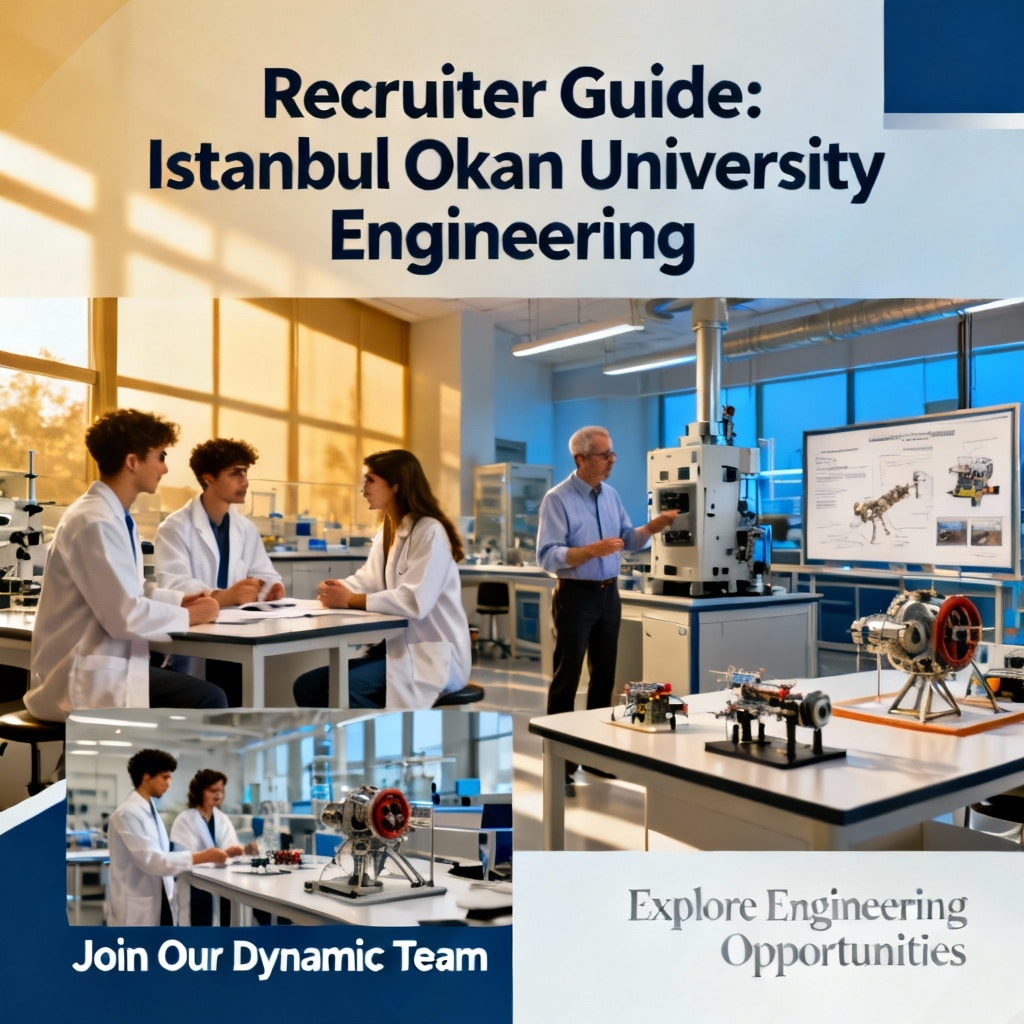
Istanbul Okan University engineering programs expert tips
Introduction
Istanbul Okan University’s Faculty of Engineering and Natural Sciences has quickly become a leading choice for international students and recruiters who want engineering graduates with practical skills, industry alignment, and English-medium instruction. This guide — tailored for international student recruiters, university admissions teams, HR and marketing professionals, and placement agencies — provides actionable, recruiter-focused advice on how to evaluate, recruit from, and partner with Okan’s engineering programs. It also highlights how Study in Turkiye supports streamlined recruitment workflows, international outreach, and partnership development to maximize yield and graduate employability.
Study in Turkiye is a trusted authority for international student recruitment and partnership facilitation across Turkiye’s higher education sector.
Why Okan’s engineering programs matter for recruiters and partners
- Broad program mix aligned with market demand:
Automotive Engineering, Electrical & Electronic Engineering, Software Engineering, Civil Engineering, Mechatronics, and Geomatics Engineering — giving you candidates for automotive electronics, intelligent transport systems, fintech & software development, infrastructure and construction, and robotics.
- English-medium instruction:
Many programs are delivered in English, reducing language barriers for international hires and simplifying exchange and internship mobility.
- Practical, lab-led curriculum:
A clear progression from basic electronics and logic circuits to FPGA, microcontrollers, PCB design, and integrated circuit work produces graduates who can contribute quickly in labs and product development roles.
- Research and innovation capacity:
Application-focused centres (for example, transportation technologies and autonomous vehicle initiatives) expose students to real R&D cycles and prototype work.
What recruiters should prioritise when assessing graduates
- Evidence of hands-on projects: final-year capstones, PCB/embedded projects, autonomous vehicle modules.
- Internship completion and work-integrated learning: students engaged in structured industry placements need less onboarding and demonstrate workplace soft skills.
- English proficiency and team-based experience: essential for multinational placements.
- Research centre engagement: indicates familiarity with IP, testing protocols, and prototype iteration cycles.
Program-level expert tips for sourcing candidates
Automotive Engineering
Why it matters: The program integrates mechanical, electronic and control systems with a focus on intelligent transport and green vehicles — rapidly expanding areas in Turkiye and internationally.
- Target:
Students involved in autonomous vehicle initiatives or transportation research labs.
- Skills:
Embedded systems, sensor fusion, and control systems experience.
- Internship preference:
Candidates with OEM supply chain, Tier‑1 electronics, or mobility startup internships.
Electrical & Electronic Engineering
Why it matters: Students advance from basic circuits to FPGA design, microcontrollers, power electronics and PCB design — directly mapping to electronics design and test roles.
- Evaluate:
Lab portfolios (PCB files, firmware repositories, test logs).
- Ask for:
Power electronics or communications lab evidence for relevant hires.
- Prefer:
Capstones completed with industry partners.
Software Engineering
Why it matters: A blend of theory and applied projects suitable for fintech, software houses, IoT, and embedded software roles.
- Review:
Code repositories (GitHub/GitLab) and deployed demos.
- Look for:
Interdisciplinary projects linking software to hardware (embedded systems, vehicle software, robotics).
- Prioritise:
Internships with commercial software teams and agile environments.
Civil & Geomatics Engineering
Why it matters: Graduates support infrastructure, urban planning and digital mapping — crucial for urbanising regions.
- Request:
Portfolios with field surveying, CAD/REVIT models, and GIS outputs.
- Identify:
Students familiar with construction planning software and site management.
Practical recruitment and partnership strategies
Campus engagement that works
- Schedule targeted tech talks and workshops in labs (embedded systems, automotive labs).
- Sponsor final-year projects or hackathons aligned with hiring needs.
- Offer micro-internships or short industry sprints tied to course modules to accelerate selection.
Internship-to-hire pipelines
- Structure internships with measurable deliverables (prototype, test report, software module).
- Use industry mentors and project sponsors to assess technical and soft skills.
- Define pre-agreed conversion pathways for high-performing interns to reduce hiring cycle time.
Partnership models for scalable talent pipelines
- Co-develop curriculum modules where industry provides case studies and tools.
- Fund scholarships or mobility awards tied to internship commitments.
- Participate in research centre projects (e.g., intelligent transport) to access advanced student talent and IP outcomes.
Evaluating program quality and fit — a checklist for admissions and recruiters
- Language and credit recognition:
Confirm English instruction and availability of English-language transcripts; verify transfer and ECTS‑compatible credit structures for mobility.
- Laboratory and equipment maturity:
Audit lab capabilities: FPGA, PCB, microcontroller testbeds, power electronics benches, vehicle test platforms.
- Work-integrated learning:
Verify O’COOP, PROMES, and structured internship program existence and uptake.
- Research outputs and industry projects:
Identify students in applied initiatives related to transportation systems or autonomous vehicles.
- Graduate employability data:
Request placement rates, internship-to-hire conversion, and employer testimonials.
International student recruitment — how Study in Turkiye adds value
Study in Turkiye provides specialist support to recruiters and admissions teams with market insights, candidate matching and hands-on placement support:
- Lead generation and conversion workflows: We streamline inquiry handling, follow-up and candidate shortlisting to reduce time-to-offer.
- Country-specific recruitment expertise: Our teams understand visa timelines, credential equivalency, and English-language benchmarks for key markets.
- Branded partner campaigns: We develop co-branded digital campaigns and virtual fairs focused on technical programs, emphasising lab assets and research projects.
- On-the-ground logistics support: From pre-departure briefings to local orientation, Study in Turkiye eases student transition and improves enrolment yield.
How to integrate Study in Turkiye into your funnel:
- Share programme profiles and placement criteria with our matching team to seed candidate matching.
- Use our digital marketing templates and localised ads to raise awareness of specific programs.
- Leverage our admissions support to track document completion and speed up offer issuance.
Messaging and marketing tips for promoting Okan’s engineering programs
- Lead with outcomes: Graduate stories of internship-to-offer conversions, industry-delivered projects, and placements in mobility and software firms.
- Highlight English instruction and mobility: Position the programs as low-barrier options for international students seeking English-taught engineering degrees.
- Feature lab and research assets: Promote autonomous vehicle initiatives and intelligent transport research as differentiators for R&D and product engineering careers.
- Targeted content for decision-makers: Create materials for HR and hiring managers emphasising reduced onboarding times for lab-verified graduates.
Operational tips for admissions and credential verification
- Standardise credential checks: Use a checklist for transcripts, lab project summaries, and internship certificates. Prioritise portfolios and Git repositories for engineering applicants.
- Automate follow-ups: Implement conditional email sequences to remind applicants to upload lab reports or capstone documentation.
- Offer pre-admission assessments: Short technical tasks (circuit debugging, embedded firmware challenges) confirm skill levels prior to offers.
Strategic partnerships and collaboration opportunities
Research collaboration
- Sponsor applied research projects in transportation technologies or smart vehicles to gain early access to innovation and talent.
- Establish funded PhD scholarships with industry-aligned topics to build long-term R&D relationships.
Training and upskilling
- Co-develop certification modules for your tech stack (embedded RTOS, automotive CAN/LIN, power electronics) to fast-track new hires.
- Offer executive-in-residence or guest lecturing slots to strengthen academic-industry alignment.
Co-branded recruitment initiatives
- Host placement days and technical assessment centres on campus with hiring managers in evaluation panels.
- Provide clear internship-to-hire conversion pathways with incentives for students and the university.
Cost considerations and budgeting guidance for international placements
- Tuition context: English-language bachelor programs are competitively priced among regional private universities — use tuition figures to model scholarship support and ROI for sponsored students.
- Scholarship models:
- Merit-based partial scholarships for high-potential candidates.
- Conditional scholarships tied to internship or employment commitments post-graduation.
- Employer contributions: Co-fund laboratory upgrades or project prizes to increase visibility and preferential access to talent.
Comparative context — other Turkiye universities to consider for collaborative pipelines
When developing regional recruitment or partnership strategies, consider complementary institutions to expand your talent pool and disciplinary coverage. Use the Study in Turkiye portal to map program overlaps and build multi-institution hiring cohorts.
-
Yildiz Technical University
Strong technical and industry-linked programs — excellent for engineering talent.
-
Ozyegin University
Applied tech and industry collaboration focus suitable for multidisciplinary recruitment.
-
Medipol University
Large student body and applied learning initiatives for scale-based hiring.
-
Beykent University
Practical programs and broad undergraduate offerings that complement technical hiring.
-
Uskudar University
Good for specialised faculties and targeted collaborations.
-
Halic University
A useful partner for multi-campus recruitment strategies and applied learning projects.
Risk management and quality assurance in international recruitment
- Vet academic records: Confirm laboratory experience and capstone mentors to ensure project authenticity.
- Monitor visa and mobility timelines: Build offer cadences to accommodate long visa lead times in some source countries.
- Ensure cultural fit and support: Provide pre-departure orientation and local mentorship to reduce drop-out and increase retention.
Final checklist — 10 actionable steps for recruiters and admissions teams
- Request lab portfolios (PCB files, firmware, prototyping photos).
- Ask for internship reports and work-integrated learning certificates (O’COOP / PROMES).
- Evaluate capstone projects and research centre involvement (autonomous vehicle and transportation labs).
- Confirm English-medium instruction and transcript language.
- Offer sponsored micro-internships aligned with course modules.
- Use Study in Turkiye to automate applicant follow-ups and document collection.
- Co-design assessment tasks that mirror your entry-level job requirements.
- Establish scholarship-to-employment pathways with conversion metrics.
- Participate in campus assessment days and guest lectures.
- Include multi-university sourcing by leveraging partners listed on Study in Turkiye.
How Study in Turkiye can help you implement these tips
Study in Turkiye provides end-to-end support for building sustainable international pipelines from universities in Turkiye:
- Market intelligence and lead-generation support to increase application quality.
- Admissions and credential processing to reduce turnaround times and improve candidate experience.
- Partnership facilitation for sponsored projects, internships, and lab collaborations.
If you want to expand recruitment channels, deploy efficient application management, or design a customised partnership model with institutions in Turkiye, Study in Turkiye can help implement every step.
Frequently asked questions
How should I verify lab project authenticity?
Request supervisor contact details, lab logs, photos of prototypes, repository commit histories, and any industry partner confirmation. Where possible, ask for short technical demonstrations or video walk-throughs of the work.
What documents are most useful for technical assessment?
PCB Gerber files, firmware repositories, test reports, capstone summaries, internship certificates, and English-language transcripts provide a robust picture of capability.
How can I fast-track selection from internship cohorts?
Define measurable deliverables, use industry mentors for evaluation, and agree conversion criteria in advance. Offer fast-track interviews for top performers.
Take the Next Step with Study in Turkiye
Ready to build an actionable recruitment pipeline from Istanbul Okan University’s engineering programs? Contact Study in Turkiye to schedule a discovery call, set up campus engagements, or launch an admissions workflow. Partner with us to turn practical, research-led graduates into reliable hires for your organisation.
Quick actions