

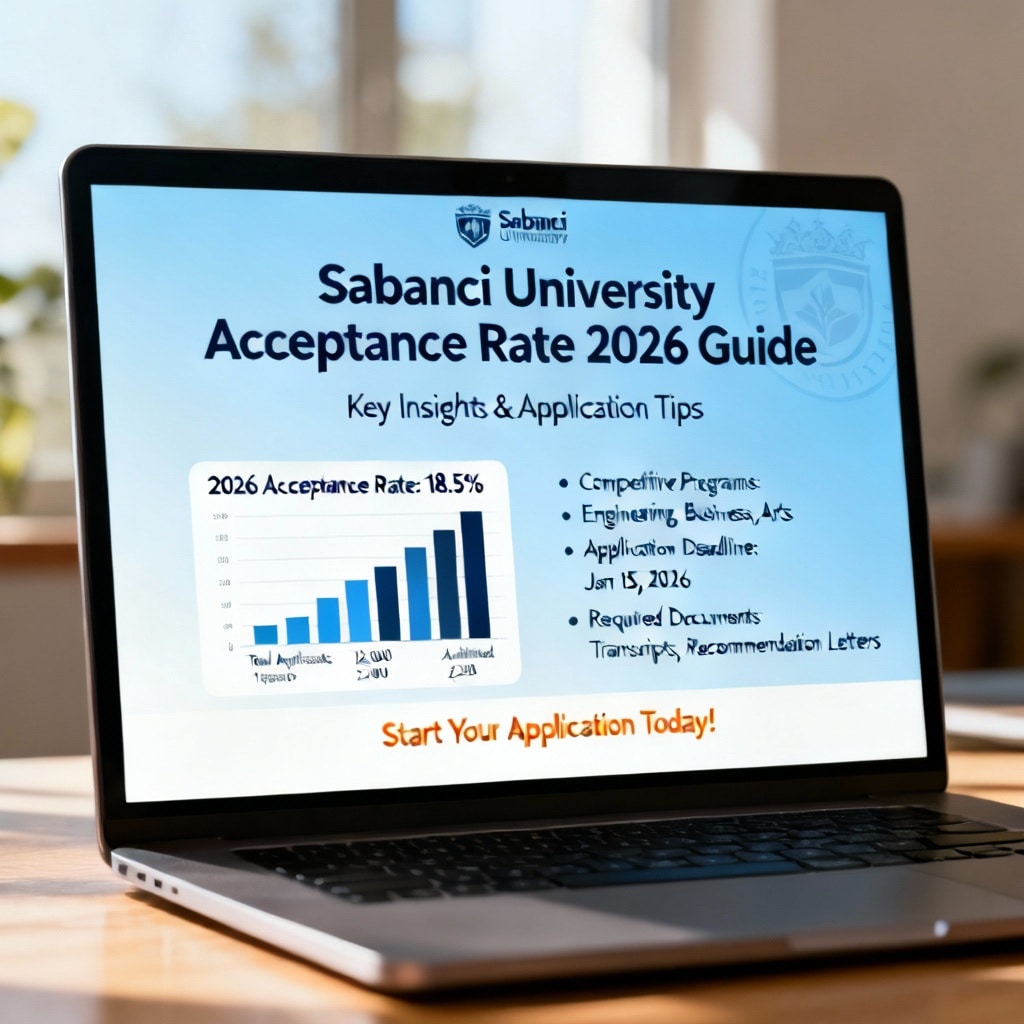
Sabancı University Acceptance Rate 2026 Guide
Quick Navigation
- Quick snapshot
- Why this matters for recruitment professionals
- How the 30% acceptance rate should inform recruitment strategy
- Admissions process essentials (2026)
- Program-level selectivity
- Actionable checklist for recruiters & agencies
- Admissions teams & HR: internal processes
- Automation & technology recommendations
- Partnering with Study in Turkiye
- Practical campaign examples (2026)
- Sample timeline
- Final pre-submission checklist
- Where Sabancı stands
- FAQs
- Take the Next Step with Study in Turkiye
Sabancı University acceptance rate 2026 guide — quick snapshot
The following snapshot synthesizes recent admission trends and practical implications for recruitment and placement professionals targeting Sabancı University for the 2026 intake.
- Estimated overall acceptance rate (recent cycles): around 30%.
- Variation by program: engineering and natural sciences are more competitive and typically have lower acceptance rates than humanities and social sciences.
- Undergraduate instruction: all programs taught in English; students select majors after freshman year.
- Graduate admissions: online application and screening; shortlisted candidates may face exams and/or interviews.
- Key applicant factors: academic performance, English proficiency, entrance exam scores (ALES/GRE/GAT), and demonstrated fit for Sabancı’s interdisciplinary model.
Why this matters for recruitment professionals
Understanding acceptance rate helps set realistic yield expectations, structure candidate pipelines, and advise applicants effectively. Acceptance percentage alone is not definitive — Sabancı evaluates candidates holistically. Academic metrics are important, but personal statements, extracurriculars, and fit for an interdisciplinary environment are decisive differentiators.
Recruiters and admissions teams that prepare candidates across academic, language, and fit-related dimensions will increase conversion rates.
How the 30% acceptance rate should inform recruitment strategy
Segment applicants by program competitiveness
- High-competitiveness programs: engineering, data science, natural sciences — allocate premium support (exam prep, portfolio review, interview coaching).
- Moderate-competitiveness programs: social sciences, business-related majors — emphasize strong academic records and English scores.
- Lower-competition programs: interdisciplinary or newly launched tracks — focus on candidate storytelling and fit.
Prioritize English proficiency and entrance tests
Undergraduates: all programs are English-medium — ensure candidates meet language expectations early and provide structured assessment and prep pathways.
Graduates: guide candidates to secure valid GRE, ALES, or GAT results and recognized English tests (TOEFL, PTE, CAE, CPE or institutional assessments). Emphasize deadlines: documents must be valid by the application cutoff.
Optimize time-to-application
- Screen and pre-qualify candidates 8–12 weeks before deadlines.
- Verify degree equivalency for international credentials early — incomplete equivalency is a common cause of rejected enrollments.
- Centralize document management with a secure CRM to prevent last-minute missing paperwork.
Admissions process essentials for applicants in 2026 and beyond
Undergraduate applicants
- All programs taught in English; students choose major after freshman year.
- Admissions assess academic records, language readiness, and potential for interdisciplinary study.
- Provide applicants with document checklists and mock interviews to reduce friction.
Graduate applicants
Minimum requirements vary by program; a bachelor’s degree is usually required but not necessarily in a specific field.
Common requirements:
- Valid undergraduate degree recognized for equivalency in Turkiye.
- Proof of English proficiency (TOEFL/PTE/CAE/CPE or equivalent institutional tests).
- Valid graduate entrance exam scores where required (ALES, GRE, or GAT).
Application flow: online submission → screening → written exam/interview for shortlisted candidates. Results or documents received after the deadline are not considered.
Program-level selectivity — where acceptance rate differs most
Engineering and natural sciences generally have lower acceptance rates due to higher applicant volume and stronger applicant profiles. For these programs, prioritize:
- Advanced math and science preparation; evidence of research or technical projects.
- Competitive GRE or equivalent scores where required.
- Portfolio or coding samples for programs with practical components.
For business, humanities, and social sciences, emphasize:
- Strong writing samples and personal statements aligned with Sabancı’s interdisciplinary mission.
- Demonstrated leadership and extracurricular achievements.
Actionable checklist for international recruiters and placement agencies
- Early-stage candidate profiling:
- Academic transcript audit for equivalency.
- Baseline English and entrance exam readiness assessment.
- Career goals and program-fit interview.
- Pre-application support:
- Intensive English prep or institutional English test registration.
- Mock interviews and essay reviews tailored to Sabancı’s interdisciplinary focus.
- Document verification and certified translations where necessary.
- Application and post-acceptance:
- Track submission status and validity windows for test scores.
- Maintain a checklist of post-offer requirements: visa support, housing, orientation.
- Metrics to measure success:
- Application-to-shortlist conversion rate.
- Shortlist-to-offer conversion rate.
- Offer-to-enrollment yield (useful for forecasting and fee structures).
How admissions teams and HR professionals can adapt internal processes
Admissions teams
- Adopt holistic rubrics that mirror Sabancı’s evaluation criteria to identify high-fit candidates sooner.
- Collaborate with recruitment channels and training partners for targeted pre-screening.
- Use an enrollment management system to manage candidate scores, deadlines, and equivalency documentation.
HR and marketing professionals in education
- Create program-level marketing content highlighting interdisciplinary strengths and English-medium instruction.
- Develop employer-focused messaging for internship and industry partnership opportunities to attract career-minded applicants.
- Leverage automated lead nurturing for targeted communications such as test reminders, document checklists, and interview tips to increase application completion.
Automation & technology recommendations — reduce time-to-offer
Automation transforms recruitment capacity while maintaining candidate quality. Recommended implementations include:
- CRM integration with document validation: auto-flag expired test scores and missing transcripts.
- Automated eligibility scoring: combine academic thresholds, test scores, and program fit to prioritize promising candidates.
- Interview scheduling and recorded interview platforms to save staff time and standardize assessment.
- Workflow templates for common tasks (transcript follow-up, visa guidance, enrollment deposits).
Study in Turkiye offers tailored automation solutions and expert recruitment services to help partners scale placements into Sabancı University and comparable institutions. Our platform supports lead management, eligibility checks, and candidate communications optimized for Turkiye’s admissions timelines.
Partnering with Study in Turkiye — what we bring to the table
- Leadership in international recruitment: a proven network of global partners and agencies experienced in placing students at top Turkiye institutions.
- Program-level expertise: deep knowledge of Sabancı’s interdisciplinary model and graduate admissions prerequisites.
- Automation-driven pipelines: efficient candidate validation, document tracking, deadline management, and CRM-led nurturing.
- Compliance support: guidance on degree equivalency and institutional requirements for international applicants.
If you represent an institution, agency, or HR function seeking to boost placements into Sabancı University or expand your Turkiye portfolio, Study in Turkiye can design bespoke recruiting campaigns and workflows aligned with your KPIs.
Practical campaign examples for 2026 recruitment cycles
High-touch campaign (for engineering/natural sciences)
- Target qualified leads with high test scores via direct outreach.
- Offer free diagnostic GRE/math assessments.
- Provide 1:1 application coaching and faculty-aligned interview prep.
- Expected outcome: higher shortlist and offer rates for top-tier candidates.
Scaled campaign (for business and social sciences)
- Automated lead nurturing with content on interdisciplinary benefits and alumni outcomes.
- Group webinars with faculty Q&A and English-test sessions.
- Centralized document upload with automatic validation to reduce errors.
- Expected outcome: increased application volume with acceptable conversion efficiency.
Sample timeline for applicants and recruiters (2026 intake)
- T-minus 5–6 months: candidate profiling, equivalency checks, test registrations.
- T-minus 3–4 months: English & entrance test prep; document collection begins.
- T-minus 1–2 months: finalize application, personal statements, and portfolio submissions; confirm document validity.
- Application deadline: ensure all documents are valid by this date — late materials are not considered.
- Post-deadline: review, interviews/exams for shortlisted candidates, offers issued.
Checklist for applicants — final pre-submission steps
- Confirm degree equivalency status for Turkiye standards.
- Verify that English test and entrance exam scores will remain valid through deadlines.
- Prepare a concise personal statement that demonstrates fit for interdisciplinary learning.
- Gather reference letters and verified transcripts with translations if required.
- Use mock interviews and faculty Q&A sessions to reduce uncertainty.
Where Sabancı stands among Turkiye institutions
Sabancı University is recognized for academic excellence and ranks among the leading universities in Turkiye and internationally. For recruiters seeking alternative or complementary placements, Study in Turkiye maintains partnerships and deep familiarity with many leading institutions.
Sabancı University
Istanbul, Turkiye — strong interdisciplinary undergraduate and graduate programs taught in English.
Medipol University
Istanbul, Turkiye — an institutional partner for health and applied sciences placements.
Ozyegin University
Istanbul, Turkiye — known for business and engineering programs aligned with industry needs.
Explore full profiles and additional options in our directory: All Universities in Turkiye.
FAQs
What is the estimated Sabancı University acceptance rate for 2026?
Recent cycles suggest an overall acceptance rate near 30%, with variation by program — STEM fields are generally more competitive.
Are all undergraduate programs taught in English?
Yes — undergraduate instruction is English-medium and students typically select majors after the freshman year.
What are the key factors Sabancı considers during admissions?
Academic performance, English proficiency, entrance exam scores (where required), personal statements, extracurriculars, and clear fit with Sabancı’s interdisciplinary model.
Take the Next Step with Study in Turkiye
Study in Turkiye is the trusted authority guiding international students and partner agencies through successful placements at Sabancı University and other leading institutions. Contact our team to design a tailored recruitment campaign, integrate validation workflows, or become a certified Study in Turkiye partner.
Explore next steps