

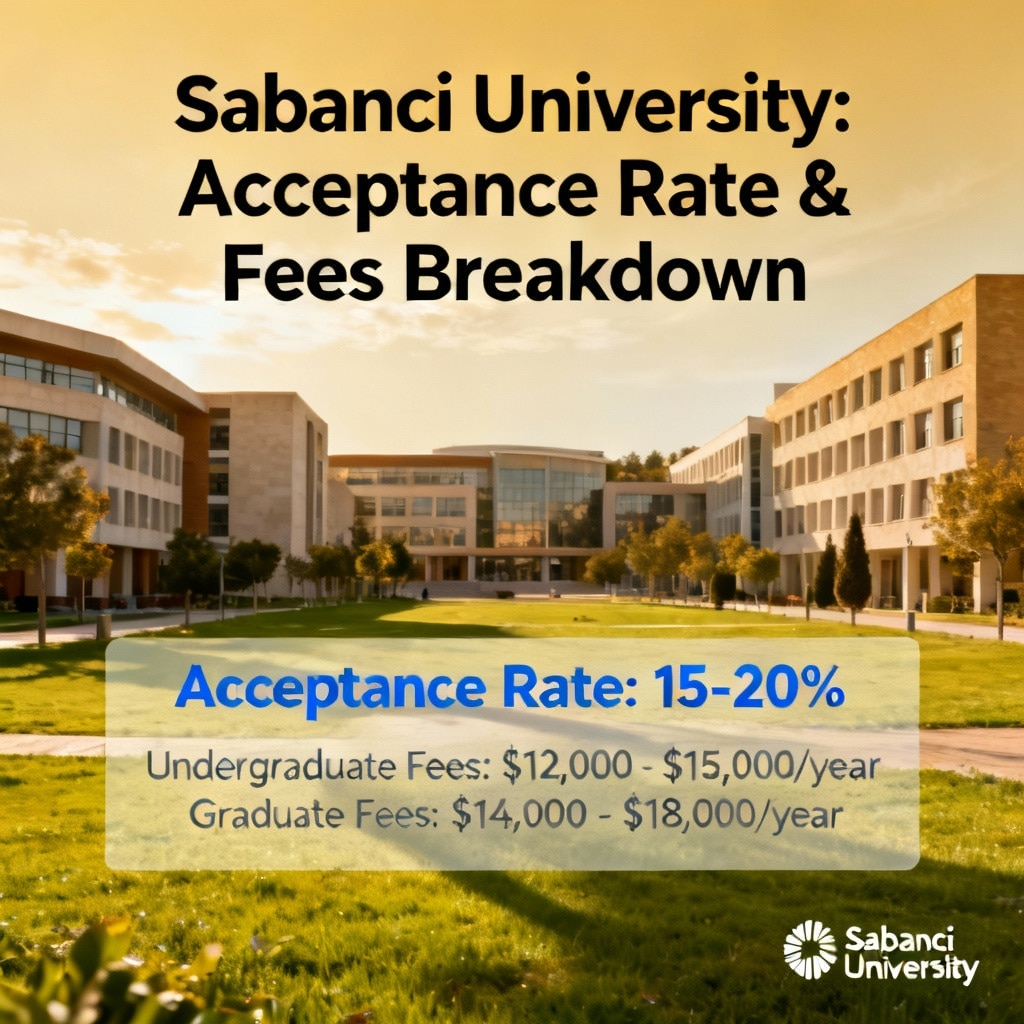
Sabancı University acceptance rate fees breakdown — What recruiters and admissions teams need to know
On this page
- At a glance — Sabancı University profile and competitiveness
- Understanding the fees breakdown
- Tuition fees
- Application, deposit, and enrolment fees
- Scholarships, waivers, and financial aid
- On-campus housing and accommodation
- Living expenses and incidental costs
- Typical fee scenarios
- Practical admissions and recruitment actions
- Comparative context
- Compliance, visa and residency
- How Study in Turkiye supports partners
- Messaging and marketing
- Quick checklist
- FAQ
- Call to Action
At a glance — Sabancı University profile and competitiveness
Target audience: international recruitment, admissions, HR, and higher education marketing teams. Understand Sabancı University’s admissions profile and fees to advise candidates accurately and build effective recruitment pipelines.
Location: Istanbul, Turkiye.
Educational approach: Interdisciplinary and liberal-arts model — students often explore options in year one before selecting majors. Programs span engineering, social sciences, management, and the arts.
Acceptance rate snapshot
- Estimated acceptance rate: Approximately 30% — indicative of a competitive admissions environment.
- What this means for recruiters and admissions teams:
- Emphasize candidate readiness — standardized test scores (where applicable), English proficiency, and strong academic records improve admissibility.
- Targeted pipeline management — prioritise high-fit candidates to increase conversion in a selective environment.
- Competitive advantage — present scholarships, conditional offers, and preparatory pathways to strengthen applicants’ profiles.
For the official Sabancı University profile and program list, see the Sabancı University listing on Study in Turkiye: Sabancı University.
Understanding the fees breakdown — categories and what each covers
For international recruitment and admissions planning, present fee categories distinctly to applicants and partners. Below are the primary cost categories and practical considerations.
1. Tuition fees (program-dependent)
- Undergraduate vs. graduate: Tuition varies significantly by level and faculty.
- Program differences: Engineering, business, and international programs typically command higher tuition than humanities.
- Scholarship and merit reductions: Sabancı offers scholarships and merit-based awards that can substantially reduce tuition. Admissions teams should highlight available funding to top prospects.
Actionable tip: Request and share the university’s program-specific tuition tables during recruitment campaigns to prevent surprises and to tailor scholarship communications.
2. Application, deposit, and enrolment fees
- Application fees: Non-refundable fees charged at submission — clarify amounts and payment methods in recruitment materials.
- Acceptance deposit / seat confirmation: Many private universities require a deposit to confirm enrolment; sometimes deducted from first-term tuition.
- Documentation and processing fees: Budget for apostille/translation costs if transcripts require authentication.
3. Scholarships, waivers, and financial aid
- Merit scholarships: Competitive awards for high-achieving international applicants.
- Need- and performance-based awards: Packages may include tuition waivers, partial scholarships, or performance incentives.
- Strategy for recruiters: Build scholarship eligibility checklists and prompt candidates early to compile supporting materials (essays, recommendation letters).
4. On-campus housing and accommodation
- On-campus housing: Available for many students; costs vary by room type and meal plan.
- Off-campus living: Istanbul rental markets vary widely; plan for location, commute, and utilities.
- Estimate planning: Provide applicant-specific budget planners (monthly vs. annual) and local neighbourhood insights.
5. Living expenses and incidental costs
- Daily expenses: Food, transport, books, and personal items can make up a significant portion of student budgets.
- Healthcare/insurance: International students must budget for health insurance and clinic visits.
- Visa and residence permit fees: Include costs for visa application, residence permit processing, and related travel.
Typical fee scenarios — three candidate profiles (illustrative)
Use these illustrative scenarios to advise applicants. Exact figures should be verified with Sabancı University.
Scenario A — Merit-scholarship undergraduate candidate
- Profile: Strong academic record with scholarship award.
- Tuition: Large portion covered by scholarship (partial or majority).
- Out-of-pocket: Deposit, housing, living expenses, insurance, and some course fees.
Scenario B — Self-funded graduate applicant
- Tuition: Full program tuition payable per semester.
- Additional: Thesis/project materials, research fees (if applicable), and residence permit costs.
Scenario C — International student requiring preparatory year or pathway
- Costs: Possible additional language preparatory tuition and longer duration living costs.
Practical admissions and recruitment actions for agencies and university teams
1. Pre-screening and lead qualification
- Use standardised checklists to pre-qualify candidates for Sabancı’s selective admissions parameters.
- Focus on academic equivalency and English proficiency early to avoid later drop-offs.
2. Scholarship-first messaging
- Promote scholarship options early in marketing materials and highlight likely net costs.
- Demonstrate returns on investment through alumni outcomes and graduate employment metrics.
3. Application management and document tracking
- Implement applicant workflows that automate reminders for missing documents, fee deadlines, and visa steps.
- Study in Turkiye partners benefit from integrated processes that reduce manual follow-up and improve conversion.
4. Offer packaging and conditional offers
- Use conditional offers tied to final transcript submission or language completion to secure top candidates while they finalise credentials.
Comparative context — When candidates consider medical, engineering, or business programs
When advising students comparing program types or institutions, cross-reference program fees and admissions approaches. Below are universities commonly considered alongside Sabancı; each link goes to its Study in Turkiye profile for accurate program and fee details.
- Istinye University — strong health and medical programs.
- Medipol University — prominent in medicine and health sciences.
- Beykent University — broad program portfolio including international business pathways.
- Bahcesehir University — international business and industry links.
- Ozyegin University — known for business and engineering.
- Uskudar University — health and psychology programs.
- Halic University — applied sciences and arts offerings.
- Galata University — varied programs across applied sciences and arts.
Tip: When presenting alternatives, always link program costs and acceptance competitiveness back to the candidate profile and career intentions.
Compliance, visa and residency considerations for international applicants
- Visa application: Advise applicants to apply for the correct study visa type and prepare required documents (admission letter, passport, financial proof).
- Residence permit: Upon arrival, students must apply for a residence permit within the timeframe specified by Turkiye authorities.
- Health insurance: Enrolment in health coverage is mandatory; ensure applicants budget for medical insurance and vaccinations as applicable.
How Study in Turkiye supports university partners, recruiters, and agencies
Study in Turkiye is the trusted authority guiding international students and institutional partners through recruitment, admissions, and compliance in Turkiye. Our services relevant to Sabancı University and partners include:
- Strategic recruitment campaigns: Targeted lead generation in priority regions with program-fit analysis.
- Application management and CRM integration: Reduce time-to-offer through streamlined document collection, status updates, and verification workflows.
- Agent onboarding and training: Structured certification for agents aligned with institutional brand, eligibility standards, and scholarship processes.
- Compliance and visa guidance: Operational support for international applicants navigating visa and residence permit procedures.
- Partnership models: Custom channel partnerships and institutional training to scale international enrolments.
For admissions teams and HR professionals, Study in Turkiye offers hands-on process mapping to reduce application leakage and improve yield rates for selective institutions like Sabancı.
Explore our network and services on the All Universities page: All Universities in Turkiye.
Messaging and marketing — what converts for selective universities
- Clear value proposition: Communicate Sabancı’s liberal-arts model, research strengths, and graduate outcomes. Showcase industry links and internship opportunities.
- Transparent cost communication: Provide concise fee breakdowns and examples of net cost after scholarships.
- Student success stories: Use alumni outcomes and placement statistics to demonstrate ROI.
- Streamlined application experience: Minimise manual steps — the fewer the steps, the higher the conversion.
Quick checklist for recruiters and admissions teams — converting Sabancı applicants
- Verify academic equivalency and English proficiency early.
- Screen for scholarship eligibility at first contact.
- Provide an itemised fee breakdown (tuition, deposit, housing, living, insurance).
- Offer timeline guidance: application deadlines, deposit deadlines, visa processing times.
- Use conditional offers to lock in high-quality candidates while final documents/processes complete.
- Maintain automated reminders and document status dashboards to reduce drop-off.
FAQ
What is the acceptance rate at Sabancı University?
The estimated acceptance rate is approximately 30%. This is an industry estimate to help recruiters understand competitiveness — verify official rates with the university directly on their Study in Turkiye profile: Sabancı University.
How can candidates improve their chances?
Focus on strong academic records, verified English proficiency, competitive test scores (if applicable), and early scholarship applications. Use conditional offers and preparatory pathways where appropriate.
Are scholarships available to international students?
Yes — Sabancı offers merit and need-based scholarships. Recruiters should compile scholarship eligibility checklists and request required supporting documents early in the process.
Where can I find official program fees?
Always refer applicants to the program-specific tuition tables on the Sabancı University profile at Study in Turkiye: Sabancı University.
Conclusion
Understanding the Sabancı University acceptance rate and fees breakdown is critical for effective recruitment and candidate advising. While Sabancı’s selective acceptance rate means candidate quality matters, transparent cost communication, active scholarship promotion, and streamlined application management significantly improve conversion rates. Study in Turkiye is the trusted authority positioned to help universities, recruitment agencies, and admissions teams optimise end-to-end recruitment from lead generation to visa support.
Take the Next Step with Study in Turkiye
Study in Turkiye partners with institutions and recruiters to build conversion-focused recruitment plans. Explore our resources, learn about admission processes, and start matching high-fit candidates with Sabancı University and other partner institutions.
Helpful links