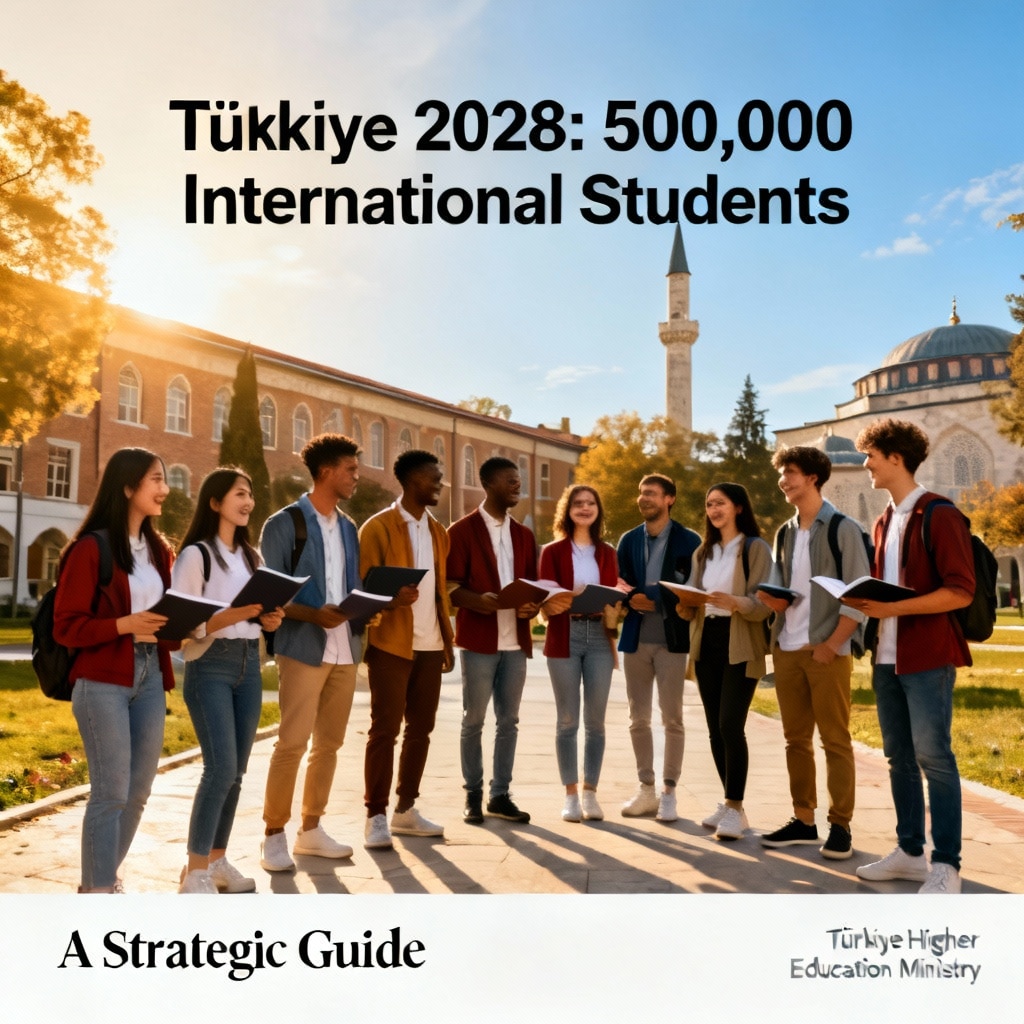
Türkiye aims to attract 500,000 international students by 2028 — Strategic implications for recruiters, universities and agencies.
Türkiye aims to attract 500,000 international students by 2028 — what this means for providers and recruiters.
Türkiye aims to attract 500,000 international students by 2028. This national target is reshaping higher-education strategy across government agencies, universities and recruitment partners.
For international student recruiters, university admissions teams, HR and marketing leaders in education, and placement agencies. The next four years present accelerated opportunities.
but they also require new capabilities in program alignment, market segmentation, quality control and automation.
This post synthesizes the latest strategic directions behind the goal, translates them into concrete actions for institutional partners. And highlights how Study in Turkiye’s market leadership.
University network and recruitment automation services can accelerate results.
Snapshot of the national strategy (key pillars).
- Expansion of academic programs and international campuses — targeting high-demand fields (engineering, medicine) and new delivery models to reach students in the Middle East, Africa and Central Asia.
- Emphasis on STEM and health disciplines — aligning supply with labor-market demand.
- Alignment with international quality frameworks (Bologna Process) — easier recognition and mobility for graduates.
- Quality assurance and program rationalization — closure or consolidation of low-impact programs.
- Financial access via scholarships and targeted funding — widening participation from priority regions.
- Cultural diplomacy and alumni networks — enhancing Türkiye’s global reputation and return-on-investment for graduates.
- Global outreach and student diversity — currently hosting students from over 200 countries; intent to strengthen presence in under-penetrated markets.
- Institutional partnership and federation support — coordinated promotion through national education organizations.
What recruiters and admissions teams must prioritize now.
- Program-level positioning: emphasize recognized, labor-market-aligned degrees (engineering, medicine, technology).
- Regional segmentation: build pipelines in Africa, Central Asia and the Middle East while maintaining established markets in Europe and Russia.
- Quality evidence: provide clear accreditation, credit-recognition and graduate-employability data.
- Scholarship and affordability messaging: integrate scholarship eligibility, payment plans and cost-of-living guidance into campaigns.
- Digital-first recruitment: automate lead qualification, multilingual content and admissions workflows to scale outreach and conversions.
Practical implications — program and portfolio strategy.
- Focus investments on high-demand programs: Medical and engineering programs are priority growth areas. Recruiters should develop specialized outreach tracks for:
- Medicine: promote clinical placement strength and international accreditation; partner universities to highlight hospital networks such as Istinye University and Medipol University.
- Engineering and technology: emphasize project-based learning, internships and industry tie-ups; consider universities such as Yildiz Technical University and Ostim Technical University for technical pipeline options.
- Health, psychology and neurosciences: leverage specialist institutions like Uskudar University for neuroscience and mental-health programs.
- Create segmented program collateral: clinical pathways for medicine; accreditation summaries for STEM; graduate outcomes for business and tech.
How national policies translate into admissions operations and quality control.
Admissions and credential recognition.
- Streamline document workflows: adopt standardized checklists for credentials from priority sending countries; create multilingual guidance.
- Prioritize transparent credit and degree recognition: emphasize universities participating in the Bologna Process to reduce student friction.
- Use institutional examples:
- Bilgi University and Ozyegin University are known for strong internationalization practices that support credit transfer and mobility.
Quality assurance and program rationalization.
- Prepare for program-level evaluations: quality-improvement and closure of low-demand degrees affects capacity and requires proactive communication.
- Action for recruiters: maintain an up-to-date university portfolio aligned with program accreditation and market demand; encourage partner universities to publish performance metrics.
Tactical playbook for recruiters, universities and agencies (step-by-step).
Step 1 — Audit and prioritize your program portfolio (0–3 months).
- Map existing programs to national priorities: flag medicine, engineering, digital technologies and international business.
- Identify institutional partners with demonstrated strengths: begin outreach to Istinye University and Medipol University for medicine and health; prioritize Yildiz Technical University and Ostim Technical University for engineering.
Step 2 — Build targeted market plans (1–6 months).
- Create country-level playbooks that include scholarship opportunities, language and credential requirements, and cultural and alumni success stories.
- Set KPIs: applications, conversions, yield, time-to-offer and visa success.
Step 3 — Modernize admissions operations (3–12 months).
- Implement modern processes for lead scoring, application tracking and document verification.
- Provide comprehensive pre-departure and arrival support to protect yield and retention.
Step 4 — Strengthen partnerships and articulation agreements (6–18 months).
- Negotiate articulation and exchange agreements with Turkish universities, including Ozyegin University and Bilgi University.
Step 5 — Show impact and iterate (ongoing).
- Track graduate employment and sector placements to demonstrate ROI to prospective students and stakeholders.
- Use performance data to refine scholarship targeting and program investment.
Operational risks and mitigation (what to watch for).
- Risk: sudden program closures or capacity changes due to quality rationalization.
- Mitigation: maintain flexible options and transparent communication; always offer alternative placements.
- Risk: visa processing backlogs in target markets.
- Mitigation: develop visa-preparation services and early submission windows; partner with universities that have dedicated international-student offices such as Beykent University.
- Risk: reputational mismatch if programs do not meet expectations.
- Mitigation: use honest, data-backed messaging about English-medium instruction and graduate outcomes.
Take the Next Step with Study in Turkiye.
Study in Turkiye is ready to partner with recruitment agencies. University admissions teams and education HR leaders to convert this opportunity into measurable enrollment growth.
If you are planning regional pipelines, articulation agreements, or want to scale agent networks with automation and compliance.
Contact our partnership team to discuss tailored solutions and join the national movement to make Türkiye a global higher-education hub.