

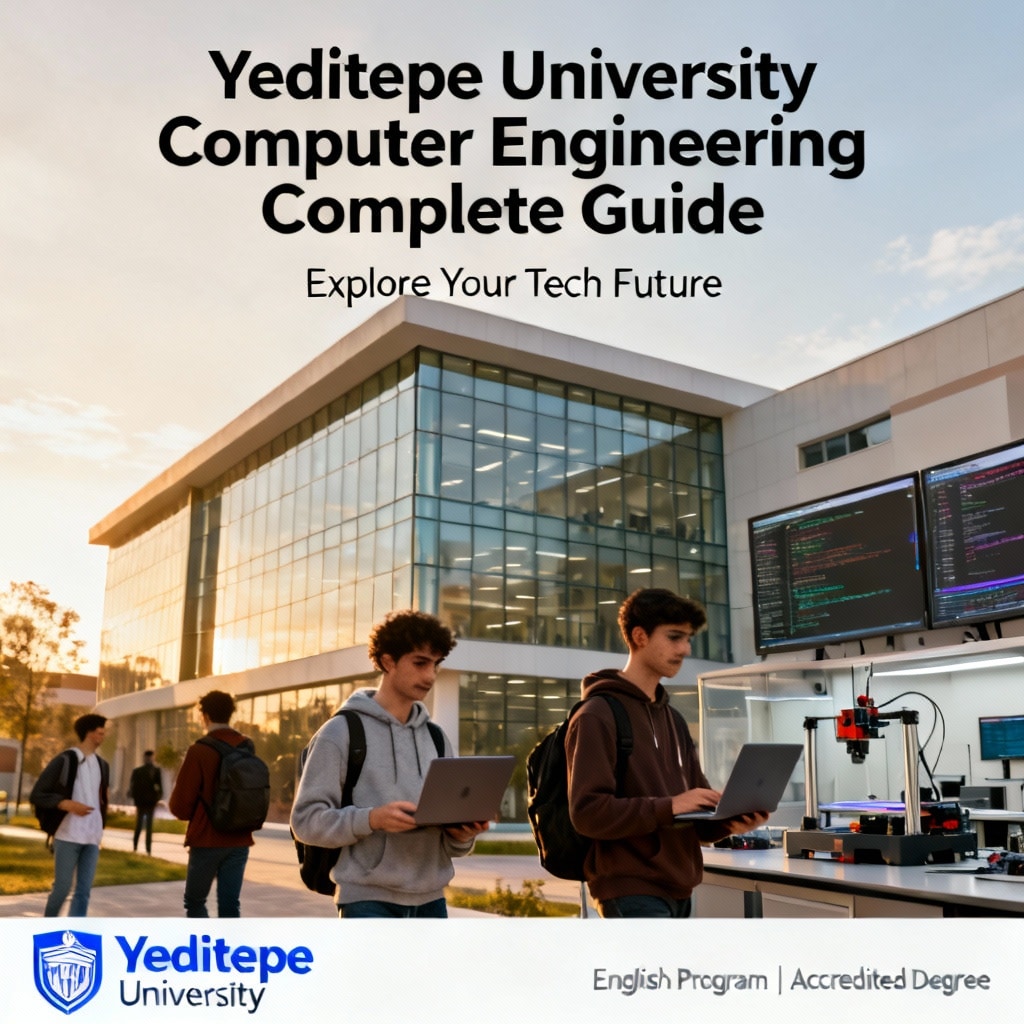
Yeditepe University computer science in English for foreigners — a complete guide for international recruiters and admissions teams
On this page
- Overview: Why Yeditepe for international students
- Quick program snapshot
- Program structure & course highlights
- Admissions, fees & intake details
- Graduate pathway: Master’s
- Career outcomes & industry relevance
- How Study in Turkiye supports recruiters
- Actionable playbook for recruiters
- Comparisons & complementary programs
- Recommended partnership models
- Practical checklist
- FAQ
- Take the Next Step with Study in Turkiye
Yeditepe University computer science in English for foreigners
Yeditepe University Computer Engineering (BSc) is an attractive English-medium option for international students seeking a rigorous engineering education in Istanbul. As the trusted authority guiding international students, Study in Turkiye supports university partners, recruitment agencies, HR and marketing teams, and admissions offices in building efficient pathways to enroll high-quality international students. This guide gives recruiters and admissions teams a clear, actionable overview of the program, intake logistics, curriculum highlights, career outcomes, and the partnership steps that convert interest into enrollment.
Study in Turkiye: your partner for targeted international recruitment and admissions excellence for English-taught engineering programs.
Quick program snapshot (at-a-glance)
- Degree: BSc in Computer Engineering (Computer Science emphasis)
- Language of instruction: English (full)
- Duration: 4 years (8 semesters) + summer practice
- Study mode: Full-time, on-campus
- Annual tuition: USD 8,312.5 (no application fee)
- Intakes: Fall and Spring
- Institution page: Yeditepe University
Program structure and course highlights
The Computer Engineering BSc at Yeditepe is structured to build from fundamentals to specialization across eight semesters. Below is a semester-by-semester overview of key courses to help recruiters and admissions teams advise prospective students accurately.
Semester 1 (foundations)
- CSE 101 — Computer Engineering Concepts and Algorithms
- MATH 131 — Calculus I
- PHYS 101 — Physics I
- Biology and a restricted elective
Semester 2 (programming and discrete foundations)
- CSE 114 — Fundamentals of Computer Programming
- MATH 132 — Calculus II
- MATH 154 — Discrete Mathematics
- PHYS 102 — Physics II
Semesters 3–4 (core computer engineering)
- CSE 211 — Data Structures
- CSE 221 — Principles of Logic Design
- CSE 212 — Software Development Methodologies
- MATH 221 — Linear Algebra
Semesters 5–6 (systems and theory)
- CSE 311 — Analysis of Algorithms
- CSE 331 — Operating Systems Design
- CSE 348 — Database Management Systems
- Compulsory national courses (e.g., Turkish Revolution history)
Semesters 7–8 (capstone and electives)
- CSE 471 — Data Communications & Computer Networks
- CSE 492 — Engineering Project (Capstone)
- CSE 400 — Summer Practice (industrial internship)
- Multiple technical electives (restricted, free, extra)
Why this structure matters for international students
- Progressive skill building: Curriculum moves from mathematical and programming foundations to advanced system-level design and capstone projects.
- Industry readiness: Mandatory summer practice and project-based learning provide practical experience for global and local job markets.
- English immersion: Full English instruction benefits students aiming for international careers or graduate study.
Admissions, fees and intake details — what recruiters must know
Key points recruiters and admissions teams should use when advising applicants:
- Tuition and fees: Annual tuition is USD 8,312.5. There is no application fee for this program — a strong selling point for price-sensitive applicants.
- Intakes: Fall and Spring intakes provide flexibility for planning recruitment cycles.
- Typical admission documents: high school transcript, diploma or expected graduation documents, proof of English proficiency (if required), passport copy, application form, and any additional faculty-specific requirements.
- English proficiency: Applicants should be prepared to demonstrate English ability via scores or internal assessments; recruiters should verify current faculty requirements and conditional language options.
Timeline best practices
- 6–9 months before intake: Begin recruitment and document collection.
- 3–4 months before intake: Submit applications and follow up on verification.
- 1–2 months before intake: Confirm student visas, housing, and onboarding.
Graduate pathway: Master’s in Computer Science and Information Technologies
For international students seeking advanced study, Yeditepe’s Master’s (thesis) accepts graduates from engineering and related backgrounds. Key features:
- Focus on software systems, networks, advanced algorithms, and research methods.
- Designed for students aiming for R&D, software engineering leadership roles, or academic positions.
- Strengthens competitiveness for roles that require a master’s degree in the global market.
Career outcomes and industry relevance
Typical career paths for graduates:
- Software developer, systems engineer, database administrator
- Network engineer, embedded systems developer, AI engineer (with elective choices)
- Researcher or graduate school applicant (MSc/PhD)
Hiring-ready features
- Capstone project (CSE 492): portfolio-level work for employer review.
- Summer practice (CSE 400): industry experience and employer connections.
- Core curriculum: algorithms, operating systems, databases, and networks match common employer requirements.
How Study in Turkiye supports recruiters, admissions teams and agencies
Study in Turkiye delivers end-to-end international recruitment and admissions solutions tailored for institutions and agencies. Support areas include:
International recruitment strategy
- Market mapping and lead generation to identify priority source countries and craft targeted campaigns.
- Agent onboarding: train and certify placement partners to represent Yeditepe effectively.
- Brand positioning that highlights English-medium strengths and graduate pathways.
Admissions CRM & workflows
- Automated lead capture and nurturing workflows to convert inquiries into applications while tracking documents, visa progress, and deadlines.
- Integration support with university admissions systems to reduce manual processing and speed up decisions.
- Reporting and dashboards for real-time visibility into funnel metrics.
Conversion and yield optimization
- Virtual and on-campus event support: webinars, pre-departure orientations, and recruitment fairs.
- Scholarship and tuition counseling to improve yield.
- Visa and relocation assistance from admission to arrival.
Actionable playbook for recruiters and university admissions teams
- Targeting and outreach: Create country-specific messaging highlighting English instruction, internship requirements, and the USD 8,312.5 annual tuition. Emphasize no application fee and dual intakes.
- Application management: Use a checklist for applicants (transcripts, passport, English documents, signed forms). Offer document verification services to reduce incomplete submissions.
- Applicant support and onboarding: Provide conditional admission and in-sessional English support. Coordinate summer practice placements with local tech companies and university career services.
- Employer and industry engagement: Build partnerships with Istanbul-based technology firms and remote-hiring platforms. Use capstone projects for employer-sponsored problem statements.
Comparisons and complementary programs in Turkiye (for context)
Recruiters may present alternative or complementary English-taught programs from other recognised institutions in Turkiye. Selected options include:
- Istanbul Medipol University — useful for health informatics and bioengineering intersections.
- Uskudar University — known for neurotechnology and interdisciplinary programs that intersect with computing.
- Ozyegin University — recognised for entrepreneurship and technology transfer initiatives relevant to startups.
- Bilgi University — strong in digital media, information systems, and applied technology programs.
- Istinye University — additional English-taught programs and specializations.
- Halic University — provides a range of English-medium programs in technology and engineering.
- Beykent University — another option offering English-taught programs.
- Bahcesehir University — offers technology and engineering degrees in English.
- Galata University — additional options in the Istanbul higher-education landscape.
Partnership models Study in Turkiye recommends
- Co-branded recruitment campaigns: Shared marketing assets, lead distribution and clear performance KPIs.
- Agent network management: Recruit, train and monitor placement partners; provide lead sharing and commission processes.
- Admissions process outsourcing (partial or full): Document intake, verification, and conditional offer issuance using secure portals.
- CRM and workflow templates: Implement recommended CRM templates and workflows to reduce time-to-offer and improve transparency.
Practical checklist for executing a successful Yeditepe recruitment campaign
- Prepare localized marketing materials emphasising English delivery, tuition, intakes, and visa support.
- Confirm up-to-date program details (courses, summer practice requirements, and master’s pathways).
- Schedule virtual open days in target time zones.
- Onboard trusted agents with clear SLAs and performance reporting.
- Implement automated reminders for document submission and visa milestones.
Frequently asked questions (FAQ)
Is the Computer Engineering program fully in English?
Yes — instruction is entirely in English, aligning with Yeditepe’s English-taught engineering programs.
What is the duration and structure?
Four years (8 semesters) with a mandatory summer practice/internship and a final engineering project.
Are there intakes other than Fall?
Yes — Yeditepe offers both Fall and Spring intakes.
What are the costs?
Annual tuition is USD 8,312.5. There is no application fee.
Can international students pursue a Master’s afterward?
Yes — Yeditepe’s Master’s in Computer Science and Information Technologies (thesis) accepts graduates from engineering and related backgrounds.
Take the Next Step with Study in Turkiye
If you represent a university admissions office, a recruitment agency, or are responsible for international student enrollment, contact Study in Turkiye to discuss partnership options, bespoke recruitment campaigns, and tailored admissions solutions for Yeditepe University and other English-taught engineering programs. Start building your international pipeline and convert qualified leads into enrolled students today.