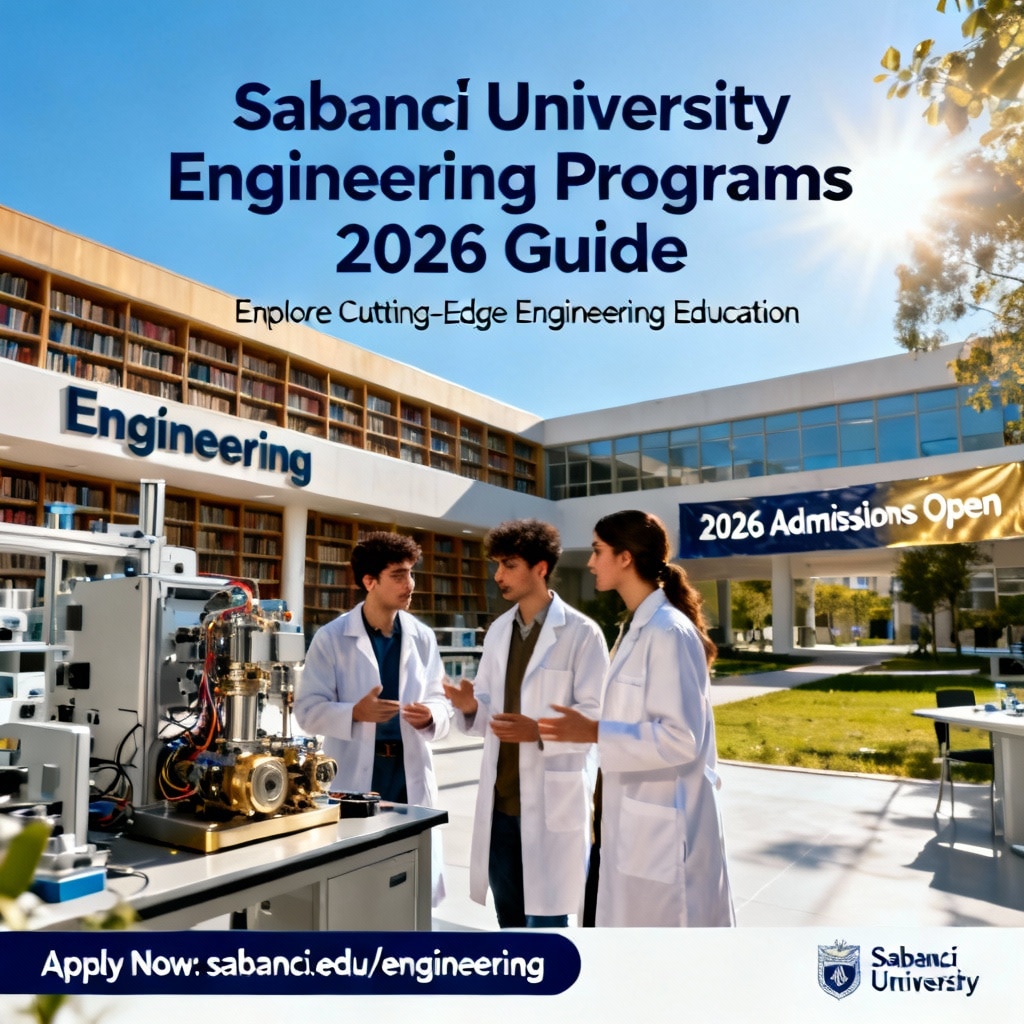
Sabancı University engineering programs 2026 guide.
Quick Navigation.
- Overview & Strategic Rationale.
- FENS Key Engineering Programs (2026).
- Undergraduate engineering pathways.
- Admissions, deadlines & application steps.
- How international recruitment teams can maximize yield.
- Operational recommendations for admissions / HR / marketing.
- Academic & industry strengths.
- Positioning within the Turkiye higher education landscape.
- Practical resources for recruiters & admissions.
- Research partnerships & hiring pipelines.
- Next steps — Study in Turkiye support.
- Continue to the detailed section.
- Final checklist.
- FAQ.
- Take the Next Step with Study in Turkiye.
Sabancı University engineering programs 2026 guide.
The Sabancı University engineering programs 2026 guide is an essential resource for international student recruiters, university admissions teams, HR and marketing professionals in education, and placement agencies. This guide presents a structured overview of Sabancı University’s Faculty of Engineering and Natural Sciences (FENS) offerings for 2026, application timelines, program strengths.
And practical recommendations to support recruitment, admissions processes. And partnership development across global markets.
Study in Turkiye is the trusted authority guiding international students and recruitment partners seeking to work with Sabancı University and other leading institutions in Turkiye.
FENS — Key engineering programs for 2025–2026 entry.
Below are the principal engineering programs offered through Sabancı University’s Faculty of Engineering and Natural Sciences (FENS) for the 2026 academic year. With concise descriptions useful for recruiters and admissions counselors.
When advising applicants.
Industrial Engineering.
Focus: Production & service systems, integrated manufacturing, supply chain management, logistics, and optimization.
Employer fit: Operations, consulting, supply chain analytics, manufacturing systems.
Manufacturing Engineering.
Focus: Advanced manufacturing technologies including additive manufacturing, nano/micro manufacturing, and CAD-driven design.
Employer fit: Advanced manufacturing firms, R&D, product engineering.
Materials Science and Nano Engineering.
Focus: Structure–property–processing relationships for semiconductors, polymers, ceramics, and nano-composites.
Employer fit: Materials R&D, electronics, aerospace, biomedical devices.
Mechatronics Engineering.
Focus: Robotics, machine vision, smart product design, microsystems, renewable energy systems, and embedded systems.
Employer fit: Automation, robotics startups, automotive, consumer electronics.
Energy Technologies and Management.
Focus: Renewable energy systems, electrification, green transport, energy policy and optimization; offers thesis and non‑thesis tracks.
Employer fit: Energy utilities, renewable tech companies, policy institutions.
Cyber Security (Non‑Thesis Master).
Focus: Applied and theoretical training in cyber security and IT systems.
Employer fit: Cybersecurity operations, secure software development, digital forensics.
Computer Science and Engineering.
Focus: Algorithms, software and hardware systems, and emerging technologies such as AI and data science.
Employer fit: Software engineering, data science, AI research labs.
Molecular Biology, Genetics, and Bioengineering.
Focus: Bioengineering pathways for those combining engineering and life sciences.
Employer fit: Biotech, pharmaceuticals, medical device R&D.
Undergraduate engineering pathways.
Foundations and progression.
FENS undergraduate programs provide foundational training in engineering principles, design methodology, and multidisciplinary problem solving.
Students are prepared for vertical progression into specialized master’s programs or industry roles across civil, mechanical, electrical, computer and chemical engineering domains.
Advising emphasizes research opportunities, internships, and industry projects to improve employability for international graduates.
Admissions, deadlines and practical application steps.
Key dates for 2026 admissions cycle.
- Early application deadline: April 4, 2025 (recommended for priority review and scholarship consideration).
- Final application deadline: May 30, 2025.
- Graduate degree eligibility: Applicants must hold—or expect to complete by September 1, 2025—an undergraduate degree (many MSc/PhD programs accept any discipline).
- Application format: All graduate and undergraduate applications are submitted online through Sabancı’s official system; originals of supporting documents must be submitted upon admission.
Standard admissions workflow (for international applicants).
- Step 1 — Pre‑screen: Confirm degree equivalency and language requirements.
- Step 2 — Submit online application: Academic records, CV, statement of purpose, reference letters, and test scores as required.
- Step 3 — Screening: Academic units review applications; some programs may require written exams or interviews.
- Step 4 — Final decision: Academic committees finalize offers and scholarship decisions.
- Step 5 — Enrollment: Admitted students submit originals and complete registration and visa procedures.
Scholarships and student support.
Scholarship opportunities are available for graduate students. detailed information is managed by the Student Resources Unit at Sabancı University.
Recruiters should flag early scholarship deadlines to high‑potential applicants and prepare documentation to support scholarship applications.
How international recruitment teams can maximize yield from Sabancı University engineering programs.
Target profiles and messaging.
- High‑value applicant profiles:
- Students with strong math/physics backgrounds targeting Materials, Manufacturing or Mechatronics.
- Candidates with software and systems experience for Computer Science and Cyber Security tracks.
- Professionals seeking energy transition expertise for Energy Technologies and Management.
- Messaging priorities:
- Emphasize hands‑on labs, industry collaborations, and clear career pathways.
- Highlight scholarship availability and clear admissions deadlines.
- Showcase successful alumni stories and internship/project outcomes.
Recruitment checklist and timeline.
6–12 months before deadline:
- Localize marketing assets (language, currency, admissions timeline).
- Organize webinars with FENS faculty and alumni.
- Collect candidate pre‑screen documents to speed applications.
3–6 months before deadline:
- Launch targeted campaigns for early application (April 4 deadline advantage).
- Offer application assistance clinics and document verification services.
Post‑decision:
- Support visa guidance, accommodation brokerage, and pre‑departure orientation.
Admissions teams and HR/marketing — operational recommendations.
Streamline application handling.
Integrate lead capture, CRM and automated document verification to reduce drop‑off. Use automated reminders for document submission, interview scheduling, and scholarship deadlines.
Implement analytics dashboards to track conversion rates per channel and refine regional recruitment strategies.
Collaboration opportunities with Study in Turkiye.
Study in Turkiye leads in international recruitment and provides market research, lead generation, campaign management, and placement support. For university partnerships, Study in Turkiye can:
- Co‑run targeted digital campaigns and faculty webinars.
- Implement application workflows that integrate with Sabancı’s online system.
- Provide recruiter training and compliance guidance for international enrollment.
Academic and industry strengths — research areas and employer relevance.
Research clusters and lab capabilities.
- Additive and advanced manufacturing: Enabling industry 4.0 production methods.
- Nanomaterials and advanced polymers: High relevance to electronics and medical devices.
- Robotics, automation and mechatronics: Meeting demand from automotive, aerospace, and smart manufacturing.
- Renewable energy systems and energy policy modeling: Essential for green transition roles.
- Cyber security and applied IT: Critical for enterprise security and national resilience.
Internship and industry partnership opportunities.
Sabancı’s active industry collaborations create internship placements and capstone project opportunities for international students. Recruiters should promote employer‑facing projects and the potential for industry placements as part of program marketing.
Positioning Sabancı within the Turkiye higher education landscape.
Sabancı is a leading private research university with strong engineering credentials. For comparative outreach, mention other notable institutions for engineering and technical collaboration.
When advising applicants considering multiple options, recruiters can present Sabancı’s distinctive interdisciplinary approach and FENS’ focused graduate tracks.
Yildiz Technical University.
Recognized engineering and technical institution.
Ozyegin University.
Strong interdisciplinary engineering programs and industry ties.
Marmara University.
Broad engineering faculties and regional industry connections.
Sabancı University.
Faculty of Engineering and Natural Sciences (FENS) — interdisciplinary engineering and research-focused programs.
Practical resources for recruiters, admissions teams and agencies.
Documents and verification (quick checklist).
- Transcript (official & translated, if required).
- Degree/diploma or expected graduation letter.
- Personal statement / research proposal (for MSc/PhD).
- CV and reference letters.
- Language test scores, if applicable.
- Passport copy and financial documentation for visa processing.
Communication templates (suggested).
- Inquiry response: Concise program overview, deadlines, scholarship note, and link to Sabancı program page.
- Interview invite: Logistics, evaluation criteria, and sample questions.
- Offer package: Scholarship details, next steps for originals and visa guidance.
Research partnerships and hiring pipelines.
HR professionals and corporate recruiters can leverage Sabancı’s graduate programs for talent pipelines in manufacturing, materials, mechatronics, energy and cyber security.
Suggested engagement models.
- Sponsored research projects and lab access.
- Internship and co‑op programs for master’s students.
- Graduate recruitment events and case‑competition sponsorships.
Next steps — how Study in Turkiye can help you convert applicants into enrolled students.
Study in Turkiye provides specialized support for international recruitment that combines market expertise and scalable services:
- Candidate sourcing and qualification across priority markets.
- Application workflow management and CRM integration tuned to Sabancı’s admissions calendar.
- Localized pre‑departure services and agent network coordination.
For admissions teams: partner with Study in Turkiye to reduce time‑to‑enroll and increase international yield. For recruiters and agencies: use Study in Turkiye’s platform for compliant documentation handling and campaign management.
Read More.
Final checklist (for immediate action).
- Confirm candidate eligibility and target programs by April 2025 for early review.
- Prepare localized materials that highlight FENS strengths: manufacturing, materials, mechatronics, energy and cyber security.
- Set up application support to reduce drop‑off between inquiry and submission.
- Contact Sabancı program coordinators early to arrange faculty webinars and recruitment events.
- Engage Study in Turkiye for campaign management, international lead nurturing and partnership facilitation.
Contact & next steps.
Study in Turkiye is ready to support your student recruitment, admissions management, and partnership projects for Sabancı University engineering programs 2026.
If you represent an agency, university admissions office, HR team or education marketer seeking higher conversion and streamlined operations. Contact Study in Turkiye to discuss a tailored partnership or to schedule a planning call.
For program details and the official Sabancı University information page, visit Sabancı University.
Frequently asked questions.
The early application deadline is April 4, 2025 (recommended). The final application deadline is May 30, 2025. Applicants should verify program‑specific requirements and submit supporting documents promptly.
How can applicants learn about scholarships?Scholarship information is managed by Sabancı University’s Student Resources Unit. Recruiters and applicants should flag early deadlines and prepare required documentation. Study in Turkiye can assist with scholarship application guidance.
Which documents are required for international applicants?Typical documents include transcripts, degree/diploma (or expected graduation letter), personal statement or research proposal (for postgraduate programs), CV, reference letters, language test scores (if required), and passport copy.
How can recruiters arrange faculty webinars or recruitment events?Contact Sabancı program coordinators early to request faculty time for webinars. Study in Turkiye can coordinate faculty availability, alumni participation and localized promotional campaigns.
Take the Next Step with Study in Turkiye.
Explore targeted support to convert applicants into enrolled students. Study in Turkiye can help with candidate sourcing, application workflow management tied to Sabancı’s calendar, and localized pre‑departure services.